How do you determine whether a business problem needs AI or conventional automation?+
Cor Advance Solutions evaluates the business problem, workflow complexity, available data, and expected return before recommending a solution. Conventional automation works best for predictable, rule-based tasks, while AI is useful for pattern recognition, forecasting, unstructured data, and uncertain scenarios. We assess feasibility, integration requirements, and potential business impact to select the right approach. This helps businesses avoid unnecessary AI costs and focus on solutions that deliver practical value.
What data is required to build a reliable machine learning model?+
The data required depends on the business problem, the model type, and the outcome you want to predict. Machine learning typically needs relevant historical data that is sufficiently accurate, representative, and consistent, with enough examples to evaluate performance reliably. Depending on the use case, data may come from ERP systems, CRM platforms, transactions, sensors, or operational databases. Cor Advance Solutions assesses data quality, availability, privacy requirements, and readiness before recommending model development.
Can AI solutions integrate with existing ERP, CRM, and data warehouse systems?+
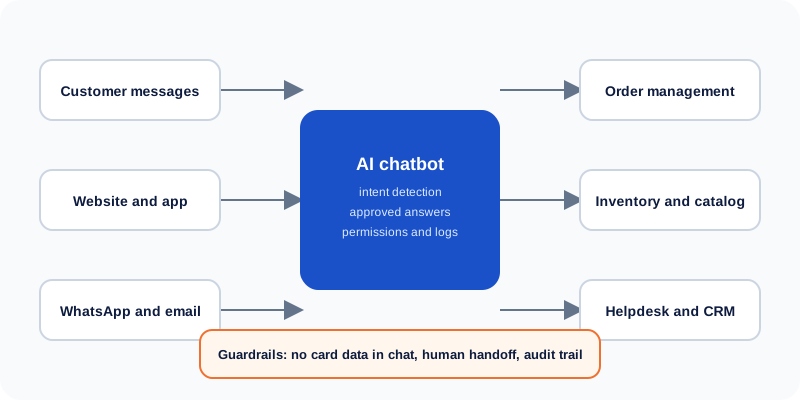
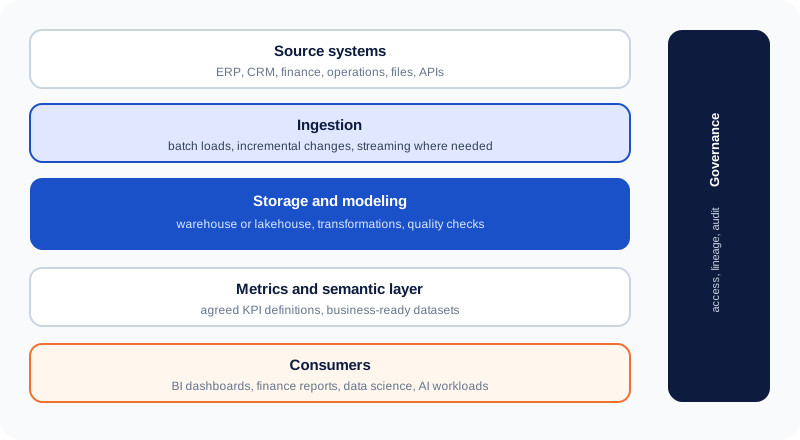
Yes, AI solutions can often integrate with existing ERP, CRM, data warehouses, and operational applications through APIs, connectors, data pipelines, or custom integration components. The appropriate approach depends on system compatibility, data access, security requirements, and infrastructure constraints. Cor Advance Solutions assesses your existing technology stack before designing the integration architecture. This allows businesses to introduce AI capabilities while retaining suitable existing systems rather than replacing their entire infrastructure.
How do you measure AI model performance and business impact?+
AI performance is measured using technical evaluation metrics and business outcomes relevant to the specific use case. Depending on the application, metrics may include forecast error, precision, recall, processing time, false-positive rates, or model calibration. We recommend establishing a baseline, defining acceptance criteria, and testing the model on appropriate validation data before deployment. After launch, ongoing monitoring helps assess performance changes and determine whether the solution is delivering measurable operational value.
How do you protect confidential business data during AI development?+
Protecting business data requires appropriate access controls, secure data transfer and storage, data minimisation, and clear retention policies throughout development. Cor Advance Solutions considers data sensitivity, deployment requirements, and applicable legal or industry obligations when designing AI solutions. Role-based permissions, controlled environments, testing safeguards, and auditability can help reduce unauthorised access and exposure. Specific security controls and compliance requirements are established for each engagement rather than assumed.
What happens when an AI model produces an incorrect prediction?+
AI models can produce incorrect predictions because of incomplete data, changing business conditions, model limitations, or previously unseen scenarios. Reliable implementations use validation, confidence thresholds where appropriate, monitoring, and exception handling to identify potentially unreliable outputs. For sensitive or consequential decisions, human review and approval should remain part of the workflow. Cor Advance Solutions can incorporate performance monitoring, documented limitations, and model improvement processes to help manage errors and reduce operational risk.
How do you move an AI prototype into production?+
Moving an AI prototype into production requires more than a working model; it needs testing, integration, security controls, deployment planning, and ongoing monitoring. Cor Advance Solutions evaluates model performance, prepares production-ready data pipelines, connects the solution to relevant business systems, and validates operational workflows against agreed acceptance criteria. Deployment also requires appropriate access permissions, error handling, and monitoring for data quality or model drift. The result is a structured path from experimentation to a maintainable AI application aligned with business requirements.
How much does custom AI development cost?+
Cost depends on scope, data preparation, model complexity, integrations, security requirements, infrastructure and ongoing maintenance. A useful estimate needs a defined use case and an assessment of the technical dependencies.
How long does an AI implementation take?+
Timelines vary with project scope, data readiness, integration complexity, testing and deployment constraints. A realistic schedule is set after discovery and feasibility assessment.
How do you measure the ROI of an AI project?+
ROI measurement starts with a baseline and agreed metrics, such as processing time, forecast error, manual workload, error rates or operating costs. Financial ROI accounts for implementation, integration, infrastructure, maintenance and verified improvements.
What happens after an AI model is deployed?+
Depending on the engagement, this can include monitoring model performance, reviewing data quality, managing versions, investigating degradation and planning updates. These responsibilities are defined in the project scope.
Can AI make business decisions without human intervention?+
Some well-defined, low-risk tasks can be automated within approved limits. Sensitive financial, operational or consequential decisions usually require human approval, additional validation and safeguards.