Agentic AI Solutions

AI & Agentic AI Solutions That Automate Complex Business Workflows

Cor Advance Solutions helps businesses design and implement AI agents that work across approved tools, business applications and data sources to complete multi-step tasks. From processing incoming requests and coordinating workflows to retrieving information and preparing actions for review, we build AI solutions around your existing operations, business rules and measurable goals.

  • Business-problem-first implementation
  • Connected workflows and existing systems
  • Human oversight and controlled execution
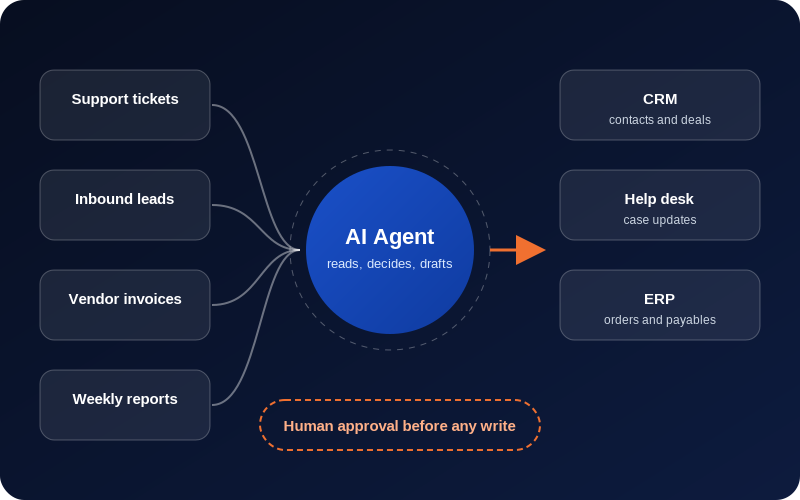
Enterprise workflow diagram showing an AI agent working with CRM, ERP, documents and analytics systems
Conceptual diagram. Systems shown are examples. Integrations depend on each application's interfaces and permissions.

Business problems

Where businesses lose time across complex workflows

A single business request often needs staff to check several systems, collect information, follow rules, update records and coordinate with other teams. Agents can automate the suitable steps when the workflow, the data access and the action permissions are clearly defined.

Employees coordinate across several systems

One request needs a CRM check, an ERP lookup, an inbox, a spreadsheet and an internal database.

Potential solution: An agent retrieves permitted information from connected systems, consolidates it and prepares the next action.

Business KPI: Handling time per request; manual steps per workflow

Document processing creates backlogs

Staff extract information from invoices, purchase orders, forms and supporting documents by hand.

Potential solution: AI extracts and classifies the information, checks required fields and routes exceptions for review.

Business KPI: Processing time; exception rate; correction rate

Customer requests wait between teams

Requests arrive by email, form or ticket, and routing and follow-up depend on manual coordination.

Potential solution: An agent classifies the request, retrieves context, drafts a response or creates a task, and escalates exceptions.

Business KPI: Time to first response; backlog age; resolution time

Supply chain exceptions need investigation

Inventory mismatches, supplier delays and shipment exceptions need information from several sources.

Potential solution: An agent assembles the status picture, flags the exception and prepares permitted next steps.

Business KPI: Exception response time; overdue orders; investigation time

Internal teams repeat the same work

IT, HR and operations answer the same routine questions and search the same documentation.

Potential solution: An agent retrieves approved guidance, prepares an answer and starts supported service workflows.

Business KPI: Time to handle a request; escalation rate

Approvals and handoffs slow operations

Requests sit in queues while teams check information, chase missing fields or wait for a decision-maker.

Potential solution: An agent checks completeness, gathers what is missing and routes a decision-ready package to the authorised approver.

Business KPI: Approval cycle time; incomplete submissions; overdue tasks

These are potential use cases, not guaranteed outcomes. Suitability depends on workflow stability, data access, system integration and risk.

Definition

What is Agentic AI, and how can businesses use it?

Agentic AI uses AI systems that work toward a defined goal by interpreting context, choosing from permitted actions, using connected tools and responding to the results. In business operations, an agent may retrieve information, prepare a decision, update an authorised system or coordinate several workflow steps. Its autonomy is limited by business rules, access permissions and approval requirements.

When does Agentic AI make sense?

  • The workflow has several related steps
  • Information must come from more than one approved source
  • Some decisions depend on context, not only fixed rules
  • The process has clear success criteria and escalation rules
  • The current process can be measured and compared after launch

When is simple automation better?

If a task is predictable, rule-based and easy to validate, conventional workflow automation is often cheaper and more reliable. We recommend an agent only where its ability to interpret context or coordinate steps adds real value.

TechnologyPrimary roleBest-fit example
Traditional automationExecutes predefined rules and stepsRoute a form to the right department
Generative AIGenerates or summarises contentSummarise a contract or draft a reply
AI agentUses context and permitted tools to pursue a defined taskInvestigate a request and prepare the next action
Agentic workflowCoordinates several steps, tools or agents under defined controlsProcess a request from intake and validation through review and system update

Agentic AI development and workflow automation

What we scope and build

Each service links a capability to a business need. Several of them can be combined in one project.

Custom AI agent development

Design an agent around one defined business task, with approved knowledge sources, tools, permissions and escalation logic.

Example: An operations agent gathers case details from approved systems and prepares a structured action plan.

Explore AI agent development

Agentic workflow automation

Connect intake, validation, information retrieval, task creation, approvals and status updates.

Example: An incoming service request is categorised, checked for missing details and routed to the right team.

Explore AI automation

Enterprise AI agent integration

Assess and integrate supported APIs, databases, CRM, ERP, document systems and internal applications.

Example: An agent retrieves authorised order data and creates a support task when a defined exception occurs.

AI document and data processing agents

Classification, information extraction, cross-document checks, missing-field detection and exception routing.

Example: Compare invoice details with a purchase order and flag mismatches for review.

Read: automating document and invoice workflows

Multi-agent systems and orchestration

Where justified, coordinate specialised agents with defined responsibilities, shared context and central controls.

Example: One component gathers information, another validates it, and a controlled workflow sends the result to a reviewer.

Human-in-the-loop AI systems

Confidence thresholds, review queues, approval checkpoints, escalation, audit logs and controlled execution.

Example: An agent prepares a purchase recommendation, and an authorised employee approves it before the order is placed.

A multi-agent architecture is not necessary for every project. A single agent or a standard workflow is often the better choice.

Industry-specific solutions

Agentic AI for real business problems

For each industry we set out the operational problem, why the current process is delayed, what the agent does, where a person must approve, and how improvement is measured. The examples are proposed scenarios, not completed client projects.

Manufacturing operations

Built for: COOs, plant managers, supply chain directors, manufacturing IT leaders

Operational problems

  • •ERP, MES, inventory and supplier data held in separate systems
  • •Production delays traced by checking several dashboards and records by hand
  • •Supplier delivery exceptions acted on late
  • •Maintenance history and work orders gathered manually
  • •Quality investigations needing records pulled from several places

Why the process gets delayed

Each exception needs data from three or four systems, and no one owns the full picture, so the investigation waits for someone to assemble it.

What the AI agent does

  • Production exception investigation: gathers approved production, inventory and order data, and proposes a likely cause with evidence
  • Supplier delay coordination: checks delivery status, identifies affected orders and drafts the procurement follow-up
  • Maintenance work-order preparation: uses approved alerts and equipment history to draft an inspection task
  • Quality case preparation: collects batch, inspection and production records for the quality team
Human approval: Production schedule changes, supplier commitments, maintenance decisions and quality disposition stay with authorised people.

Measured by: Time to investigate an exception; overdue work orders; supplier follow-up time

Financial services and insurance

Built for: Operations heads, finance transformation leaders, insurance operations managers, CIOs, risk teams

Operational problems

  • •Data for reports collected manually from several systems
  • •Invoice, payment and reconciliation exceptions investigated slowly
  • •Claim documents assembled from different sources
  • •Customer requests reaching the wrong department
  • •Compliance reviews needing evidence gathered by hand

Why the process gets delayed

Exceptions cross ledgers, payment platforms and document stores, and each team checks only its own part before passing the case on.

What the AI agent does

  • Financial exception investigation: finds relevant transactions and discrepancies in authorised records and prepares an evidence summary
  • Invoice and payment processing: extracts invoice details, compares them with purchase orders and routes mismatches to accounts payable
  • Insurance claim intake: classifies documents, flags missing information and prepares the claim file for review
  • Reporting preparation: gathers approved data and drafts the reporting package
Human approval: Payments, fund transfers, claim approvals or denials, credit decisions and regulated submissions stay under applicable controls and authorised review.

Measured by: Exception resolution time; document completeness; reconciliation backlog; reporting preparation time

E-commerce and retail operations

Built for: E-commerce directors, customer operations managers, retail operations leaders, marketplace sellers

Operational problems

  • •Customer requests matched by hand to orders, payments, stock and delivery records
  • •Returns, refunds and shipment exceptions investigated one by one
  • •Product information held in different catalogues
  • •Support tickets routed slowly to the right team
  • •Inventory discrepancies needing data pulled from several systems

Why the process gets delayed

Order, stock and payment data update at different times in different tools, so each customer question starts with a search across them.

What the AI agent does

  • Order issue resolution: retrieves verified order and shipment data, classifies the request and starts the approved support workflow
  • Returns preparation: checks order details and return policy, and routes eligible cases
  • Inventory exception handling: compares stock records, flags discrepancies and assigns a task to operations
  • Product data quality: finds missing or conflicting attributes across sources and prepares corrections for review
Human approval: Refunds, account restrictions, high-value adjustments and pricing changes follow policy-based approval.

Measured by: Ticket handling time; return-case processing time; inventory discrepancy resolution time; repeat-contact rate

Logistics and supply chain

Built for: Logistics directors, transport managers, procurement heads, warehouse operations leaders

Operational problems

  • •Shipment status checked by hand across several carrier portals
  • •Mismatches between purchase orders and expected delivery dates
  • •Repeated follow-ups between customers, carriers and internal teams
  • •Inconsistent status records across suppliers and warehouses
  • •Current information arriving too late for shipment decisions

Why the process gets delayed

Carrier and warehouse data reach the operations team in different formats and at different times, so a delay is often noticed after the customer has already called.

What the AI agent does

  • Shipment exception investigation: retrieves status from connected tracking systems and consolidates delay details and affected orders
  • Procurement coordination: compares supplier updates with order requirements and creates follow-up tasks
  • Delivery communication: drafts customer notifications from verified shipment updates
  • Order prioritisation: lists at-risk orders against approved business rules and stock information
Human approval: Carrier selection, rerouting, contractual commitments and costly operational changes stay with authorised staff under approved rules.

Measured by: Exception response time; overdue shipments; manual tracking time; order-status accuracy

Healthcare workflows need privacy safeguards and workflow-specific validation. Clinical diagnosis, treatment and emergency triage stay with qualified professionals.

Cross-industry workflows

High-value business workflows you can automate with AI agents

If your sector is not listed above, these workflows appear in most businesses. Voice-based customer calling is covered on our AI voice agent page.

WorkflowWhat the agent can doMain KPI
Accounts payableExtracts invoice data, compares records and routes mismatchesInvoice exception processing time
Customer operationsClassifies requests, retrieves context and prepares responses and tasksHandling time; backlog
Sales operationsSummarises enquiries, enriches authorised records and prepares follow-up tasksLead processing time; follow-up completion
ProcurementChecks order status, gathers supplier updates and prepares exception casesSupplier follow-up time
Internal IT supportRetrieves approved knowledge and starts supported ticket workflowsResolution time; escalation rate
Contract and document operationsExtracts key fields, identifies missing data and routes review requestsReview preparation time; correction rate
Business reportingCollects approved information and drafts the reporting packageReporting preparation time

How it works

From a business request to a completed workflow

Each step has a clear role, and every step is logged.

  1. Step 1

    Trigger

    A customer request, a new document, a system event or an employee task starts the workflow.

  2. Step 2

    Gather approved information

    The agent retrieves only the information it is authorised to access.

  3. Step 3

    Interpret and select a permitted action

    It evaluates the request against the goal, the context and the business rules.

  4. Step 4

    Execute or request approval

    Low-risk, authorised actions proceed within configured permissions. Sensitive or consequential actions go to a person.

  5. Step 5

    Verify, record and monitor

    The result is checked, the action is logged, failures are reported and unresolved tasks are escalated.

Example: invoice exception workflow

  1. A new invoice enters the document system.
  2. The agent extracts the invoice number, supplier, amount and relevant dates.
  3. It compares the permitted fields with the purchase order and goods-receipt records.
  4. If the data matches and policy allows, it prepares the next workflow step.
  5. If there is a mismatch, it creates an exception case for the accounts payable team.
  6. The system records the decision, the evidence and the final status.

Why this example matters

It shows a real business process with its inputs, system access, validation, exception handling and human review. That is more useful to a decision-maker than a general claim that an agent will transform finance.

Illustrative example. Real steps depend on your systems and approval rules. For how agents and generative AI differ, read agentic AI vs generative AI for enterprise automation.

Enterprise integrations and data readiness

Connect AI agents to your existing business systems

Agents become useful when they can reach the right business context and act through approved systems. We assess integrations before we choose the model or the architecture. You do not have to replace your current applications to start.

What decides whether an integration is feasible

  • API availability and vendor limitations
  • Data quality, consistency and freshness
  • Authentication and authorisation requirements
  • Read versus write permissions
  • Rate limits and operational reliability
  • Error handling and rollback requirements
  • Audit, retention and monitoring needs

We do not claim support for a named CRM, ERP or cloud platform unless we can demonstrate the integration or have a credible delivery plan for it.

CRM and sales

Lead records, customer context, follow-up tasks and sales workflow status.

ERP and finance

Purchase orders, inventory records, invoice details and approved transaction workflows.

Data platforms

Warehouses, lakehouses, databases and governed analytics sources.

Documents and knowledge

Policies, contracts, SOPs, knowledge bases and document repositories.

Operations and support

Ticketing tools, project management, email and service workflows.

APIs and custom applications

Business-specific applications and internal services, with proper authentication and permissions.

Security, governance and human oversight

Enterprise AI agents with defined permissions and human control

Buyers need to know more than what an AI can do. They need to know how a wrong action is prevented, detected and reversed.

Least-privilege access

The agent receives only the permissions its assigned task needs.

Approved knowledge sources

Responses and actions rely on verified business information.

Human approval checkpoints

Payments, external commitments, account changes and other consequential actions need appropriate review.

Audit trails

Requests, tool calls, approvals, errors and outcomes are recorded.

Safe error handling

API failures, missing information and conflicting records trigger a safe fallback, not a guess.

Protection against injected instructions

Untrusted documents and messages cannot act as system instructions, and data leakage is controlled.

Testing and monitoring

Accuracy, completion, unauthorised action attempts and failure patterns are tracked.

Access and retention policies

Data handling follows your organisation's policies and applicable regulations.

The goal is not to give an agent unrestricted access. It is to give it the minimum permissions for a clearly defined task, with verification and escalation where required.

Implementation process

From AI strategy to a working business solution

Each phase ends with a deliverable, so you know what you receive at every step. We do not promise a fixed timeline before the complexity, integrations and risk are known.

  1. 1

    Workflow discovery

    Identify the bottleneck, the current process, the users, the exceptions, the business impact and the decision points.

    Deliverable: Workflow assessment and prioritised use cases

  2. 2

    Feasibility and business case

    Review data readiness, integration complexity and risk, and decide whether an agent is preferable to standard automation.

    Deliverable: Feasibility assessment and success metrics

  3. 3

    Architecture and guardrails

    Define the agent's tools, data access, boundaries, approval points, fallback logic and monitoring.

    Deliverable: Architecture and workflow specification

  4. 4

    Prototype and integration

    Build the selected workflow, connect the approved systems and test representative scenarios.

    Deliverable: Working prototype or pilot

  5. 5

    Testing and controlled deployment

    Validate outputs, permissions, edge cases, failure recovery, human approvals and user acceptance.

    Deliverable: Test results and deployment readiness review

  6. 6

    Monitoring and optimisation

    Track business KPIs, failures, costs, escalations and user feedback, and improve the workflow on evidence.

    Deliverable: Performance review and optimisation backlog

Business outcomes and ROI

How to measure the business value of Agentic AI

We do not promise a fixed percentage. Each project defines its measures before the pilot, records a baseline and reports results over a comparable period.

Simple ROI calculation

Net benefit = measured savings + measured added value − total AI costs

ROI (%) = net benefit ÷ total AI costs × 100

Total AI costs include implementation, integration, model usage, monitoring, maintenance and human review.

How do you measure ROI from Agentic AI? Measure the workflow's baseline cost, handling time, error rate and completion rate. Compare these with a controlled pilot, including all implementation, model, integration, monitoring and review costs. Scale only when the measured benefit justifies the running cost and risk.

MeasureWhat to track
Workflow timeAverage time to complete a request, before and after deployment
Manual effortHuman minutes spent on routine steps
Exception handlingTime from exception detection to resolution
QualityError, rework and correction rates
CompletionShare of workflows completed successfully
EscalationsShare of cases needing human intervention
Operating costModel, API, infrastructure, monitoring and human review costs
AdoptionShare of eligible workflows actually using the solution

Case studies and demonstrations

See how agents handle real workflow problems

Published case studies will appear here once they are verified and approved for disclosure. Until then, these are illustrative demonstrations of the approach.

Invoice processing and exceptions

From document intake to field extraction, validation, mismatch detection and approval routing.

Illustrative demonstration. Not a client result.

E-commerce order coordination

Retrieving order data, identifying inventory mismatches, preparing updates and routing exceptions.

Illustrative demonstration. Not a client result.

Voice AI and customer support

A voice agent answers approved enquiries, retrieves information and transfers complex requests to a person.

Illustrative demonstration. Not a client result.

Why Cor Advance Solutions

A business-first approach to Agentic AI implementation

We are a technology consulting and engineering team based in Ahmedabad, India, working with clients remotely. We describe what we can deliver, and we are specific about what we cannot.

Start with the operational problem

We identify a measurable bottleneck before recommending any AI.

Fit the solution to existing systems

We assess APIs, data readiness and integration limits first.

Choose the right level of autonomy

Standard automation, a single agent or coordinated agents, depending on the task.

Build in oversight

Permissions, approvals, escalation and monitoring are designed in from the start.

Measure the outcome

Business KPIs are agreed before the pilot begins.

Plan for production

Testing, reliability, maintenance and continuous improvement are part of the scope.

Client case studies and results are published only with client permission and verified methodology. Until then, the workflows on this page are illustrative.

Start the conversation

Find the right Agentic AI opportunity for your business

You do not need to automate a whole department to start. Begin with one workflow that takes significant manual effort, needs information from several systems or is often delayed. We will help you assess it and decide whether an agent is the right tool.

The enquiry form asks for

  • Full name
  • Business email
  • Company name
  • Job title or department
  • Industry
  • Workflow you want to improve
  • Systems currently involved
  • Optional: a short description of the problem

Workflow type

Document processingCustomer operationsFinance and procurementSales operationsManufacturing and supply chainInternal IT or employee supportOther

We use the information you provide to understand your requirements and discuss relevant implementation options. Please do not submit confidential customer records or sensitive personal data through this form.

Frequently asked questions

Agentic AI solutions: FAQs

What are Agentic AI solutions?+

Agentic AI solutions use AI systems that work toward defined goals by interpreting context, using approved tools and taking permitted actions. In business workflows, they can gather information, prepare recommendations, coordinate tasks and perform authorised steps. Actions that need oversight go to a person.

What is the difference between Agentic AI and traditional automation?+

Traditional automation usually follows predefined rules and steps. Agentic AI can use context to choose between permitted actions and respond to changing inputs. Traditional automation is still preferable for stable, predictable tasks. Agentic AI adds value when a workflow needs interpretation, tool use or coordination across several steps.

Which business processes can AI agents automate?+

Depending on the workflow and the integrations available, agents can support document intake, invoice validation, customer request routing, supplier follow-ups, internal knowledge retrieval, shipment exception investigation and reporting preparation. High-impact actions need approval and control mechanisms.

Can AI agents integrate with our existing CRM or ERP?+

Often, yes. Integration depends on the system's APIs, authentication options, data permissions and the workflow itself. A technical assessment confirms whether an agent can securely retrieve information, update records or start actions in your environment.

Are Agentic AI systems safe for enterprise use?+

Safety depends on system design, not on the model alone. Enterprise implementations define permissions, approved data sources, approval points, monitoring, logging, testing and recovery procedures. Sensitive and consequential actions remain subject to your business controls.

What is a multi-agent AI system?+

A multi-agent system coordinates two or more agents or specialised components to complete a broader task. It suits processes where responsibilities can be separated and coordinated safely. For a narrow process, a single agent or a conventional workflow is often simpler and easier to control.

How long does it take to implement an AI agent?+

It depends on workflow complexity, integration availability, data quality, security requirements and testing. A narrowly scoped prototype takes far less effort than a production deployment across several enterprise systems. A discovery and feasibility phase sets the project-specific timeline.

How much do AI agent development services cost?+

Cost depends on the number of workflows, integration complexity, usage volume, model choice, security controls and ongoing support. The best starting point is one high-value use case, with both implementation and running costs estimated.

How do you measure Agentic AI ROI?+

We compare the current workflow's time, cost, error rate and completion rate with results from a controlled pilot. Model usage, infrastructure, integration, maintenance and human review are included in the calculation. We use measured results, not generic industry ROI figures.

Should we use Agentic AI or standard workflow automation?+

Use standard automation when the steps are predictable and rules cover the cases. Consider Agentic AI when the task needs context, information gathering or selection among approved actions. Many strong solutions combine both.

Can AI agents make decisions without human approval?+

They can run certain predefined, low-risk actions when the system is explicitly authorised to do so. Decisions with financial, legal or significant operational consequences should have approval or escalation built in.

Does Cor Advance Solutions also offer AI voice agent development?+

Yes. Our AI voice agent service covers phone-based interactions and calling workflows. Agentic AI solutions cover broader workflows across business applications, data sources and teams, and the two can be combined where a process needs both.
Find the workflow where an AI agent can help first

Tell us the workflow, the systems involved and the outcome you need. We will assess it with you and suggest a practical starting point.

Get in Touch

Start Your ProjectWith Us

Tell us about your business goals and challenges. Our experts will get back to you within one business day with a free, no-obligation consultation.

  • Expert GuidanceDiscuss your ideas directly with our specialists
  • Tailored SolutionsGet a customized plan for your business
  • Quick ResponseWe reply within 1 business day
  • 100% ConfidentialYour information is always safe with us

100+ Projects Delivered

5+ years expertise

Free Consultation

Let's Discuss Your Project

Fill out the form and our team will get in touch with you shortly.

By submitting this form, you agree to our Privacy Policy. We never share your information.

Free

Consultation

Quick

Response

Dedicated

Support