Supply Chain AI Agent Development: How to Automate Supplier Delays, PO Follow-Ups, and Inventory Exceptions
Supply chain teams waste thousands of hours on manual follow-ups with suppliers, chasing purchase orders, and handling inventory problems. AI agents automate all of this. Learn how to build intelligent agents that solve supply chain problems 24/7.
A supply chain manager sits at their desk every morning and does the same thing: they check purchase orders that were supposed to arrive last week. They call suppliers asking for delivery dates. They investigate why inventory is lower than expected. They solve the same problems every single day. By the time they finish handling these issues, they've lost 3-4 hours to manual work that doesn't add value.
This is the reality of supply chain management without automation. Supplier delays create bottlenecks. Purchase orders get lost in email chains. Inventory exceptions trigger manual investigations. Someone has to follow up. Someone has to call. Someone has to solve. This manual work is expensive, slow, and error-prone.
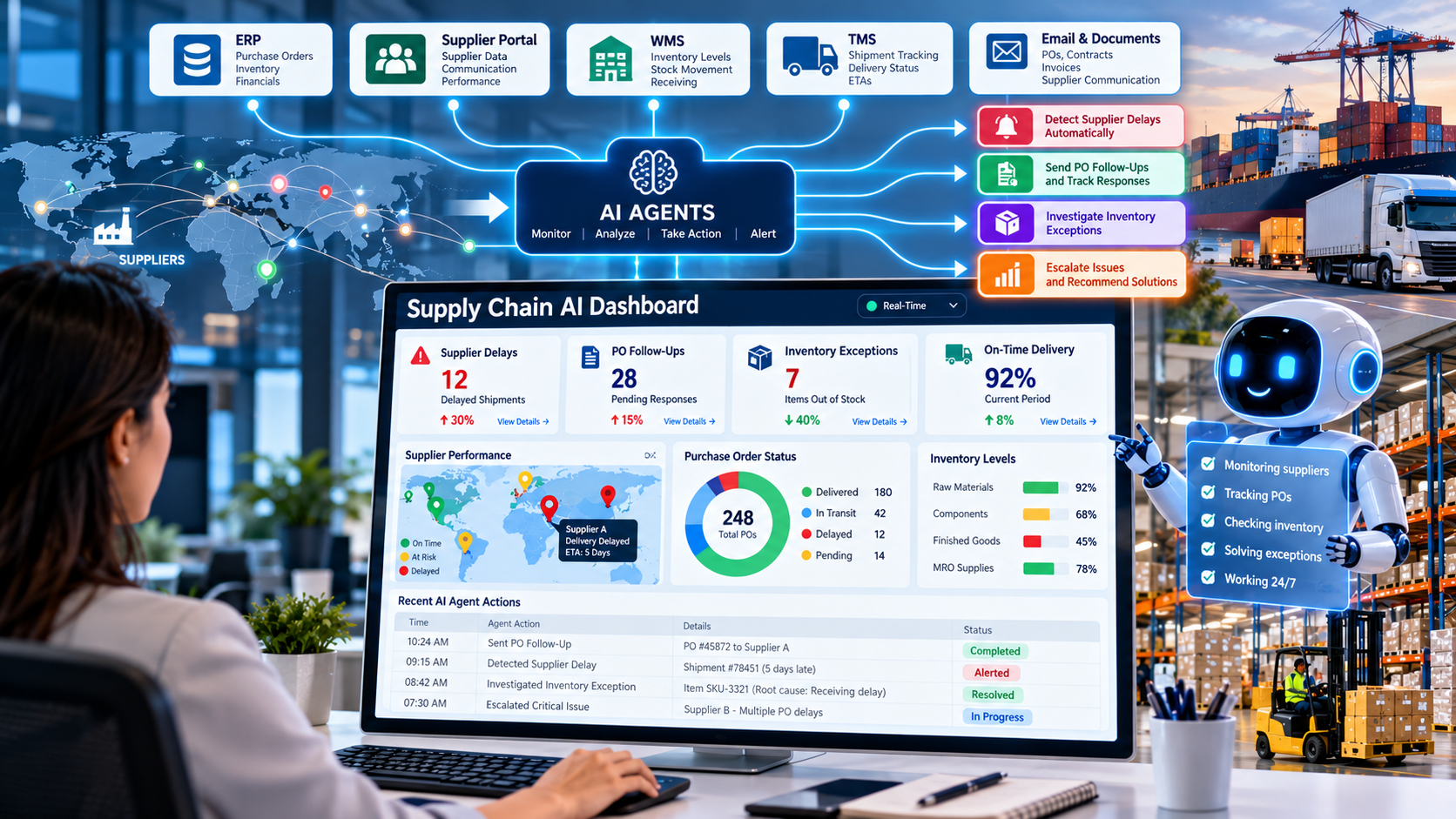
Supply chain AI agent development solves this problem. Instead of people manually tracking supplier issues, intelligent agents work 24/7 to monitor suppliers, flag delays automatically, follow up on purchase orders, and investigate inventory problems. These agents learn from your data. They understand your suppliers. They catch problems before they become crises. The result: supply chain teams move from firefighting to strategy. Delivery reliability improves. Costs drop. Inventory stays accurate. This is the power of AI agent development for supply chains.
Why Supply Chain Problems Don't Get Solved
Supplier Delays Keep Happening
A supplier promises delivery on Friday. Friday comes and goes. Nobody knows where the shipment is. Supply chain managers don't realize there's a delay until Monday morning when production needs the materials. Now it's a crisis. The factory slows down. Customers wait for orders. Revenue gets delayed.
This happens because nobody is actively monitoring supplier performance. There's no system that tracks promised delivery dates, compares them to actual dates, and flags delays automatically. According to Gartner supply chain research, organizations without proactive monitoring experience 3x more supply chain disruptions. It all depends on suppliers calling to say "we're late" (which rarely happens) or managers discovering delays reactively.
Purchase Orders Get Lost in Email
A purchase order goes out to a supplier. Three days pass. Did they receive it? Did they start? Is there a problem? Nobody knows. Someone has to follow up by email. If there's no response, they call. If the supplier is unreachable, they wait. A week later, they find out the PO was never received. Now there's a backlog.
Manual follow-ups are slow and unreliable. An AI agent doesn't wait. It sends a message automatically. It tracks whether the supplier acknowledged the PO. It follows up again if there's no response. It escalates if the issue isn't resolved. All without human intervention.
Inventory Exceptions Require Manual Investigation
Inventory levels don't match what the system says. A part should be in stock but isn't. Someone has to investigate. Was it miscounted? Did it get damaged? Did someone forget to update the system? This investigation takes hours. And by then, production needs the part.
Without automated exception management, inventory problems aren't discovered until they cause problems. With AI agents, exceptions are flagged in real-time. The agent investigates. It cross-references recent transactions. It checks receiving records. It identifies the root cause. It alerts the supply chain team with a solution.
What Are Supply Chain AI Agents?
Definition: Intelligent Automation for Supply Chain
An AI agent is software that works independently to solve problems in your supply chain. Unlike traditional automation (which follows fixed rules), AI agents learn and adapt. They monitor supplier performance. They understand when something is unusual. They take action without being told exactly what to do.
Think of an AI agent like hiring an experienced supply chain manager who works 24/7, never sleeps, never forgets, and costs a fraction of what you'd pay a person. This manager knows your suppliers. They understand your inventory patterns. They spot problems early. They solve issues before they become crises.
How AI Agents Differ From Traditional Automation
Traditional automation uses IF-THEN rules. "If PO status is not confirmed after 2 days, send reminder." This works for standard situations. But what if the supplier is reliable but this time is different? What if there's a holiday? What if the delay is due to a port closure? The rule-based system doesn't understand context.
AI agents use machine learning. They learn patterns from historical data. They understand what "normal" looks like for each supplier. They recognize when something is abnormal. They understand context. They make decisions more like a human expert would—except they do it instantly and consistently.
How Supply Chain AI Agents Actually Work
Step 1: Data Collection and Integration
An AI agent first needs data. It connects to your ERP system (like SAP or NetSuite), your supplier portal, your inventory system, and your shipping trackers. It pulls in:
- Purchase order details and status
- Supplier delivery history and performance
- Current inventory levels and movement
- Shipment tracking information
- Receiving and inspection data
- Supplier communication history
Step 2: Pattern Recognition and Learning
Once the agent has data, it learns. It analyzes historical patterns:
- "Supplier A typically takes 5 days from PO to delivery, but sometimes 7 days around holidays"
- "When we receive 100 units, inventory reconciliation takes 2 days"
- "Supplier B's delays are usually caused by port congestion on certain routes"
- "This product SKU has 15% variation in demand each month"
Step 3: Real-Time Monitoring
The agent monitors continuously. It watches purchase orders. It tracks delivery commitments. It monitors inventory. When actual performance deviates from expected patterns, the agent flags it immediately. "Supplier A usually confirms within 24 hours, but it's been 36 hours with no confirmation. This is unusual."
Step 4: Automated Action
When the agent detects an issue, it takes action:
- Sends automated follow-up messages to suppliers asking for status updates
- Escalates to humans if a problem persists or requires human judgment
- Suggests alternative suppliers if a delay will cause a shortage
- Adjusts inventory forecasts based on expected delays
- Alerts procurement teams to problems before they cascade
Three Critical Supply Chain AI Agent Use Cases
Use Case 1: Automated Supplier Delay Detection
The Problem: You don't know there's a supplier delay until it impacts your operations. A promised delivery date passes. Someone eventually notices. Now you're in reactive mode.
How the AI Agent Solves It: The agent monitors all purchase orders and expected delivery dates. When a shipment hasn't arrived by the promised date, it investigates automatically. It checks tracking systems. It looks at the supplier's recent performance. It understands whether this delay is normal for this supplier or unusual. If the delay is concerning, it takes action:
- Sends a message to the supplier asking for updated ETA
- Checks with alternative suppliers for backup options
- Alerts your procurement team with a summary and recommendations
- If the delay will cause a shortage, suggests expedited alternatives
Real Impact: Instead of discovering a delay 3 days after it happens, you know about it immediately. You have 5 days to solve the problem instead of 2. You can coordinate alternatives. You avoid emergency freight costs. You meet customer commitments.
Use Case 2: Autonomous Purchase Order Follow-Ups
The Problem: A purchase order is sent. Did the supplier receive it? Did they start processing? Did they understand the requirements? You don't know until you follow up. This follow-up takes hours of manual work—emails, phone calls, waiting for responses.
How the AI Agent Solves It: The agent owns PO follow-ups. When a purchase order is issued, the agent:
- Sends the PO to the supplier through their preferred channel (email, portal, EDI)
- Tracks whether the supplier acknowledged receipt
- Follows up automatically if there's no acknowledgment within expected timeframe
- Asks clarifying questions if the PO seems unusual for this supplier
- Confirms critical details like delivery address, lead time, and special requirements
- Escalates to a human only if the supplier doesn't respond or if there's a complex issue
Real Impact: POs are confirmed within hours instead of days. Misunderstandings are caught early. Suppliers know your expectations clearly. Lead times are more predictable. Your team spends time on strategy instead of follow-ups.
Use Case 3: Intelligent Inventory Exception Management
The Problem: System says you have 500 units in stock. You need 200 for a customer order. You go to the warehouse and find only 50. Where did the other 350 go? Someone has to investigate. This investigation takes hours and often finds mistakes in receiving, movement tracking, or inventory counts.
How the AI Agent Solves It: The agent monitors inventory accuracy continuously. When inventory levels don't match expectations, it investigates automatically:
- Checks recent receiving and movement transactions
- Cross-references with quality inspection records
- Looks for unusual patterns that indicate data errors
- Identifies which SKUs have persistent accuracy problems
- Proposes recount priorities for physical verification
- Suggests system corrections with confidence scores
Real Impact: Inventory discrepancies are identified in real-time instead of during monthly cycle counts. Root causes are identified faster. System accuracy improves. You can trust your inventory forecasts. You hold less safety stock because you're confident in your numbers.
Real Benefits of Supply Chain AI Agent Development
80% Reduction in Manual Supply Chain Work
A supply chain manager spends 4-5 hours daily on manual tasks: following up with suppliers, investigating inventory problems, chasing purchase orders. An AI agent automates these tasks. Your team moves from 80% manual work to 20% manual work. They handle the complex situations that need human judgment. The agent handles everything else.
Faster Problem Detection (Hours Instead of Days)
Without automation, supply chain problems aren't discovered until they impact operations. With AI agents, problems are detected in real-time. A supplier delay is flagged within hours, not days. You have time to respond. You avoid crisis management.
Improved On-Time Delivery Performance
When you detect supplier delays early, you can respond. You coordinate alternatives. You expedite critical shipments. Companies using AI agents for supply chain management see 15-25% improvement in on-time delivery rates.
Better Inventory Accuracy
Real-time exception management catches inventory errors before they cascade. Inventory accuracy improves from 92-95% to 98-99%. This means better forecasts, lower safety stock requirements, and fewer emergency purchases.
Cost Savings and Financial Impact
AI agents reduce costs in multiple ways:
- Labor savings: 2-3 FTE supply chain staff can be redeployed to higher-value work
- Avoiding expedited freight: Early problem detection prevents expensive rush shipments
- Reducing inventory carrying costs: Better accuracy means less safety stock needed
- Preventing stockouts: Proactive monitoring prevents production delays and lost sales
Total annual savings: $500K-$2M for a mid-size manufacturing company.
How to Implement Supply Chain AI Agents
Phase 1: Assessment and Planning (2-4 weeks)
Start by understanding your current supply chain challenges. Which problems happen most frequently? Which cause the most cost? Which are easiest to automate? Map your systems. Understand your supplier base. Define success metrics.
Phase 2: Build Your First Agent (4-8 weeks)
Start with one use case that will deliver immediate value. Maybe it's supplier delay detection. Maybe it's PO follow-ups. Choose the problem that causes the most friction today. Build an agent focused on solving that one problem well.
Phase 3: Integration and Testing (2-4 weeks)
Connect the agent to your ERP, supplier systems, and communication channels. Test thoroughly. Make sure the agent can access the data it needs. Make sure it sends messages through channels your suppliers actually monitor. Test edge cases. Make sure escalations work correctly.
Phase 4: Pilot Rollout (4-8 weeks)
Launch with a subset of suppliers or SKUs. Monitor performance. Let the team adjust how the agent works. Collect feedback. Make improvements. Most agents take 4-8 weeks to stabilize.
Phase 5: Full Deployment and Expansion (Ongoing)
Once the first agent is working well, expand it to all suppliers and products. Then build additional agents for other supply chain challenges. The framework is reusable.
Return on Investment: The Numbers
Investment: AI agent development typically costs $150K-$300K depending on complexity and integration requirements. According to McKinsey supply chain insights, companies that invest in supply chain automation see 15-20% improvement in operational efficiency.
Annual Benefits:
- Labor savings (2-3 FTE): $200K-$300K
- Reduced expedited freight (avoiding 20% of emergency shipments): $100K-$300K
- Improved inventory accuracy (less safety stock needed): $50K-$150K
- Prevented stockouts (improved revenue): $100K-$500K
Total Year 1 Benefit: $450K-$1.25M
Payback Period: 3-8 months
Year 2 and beyond, these benefits recur without additional investment. The ROI compounds as you build more agents.
Best Practices for Supply Chain AI Agent Success
Start With Clean Data
AI agents learn from historical data. If your data is messy (duplicate suppliers, inconsistent product codes, missing delivery dates), the agent learns bad patterns. Spend time cleaning your data before building agents.
Define Clear Escalation Rules
Not every situation requires human intervention, but some do. Define clearly when the agent should escalate to a human. Usually it's when the situation is unusual, complex, or requires human judgment.
Communicate With Suppliers
Your suppliers need to understand they're interacting with an AI agent. Set expectations. Tell them how the agent works. Make sure they know how to respond. Some suppliers appreciate the efficiency. Others need reassurance.
Monitor and Adjust Continuously
AI agents aren't "set it and forget it." Monitor performance. Look at what the agent is doing. Make adjustments. As your business changes, the agent may need to adapt. Professional supply chain organizations, as defined by APICS, emphasize continuous improvement and technology adaptation as critical success factors.
Frequently Asked Questions About Supply Chain AI Agents
Will an AI agent put people out of work?
No. AI agents handle repetitive tasks (following up, monitoring, investigating). They free up people to do more strategic work. Instead of spending 4 hours on follow-ups, your supply chain manager spends 4 hours on supplier relationships, contract negotiations, and process improvements. The job becomes more valuable, not obsolete.
How long does it take to see ROI?
Most companies see measurable improvements within 2-4 weeks of deployment. Full ROI (payback of investment) typically happens within 3-8 months. Some benefits appear immediately (reduced manual work), others take longer (improved inventory accuracy).
What if our suppliers don't use modern systems?
AI agents can work with any supplier. If a supplier uses email, the agent sends email. If they use EDI, the agent sends EDI. If they use a web portal, the agent can interact with the portal. The agent adapts to your supplier's technology level.
What happens if the AI agent makes a mistake?
AI agents are monitored closely. If an agent makes a mistake, the impact is usually small (a redundant follow-up message, for example). Critical decisions are escalated to humans. As the agent learns from your feedback, mistakes decrease over time.
Can we build multiple AI agents?
Absolutely. Once you have the infrastructure, adding more agents is relatively fast and cheap. You might start with supplier delay detection, then add PO follow-ups, then inventory management. Each agent can be built independently and deployed at its own pace.
The Future of Supply Chain Management is Automated
Supply chain teams are under constant pressure: deliver faster, hold less inventory, maintain quality, and keep costs down. These demands are impossible to meet with manual processes. The companies winning in supply chain are those automating routine work with AI agents. They detect problems earlier. They respond faster. They run leaner operations. They serve customers better.
If your supply chain team is still spending hours on manual follow-ups, chasing purchase orders, and investigating inventory problems, you're leaving money on the table. It's time to automate. Not for efficiency alone, but because automation enables strategy. Once the routine work is automated, your team can focus on the work that actually improves your business: supplier relationships, process innovation, and strategic planning.
AI automation for supply chain isn't about replacing people. It's about multiplying what they can accomplish. One person with AI agents can do the work of five people without agents. And their output is better—more reliable, more consistent, less error-prone.
Ready to Automate Your Supply Chain?
Our AI agent development team builds custom agents for supplier management, purchase order automation, and inventory exception handling. Let's discuss how AI agents can solve your supply chain challenges.
Schedule Free Consultation