AI Voice Agents

AI Voice Agent Development Services That Turn Business Calls Into Completed Workflows

Your customers call to book appointments, check orders, ask about services, request updates and solve problems. When your team is busy or your lines are unavailable, those conversations become missed opportunities. Our AI voice agent development services build agents that understand the call, retrieve the right information, connect with your business systems and execute approved workflows.

  • Business-first AI automation
  • Connected workflows
  • Human oversight
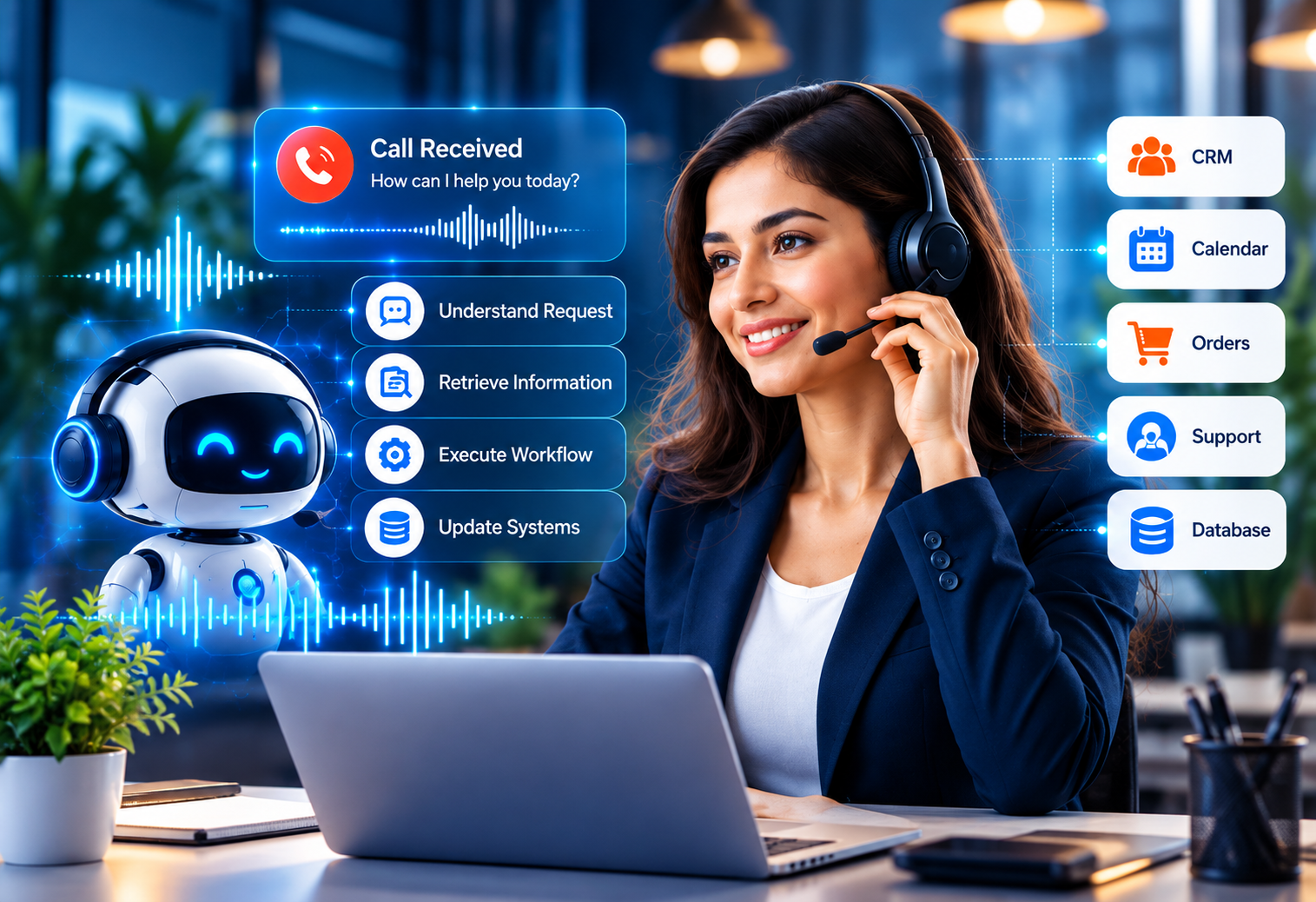
AI voice agent handling a customer call, with steps for understanding the request, retrieving information, executing the workflow and updating business systems

What your business can automate

  • Answer incoming customer calls around the clock.
  • Qualify sales inquiries and identify high-intent prospects.
  • Schedule, reschedule and confirm appointments.
  • Retrieve order, shipment and service information.
  • Handle frequently asked questions using approved business knowledge.
  • Route complex or sensitive calls to the right human team.
  • Record call outcomes and update connected business systems.

What are AI voice agent development services?

AI voice agent development services involve designing, building and integrating AI-powered systems that communicate with customers over phone calls. A well-built AI voice agent understands spoken requests, retrieves relevant information, executes approved business workflows and transfers complex requests to human employees.

  • An AI voice agent handles inbound and approved outbound calls, from appointment booking to order-status checks.
  • Unlike a traditional IVR, it understands natural speech and can work with live business data.
  • Reliable results depend on integrations, permissions, approved knowledge sources and clear escalation rules.

The business problem

Your business may be losing revenue before a customer reaches your team

Phone calls are often the first step in a customer relationship. Manual call handling, disconnected systems and limited support hours create costs that are hard to see until they affect revenue, customer satisfaction and productivity.

Missed calls become missed business opportunities

A potential customer calls to request pricing, book a consultation or enquire about a service. Your team is already busy, so the customer gets no response.

Business impact

  • •Potential leads move to competitors.
  • •Sales teams follow up late.
  • •High-intent inquiries are not captured.
  • •Marketing spend does not turn into qualified opportunities.
AI voice agent solution: An AI phone agent answers calls, understands the requirement, collects relevant details and transfers qualified inquiries to the right sales representative.

Employees spend too much time on repetitive questions

Customers keep asking about business hours, appointment availability, delivery updates, pricing, service coverage and account procedures.

Business impact

  • •Higher customer service workload.
  • •Longer call waiting times.
  • •Repetitive administrative work.
  • •Reduced employee productivity.
AI voice agent solution: An AI customer service voice agent handles approved FAQs, retrieves relevant information and escalates requests that need human attention.

Customers cannot get support outside business hours

A buyer may call in the evening, a patient may need to reschedule on a weekend, or a customer may want to check an order late at night.

Business impact

  • •Delayed responses.
  • •Lost after-hours leads.
  • •Unnecessary next-day follow-ups.
  • •Poor customer experience.
AI voice agent solution: A 24/7 AI voice assistant handles supported inquiries, captures customer details and starts approved workflows outside regular working hours.

Phone conversations are disconnected from business systems

Your team answers the call, then opens a CRM, searches an order system, checks appointment slots and updates records by hand.

Business impact

  • •Repeated data entry.
  • •Inconsistent customer information.
  • •Slower issue resolution.
  • •Limited visibility into call outcomes.
AI voice agent solution: API-connected voice agents retrieve and update authorized information across supported CRM, ERP, scheduling and order management platforms.

Traditional IVR systems create friction

Customers struggle with long phone menus and rigid options. They want to explain their problem naturally, not press buttons to reach the right department.

Business impact

  • •Frustrating customer journeys.
  • •Repeated calls and transfers.
  • •Abandoned interactions.
  • •Pressure on support teams.
AI voice agent solution: Conversational AI voice agents let customers explain their needs in their own words and steer each call toward the right outcome.

The business opportunity: move beyond answering calls. Automate the workflows that happen during and after each conversation.

Our solution

Build AI voice agents that understand, respond and take action

An effective AI voice agent does more than convert speech to text and read back a reply. It understands intent, retrieves relevant information, follows business rules and executes approved actions. We engineer each agent around your business processes.

Map your call workflow
  1. 01

    Understand the conversation

    The customer speaks naturally. Speech recognition converts the call into text so the system can identify the request, intent and context.

  2. 02

    Identify the customer's requirement

    The AI works out whether the caller wants to book an appointment, check an order, request a quotation, report a problem or speak with a representative.

  3. 03

    Retrieve relevant business information

    The agent uses approved knowledge sources or connected business systems to find the facts that answer the request.

  4. 04

    Execute the appropriate workflow

    Based on permissions and business rules, the agent can check appointment availability, create a qualified sales inquiry, retrieve order status, schedule or reschedule a supported appointment, create a service request or route the call to a relevant employee.

  5. 05

    Confirm the outcome

    The AI tells the customer the result and confirms the next step.

  6. 06

    Escalate when necessary

    If the request is out of scope, involves sensitive information or needs human judgment, the agent transfers the conversation to the right team member with context.

AI phone agent development

What can an AI voice agent actually do for your business?

Our AI voice agent development services support different calling workflows, depending on your operational requirements, system integrations and business rules.

Inbound AI voice agents

Handle incoming customer calls without depending entirely on manual answering.

  • Customer inquiries
  • Service information requests
  • Appointment scheduling
  • Order-status questions
  • Support routing
  • Business-hours and location inquiries

Outbound AI voice agents

Automate approved outbound calling for customer engagement and follow-ups. Outbound calling must follow applicable consent, calling-hour, do-not-call and telecommunications requirements.

  • Appointment reminders
  • Lead follow-ups
  • Customer feedback requests
  • Service renewal reminders
  • Order and delivery notifications
  • Event and booking confirmations

AI appointment scheduling agents

Help customers schedule, confirm, cancel or reschedule supported appointments. The agent checks connected calendar availability, applies scheduling rules and confirms the booking.

AI lead qualification agents

Understand a prospect's requirements, collect relevant details and categorize inquiries against your sales qualification criteria. Qualified opportunities reach the sales team with a structured call summary.

AI customer support voice agents

Handle approved customer questions, retrieve account or service information and route unresolved issues to human support.

AI order and delivery tracking agents

Connect to supported order management or logistics systems, retrieve shipment information and communicate verified updates.

Multilingual AI voice agents

Support conversations in selected languages, based on the speech recognition, language models and voice technologies used in the implementation. Useful for businesses serving multilingual markets across the USA, UK, Canada, Australia and India.

AI voice agents with human handoff

Transfer the call when the AI cannot confidently resolve an issue, when the customer asks for a representative or when a business rule requires human involvement.

Industry-specific AI voice agents

AI voice agents built around the problems your industry faces

A generic voice bot cannot solve every industry's problems. A hospital needs safe patient communication, an e-commerce company needs accurate order information and a real estate business needs faster lead qualification. Each block below shows the problem, the workflow and the outcome.

The business problem: Reception teams handle appointment requests, rescheduling, clinic-hour questions and repetitive administrative calls. When volumes rise, patients wait longer or struggle to reach the right department.

What it can automate

  • Appointment booking and rescheduling
  • Appointment confirmations and reminders
  • Clinic timings, location and department inquiries
  • General information from approved hospital content
  • Routing to the right department
  • Escalation to staff for clinical or sensitive questions

Example workflow

  1. Patient calls the clinic and the agent identifies an appointment request.
  2. It collects the details required by the clinic's process.
  3. It checks connected scheduling availability and offers options.
  4. After confirmation, it records the booking and sends a confirmation through an approved channel.

Business outcome: Fewer repetitive administrative calls, and patients reach the right service faster.

Clinical advice, diagnosis, emergency assessment and other high-risk medical decisions stay under qualified human supervision. Healthcare deployments must address applicable privacy, security and regulatory requirements.

Explore healthcare AI voice agents

E-commerce: AI voice agents for online stores and retail businesses

The business problem: Online stores receive repeated calls about order status, delivery delays, returns, stock, payments and product specifications. Manual handling slows responses and raises support costs.

What it can automate

  • Order-status inquiries
  • Shipment and delivery updates
  • Product information requests
  • Return and refund process questions
  • Support ticket creation
  • Payment-related inquiry routing
  • Sales inquiry qualification

Example workflow

  1. Customer asks, "Where is my order?"
  2. The agent identifies the order-tracking intent and runs the verification process.
  3. It retrieves the order from the connected system and shares the verified status.
  4. If the order is delayed, it creates or routes a support request.

Business outcome: Fewer order-status calls and faster access to verified order information.

See our ecommerce AI chatbot services

Real estate: AI voice agents for developers, brokers and agencies

The business problem: Inquiries arrive from property portals, websites, ads and referrals. Sales teams struggle to respond fast, qualify every lead, answer property questions and arrange site visits. A missed call from a high-intent buyer is a lost sale.

What it can automate

  • Property availability inquiries
  • Buyer and tenant lead qualification
  • Budget and location preference collection
  • Site visit scheduling
  • Project information from approved data
  • Broker and sales team call routing
  • Lead follow-up workflows

Example workflow

  1. A prospect calls about a residential project.
  2. The agent asks which property or configuration they want.
  3. It collects budget, preferred location and purchase timeline, then checks the lead criteria.
  4. It offers site visit slots and sends the qualified lead and call summary to the sales CRM.

Business outcome: Sales teams prioritize serious buyers and spend less time on manual lead qualification.

Explore real estate AI voice agents

Banking and financial services: AI voice agents for customer operations

The business problem: Institutions handle recurring questions about account services, branches, application status and payments. Call volumes are high, and customer data needs strict access controls.

What it can automate

  • General banking service inquiries
  • Branch and operating-hour information
  • Application-status inquiries through authorized integrations
  • Appointment scheduling
  • Service request creation
  • Call routing to the correct department
  • Approved payment and account-service information

Example workflow

  1. A customer calls about an application.
  2. The agent identifies the request and starts the identity verification process.
  3. It retrieves permitted status information and communicates it.
  4. If more action is needed, it routes the request to the relevant service team.

Business outcome: Less routine inquiry handling, with controlled access to customer information.

Every workflow is subject to identity verification and access policies. Security requirements are defined for each deployment.

Explore financial services AI solutions

Insurance: AI voice agents for policyholders and claims teams

The business problem: Customers call about policy details, renewal dates, premium payments, claim submissions and claim status. A single request often means contacting several departments.

What it can automate

  • General policy inquiries
  • Renewal reminders
  • Claim-status inquiries
  • Claim-intake information collection
  • Document submission instructions
  • Appointment scheduling
  • Policyholder support routing

Example workflow

  1. A policyholder calls to check a claim.
  2. The agent identifies the claim-related request and runs identity verification.
  3. It retrieves the permitted claim status and shares the available update.
  4. Disputes or decisions go to a claims specialist.

Business outcome: Quicker access to routine claim information and fewer repetitive calls to claims teams.

Logistics and transportation: AI voice agents for shipment and delivery operations

The business problem: Logistics firms handle frequent calls from customers, drivers, vendors and operations teams. Delays and delivery changes add more communication work.

What it can automate

  • Shipment-status inquiries
  • Delivery-window information
  • Delivery appointment coordination
  • Customer notification workflows
  • Service request creation
  • Driver and operations call routing
  • Escalation of delivery exceptions

Example workflow

  1. A customer calls about a delayed shipment.
  2. The AI identifies the shipment reference and retrieves the status from the logistics system.
  3. It explains the verified update.
  4. If there is an exception, it creates a support request and sends the call summary to the relevant team.

Business outcome: Fewer tracking calls, so operations teams can focus on shipment exceptions.

Education: AI voice agents for schools, colleges and universities

The business problem: Institutions get repeated calls about admission requirements, deadlines, courses, fees, campus visits and student services. Admission teams struggle during enrollment peaks.

What it can automate

  • Admission inquiries
  • Course and programme information
  • Application deadline information
  • Campus visit scheduling
  • Admission counselling appointments
  • Application-status inquiries through authorized systems
  • Student support call routing

Example workflow

  1. A prospective student calls about a course.
  2. The agent identifies the programme and answers approved admission questions.
  3. It collects inquiry details and books a counselling appointment if requested.
  4. It passes the summary to the admissions team.

Business outcome: Admission teams manage recurring inquiries and prioritize prospective students.

Explore education AI solutions

Travel and hospitality: AI voice agents for hotels and travel companies

The business problem: Hotels and travel firms receive calls about availability, reservations, check-in details, booking changes and amenities. At peak periods, manual handling hurts the guest experience.

What it can automate

  • Room availability inquiries
  • Reservation information
  • Booking requests through approved systems
  • Reservation confirmation
  • Booking-change requests
  • Check-in and check-out information
  • Facility inquiries and escalation to reception

Example workflow

  1. A guest asks about rooms for specific dates.
  2. The agent checks availability in the connected booking system.
  3. It presents the options and starts the approved reservation process.
  4. It confirms the outcome or transfers the guest to reservation staff.

Business outcome: Faster reservation inquiry handling and easier access to booking support.

Automotive: AI voice agents for dealerships and service centres

The business problem: Dealerships and service centres receive calls about stock, test drives, servicing, maintenance schedules, repair updates and sales. When staff are busy, customers wait.

What it can automate

  • Vehicle availability inquiries
  • Test-drive scheduling
  • Service appointment booking
  • Maintenance inquiry routing
  • Repair-status inquiries through connected systems
  • Sales lead qualification
  • Customer follow-up workflows

Example workflow

  1. A vehicle owner calls to book a service.
  2. The agent collects the vehicle and customer details.
  3. It checks service-centre availability and schedules the appointment under the business rules.
  4. It sends the booking details to the service team.

Business outcome: Fewer routine booking calls and better handling of customer requests by dealership teams.

Have a specific calling problem in your industry? Let's map the workflow before we select the technology.

Discuss your industry workflow

For property businesses, see our real estate AI voice agent workflow, covering lead qualification and site visit scheduling.

Real-world workflow demonstration

From customer question to completed business action

A useful AI voice agent connects every conversation to a measurable business process. Here is an e-commerce example of a customer checking a delayed order.

System actions during the call

  • Identifies the order and applies the required verification rules.
  • Retrieves shipment information through an authorized API.
  • Creates a support request if the customer asks for one.
  • Records the call outcome and routes the request to the right team.

Final result: the customer gets a verified answer, and the business gets a structured support request instead of an unrecorded phone call.

Illustrative call transcript

  • CustomerI placed an order last week. Can you tell me when it will arrive?
  • AI Voice AgentI can help you check that. May I have your order reference?
  • CustomerProvides the order reference.
  • AI Voice AgentThank you. I'll check the latest available shipment information.
  • AI Voice AgentYour order is currently in transit. The latest available update shows an expected delivery date of [verified date].
  • CustomerWhat if it doesn't arrive?
  • AI Voice AgentI can create a support request so our team can review the delivery. Would you like me to do that?

This is an illustrative workflow. The order date and status shown are placeholders, not real customer data.

This is the difference between an AI voice bot that talks and an AI voice agent that takes part in business operations.

AI voice agent CRM integration and business systems

Connect customer conversations with the systems your business already uses

An AI voice agent is only as useful as the information it can securely reach. Without integrations, it gives generic answers. With the right connections, it can retrieve relevant data and start approved workflows.

CRM integration

Connect voice interactions with customer relationship management workflows.

  • Create new lead records
  • Update contact information
  • Record inquiry details
  • Assign qualified leads
  • Add call summaries and follow-up tasks

ERP integration

Connect approved voice workflows with enterprise resource planning systems.

  • Retrieve permitted order information
  • Check relevant service or inventory data
  • Initiate supported business requests
  • Route operational inquiries

EHR and EMR integration

Support healthcare administrative workflows through authorized integrations.

  • Appointment availability
  • Scheduling and rescheduling
  • Administrative patient inquiries
  • Relevant appointment updates

E-commerce and order management

Connect customer calls with supported commerce systems.

  • Order-status retrieval
  • Delivery updates
  • Return-process information
  • Customer support requests

Calendar and scheduling

Connect approved scheduling platforms to check availability and manage appointments.

  • Availability checks
  • Booking, rescheduling and cancellation
  • Confirmation messages

Contact centre and telephony

Connect the AI voice agent with supported phone systems, call routing and contact centre infrastructure.

  • SIP and cloud telephony
  • Call routing rules
  • Handoff to human agents

Integration principle: we assess your existing technology before recommending an architecture. Integration scope depends on API availability, authentication, permissions, data quality and vendor limitations.

Enterprise AI voice agent architecture

What powers an intelligent AI voice agent?

A production-ready AI voice agent needs more than a language model. It needs an architecture that manages audio, conversation context, business data, system actions and human escalation.

1. Telephony and voice infrastructure

Connects the agent to supported phone numbers, SIP infrastructure, cloud telephony or contact centre systems.

2. Speech-to-text

Converts customer speech into text for intent identification and conversation processing.

3. Natural language understanding

Interprets the caller's intent, relevant entities and conversational context.

4. AI reasoning and conversation management

Manages the dialogue, selects appropriate responses and decides which approved tools or workflows may be used.

5. Knowledge retrieval

Retrieves relevant information from approved business knowledge sources, documents and databases.

6. Business logic and API layer

Applies business rules, validates requests and connects the agent to authorized systems.

7. Text-to-speech

Converts the agent's response into natural-sounding speech.

8. Monitoring and analytics

Tracks call outcomes, escalation rates, unresolved requests, workflow completion and system errors.

9. Human handoff

Transfers conversations to employees when customer preference, business rules or risk conditions require it.

Architecture objective: a voice system that is understandable, auditable, connected to business processes and manageable by your technical and operations teams.

Security, accuracy and human oversight

Automate customer calls without losing business control

A voice agent that gives wrong information, or reaches data it should not, creates more problems than it solves. Data protection, accuracy and accountability are designed in from the start.

Controlled access to business data

  • Use appropriate authentication and authorization.
  • Limit data access to the agent's defined responsibilities.
  • Apply role-based access controls where appropriate.
  • Avoid exposing unnecessary customer information.

Verified responses

  • Use approved knowledge sources.
  • Retrieve real-time information from authorized systems where supported.
  • Apply validation rules before executing business actions.
  • Do not present unverified information as fact.

Human escalation

  • Transfer sensitive or complex requests.
  • Provide human support when the agent cannot confidently answer.
  • Define escalation rules for each workflow.
  • Pass relevant conversation context to the receiving team.

Call records and monitoring

  • Define what information is logged.
  • Monitor failed workflows and unresolved interactions.
  • Apply retention and access policies.
  • Set up consent and notification processes for call recording.

Compliance considerations

Depending on where you operate and your industry, the solution may need to account for:

  • Applicable data protection and privacy laws
  • Healthcare privacy and security obligations
  • Financial services security requirements
  • Telecommunications and automated calling rules
  • Consent, call recording and data retention requirements

No voice technology is compliant by default. Security and compliance controls must be defined for each actual deployment.

Comparison

AI voice agent vs traditional IVR vs basic voice bot

Businesses are moving beyond phone menus because customers expect to explain their needs and get them handled in one conversation.

CapabilityTraditional IVRBasic voice botAI voice agent
Customer interactionMenu-basedLimited conversationNatural conversation
Intent understandingLimitedPredefined or basicContext-aware
Dynamic responsesLimitedDepends on setupBased on connected information
Business system integrationOften routing-focusedVariesCan retrieve and update authorised systems
Workflow executionLimitedLimitedSupports approved actions
Complex requestsTransfers or menu pathsOften strugglesEscalates with context
PersonalisationLimitedDepends on dataBased on permitted customer context
Business process automationLimitedTask-specificBuilt around connected workflows

Important: not every AI voice agent performs every action listed here. Real capabilities depend on the model, telephony platform, integrations, permissions, testing and business rules. The goal is not to replace every phone interaction with AI. It is to automate the right tasks and make human support more effective.

AI voice agent development process

From business requirement to production-ready voice automation

Deploying a voice agent without understanding the existing call workflow leads to poor responses, unnecessary escalations and incomplete automation. Our process starts with the business problem.

  1. Phase 1

    Business and call workflow discovery

    We review current inbound and outbound calling, call volumes, common inquiry categories, repetitive tasks, the systems involved and compliance requirements.

    Deliverable: Business problem assessment and priority use cases.

  2. Phase 2

    Use-case and conversation design

    We define customer intents, conversation paths, required customer information, response boundaries, business rules and escalation conditions.

    Deliverable: Voice agent conversation and workflow design.

  3. Phase 3

    AI and telephony architecture

    We select speech recognition, language models, text-to-speech, telephony infrastructure, knowledge retrieval and the integration architecture.

    Deliverable: Technical architecture and implementation plan.

  4. Phase 4

    AI voice agent development

    We build the conversation logic, knowledge access, workflow execution and system connections.

    Deliverable: Working voice agent implementation.

  5. Phase 5

    Integration and workflow testing

    We test intent recognition, data retrieval accuracy, API responses, scheduling actions, failed requests, human escalation and unclear or unexpected inputs.

    Deliverable: Tested workflows and integration results.

  6. Phase 6

    Deployment and monitoring

    We deploy in the agreed environment and set up monitoring for operational performance.

    Deliverable: Production deployment and monitoring approach.

  7. Phase 7

    Continuous improvement

    We review real interaction patterns, find unresolved requests and refine the system against measurable results.

    Deliverable: Ongoing optimization recommendations.

Why Cor Advance Solutions

Build AI voice automation around business outcomes, not just AI features

Choosing an AI voice agent development company takes more than comparing language models and voice quality. The partner should understand how customer conversations, business systems and operations fit together.

Business-first solution design

We start with what needs to improve: missed calls, repetitive inquiries, manual scheduling, lead qualification or support workload.

Industry-specific workflows

Voice interactions are designed around real operational needs in healthcare, e-commerce, real estate, financial services, insurance, logistics and other sectors.

Connected AI and business systems

We plan how the agent will work with your existing CRM, ERP, EHR/EMR, scheduling, order management and other supported systems.

Enterprise-oriented architecture

Integration requirements, access controls, monitoring, reliability and future operational needs are planned from the start.

Human-centred automation

We identify which tasks can be automated and which situations need an employee.

Measurable performance

We agree on performance indicators before implementation, so you can judge whether the solution improves operations.

We are based in Ahmedabad, India, and work with clients remotely. Client results and case studies are published only once they are verified and approved.

Working demo and case studies

See how an AI voice agent could handle your workflow

A demo should show more than a conversation. It should show how the agent connects a customer request to a real business action.

Explore our case studies

Illustrative example: AI voice agent for a healthcare clinic

Business challenge

The clinic gets frequent calls about appointment availability, rescheduling, operating hours and general administrative questions.

Proposed workflow

  1. Patient calls the clinic.
  2. AI identifies the appointment-related intent.
  3. The agent checks the connected scheduling system.
  4. It offers available slots, and the patient confirms one.
  5. The system records the appointment and the agent confirms it.
  6. Complex or clinical questions go to staff.

What a demo shows

Natural conversation, appointment intent recognition, scheduling lookup, slot confirmation, workflow completion and human escalation.

Demo status: illustrative only. This is not a claim of a completed client deployment or a verified result.

AI voice agent cost and ROI

What could your business save by automating repetitive calls?

Evaluate the business case with your own call volumes, handling times, labour costs, automation rates and outcomes. We do not promise a fixed saving percentage.

Planning formula

Monthly manual handling hours = monthly eligible calls × average handling time (minutes) ÷ 60

Automatable hours = monthly manual handling hours × estimated automation rate

Gross labour capacity released = automatable hours × cost per handling hour

Estimated net monthly benefit = gross labour capacity released − monthly AI operating costs

This is a planning estimate, not guaranteed cash savings. The financial impact depends on whether released capacity cuts overtime, avoids hiring or moves to higher-value work.

Other ROI factors

  • Missed-call recovery
  • Lead qualification speed
  • Appointment completion rates
  • Customer response time
  • First-contact resolution
  • Call transfer and escalation rates
  • Workflow completion rate
  • Customer satisfaction
Discuss your AI voice agent ROI

Suggested pilot KPIs

KPIWhat it measures
Call answer rateShare of eligible calls answered
Containment rateCalls resolved without a human transfer
Workflow completion rateCalls that result in the intended action
Escalation rateCalls transferred to employees
Intent recognition accuracyCorrect identification of customer intent
Data retrieval accuracyCorrectness of the information retrieved
Average handling timeTime spent per interaction
Cost per resolved callOperating cost for completed interactions

Frequently asked questions

Frequently asked questions about AI voice agent development services

What are AI voice agent development services?+

AI voice agent development services involve designing, building and integrating AI-powered systems that talk to customers over phone calls. These systems understand spoken requests, retrieve relevant information, execute approved business workflows and transfer complex requests to human employees.

How is an AI voice agent different from a traditional IVR system?+

Traditional IVR systems guide callers through predefined menus. AI voice agents understand natural-language requests, interpret customer intent and work with connected business systems to support more dynamic workflows.

Can an AI voice agent integrate with our existing CRM or ERP?+

Yes, where suitable APIs or supported integration methods are available. The agent can be designed to retrieve permitted customer information, create leads, update records and start approved workflows in connected CRM or ERP platforms.

Can AI voice agents be used in healthcare?+

Yes. Healthcare organizations can use AI voice agents for administrative workflows such as appointment scheduling, reminders, clinic information and call routing. Clinical advice and sensitive decisions stay under appropriate professional supervision.

Can AI voice agents handle inbound and outbound calls?+

Yes. Depending on the implementation, agents can handle inbound customer service calls and approved outbound workflows such as appointment reminders, lead follow-ups and service notifications. Outbound deployments must follow applicable consent and telecommunications requirements.

Can an AI voice agent schedule appointments automatically?+

Yes, when it is connected to an authorized scheduling system. The agent can check availability, offer suitable options, confirm the customer's choice and record the appointment according to the configured business rules.

Can AI voice agents support multiple languages?+

Yes, when the selected speech recognition, language model and text-to-speech technologies support the required languages and accents. Each language should be tested with representative callers before deployment.

How much does AI voice agent development cost?+

Cost depends on call volume, workflow complexity, language requirements, telephony infrastructure, integrations, security requirements and the deployment environment. A focused appointment-booking agent has different needs from an enterprise voice platform connected to several systems. We provide a scoped estimate after discovery.

How long does it take to develop an AI voice agent?+

The timeline depends on the number of workflows, integrations, testing needs and deployment constraints. A limited pilot is scoped differently from a multi-department rollout. A discovery assessment is needed before we can give a realistic timeline.

Can AI voice agents transfer calls to human employees?+

Yes. Human handoff can be configured for complex inquiries, customer requests, sensitive situations, failed workflows and other defined escalation conditions. The receiving employee can get the conversation context where the platform supports it.

Are AI voice agents secure for enterprise use?+

They can be designed with enterprise-grade controls such as authentication, access restrictions, data minimization, monitoring and secure API communication. Actual security depends on the full deployment architecture, the vendors involved and the compliance requirements that apply.

Which industries can benefit from AI voice agents?+

Healthcare, e-commerce, real estate, banking, insurance, logistics, education, hospitality and automotive businesses can use AI voice agents for suitable customer communication and operational workflows. The best use cases depend on call volume, repetitive tasks and available integrations.

What is the difference between an AI voice bot and an AI voice agent?+

A basic voice bot often follows fixed conversation paths. An AI voice agent uses language understanding, connected data sources and approved tools to complete multi-step business workflows. The difference depends on the actual capabilities and architecture of each solution.
Stop making your team handle every repetitive customer call manually

Your business may not need to automate every conversation. Start by finding the calls that use the most staff time, delay customer responses or cause missed opportunities. We will help you design an AI voice agent around your operational requirements.

Let's start with three questions

  1. Which customer calls consume the most employee time?
  2. Which business systems need to be connected?
  3. What measurable operational outcome should automation improve?

Use the inquiry form below to share your requirements. Our team will review the workflow, integration needs and potential implementation approach. Read our privacy policy.

Get in Touch

Start Your ProjectWith Us

Tell us about your business goals and challenges. Our experts will get back to you within one business day with a free, no-obligation consultation.

  • Expert GuidanceDiscuss your ideas directly with our specialists
  • Tailored SolutionsGet a customized plan for your business
  • Quick ResponseWe reply within 1 business day
  • 100% ConfidentialYour information is always safe with us

100+ Projects Delivered

5+ years expertise

Free Consultation

Let's Discuss Your Project

Fill out the form and our team will get in touch with you shortly.

By submitting this form, you agree to our Privacy Policy. We never share your information.

Free

Consultation

Quick

Response

Dedicated

Support