Ecommerce AI Chatbot Development

AI Chatbot Development Services for Ecommerce Businesses

Build an intelligent ecommerce experience that helps shoppers discover products, get instant answers, complete purchases and receive post-purchase support.

Cor Advance Solutions develops AI-powered ecommerce chatbots and shopping assistants that connect with your product catalogue, inventory, CRM, order management and existing business systems. From conversational product discovery to customer support automation, we help turn disconnected customer interactions into connected workflows.

  • Product-aware AI shopping assistants
  • Intelligent customer support automation
  • Secure ecommerce platform and business system integrations
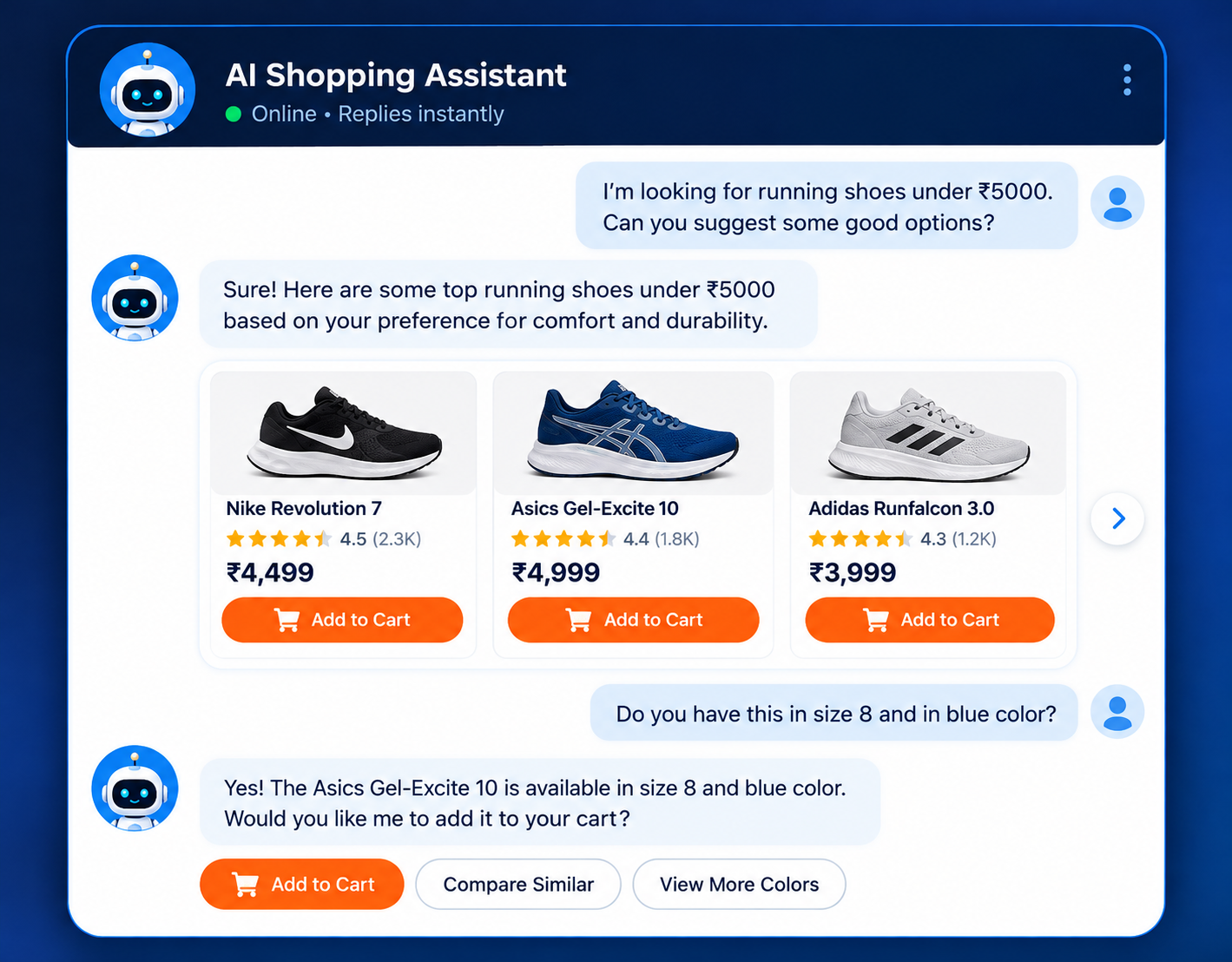
AI shopping assistant chat interface recommending running shoes with prices and ratings, then confirming size and colour availability
Illustrative interface. Products, prices and ratings are sample data, not a live store.

The problem

Is your ecommerce website losing sales because customers cannot get the answers they need?

These are ecommerce experience and operations problems. They need connected data and business-specific AI workflows, not a generic chat widget.

01

Visitors leave without purchasing

Customers cannot find the right product, understand specifications or get immediate answers.

02

Shopping carts remain abandoned

Delivery costs, payment questions and unclear return policies create purchase friction.

03

Customer support teams are overloaded

Staff spend valuable time answering repetitive order, shipping and refund questions.

04

Product and inventory information is disconnected

Customers receive inconsistent information because business systems do not communicate effectively.

05

International customers need better assistance

Different time zones, languages and regional delivery policies make support difficult to scale.

06

Management lacks actionable customer insights

Businesses cannot easily identify why customers hesitate, abandon carts or contact support.

Solving these problems requires intelligent automation, connected data and AI workflows designed around how your store actually operates.

Ecommerce AI chatbot solutions

AI chatbot development solutions built around your ecommerce operations

Each solution below names the customer problem, what the AI does, how it works, what it connects to and the business KPI it should move.

AI Shopping Assistant Development

Problem
Shoppers cannot quickly narrow a large catalog to the right product.
What the AI does
Asks short questions about need and budget, then recommends matching products from the live catalog.
How it works
Language understanding maps the request to catalog attributes, retrieves matching items and explains the trade-offs.
Required integrations
Product catalog or PIM, inventory, storefront search.
Expected business KPI
Assisted conversion rate and product page engagement.

AI Customer Support Chatbot

Problem
Repetitive questions fill the support queue and slow down complex cases.
What the AI does
Answers approved policy and help questions, and routes anything outside scope to a person.
How it works
Intent detection selects approved content, and a rules layer decides when to escalate.
Required integrations
Helpdesk, knowledge base, storefront help content.
Expected business KPI
First response time and cost per resolved query.

AI Product Recommendation Chatbot

Problem
Customers need help choosing between similar products.
What the AI does
Compares products on the attributes that matter to the shopper and explains the difference in plain language.
How it works
Retrieves attribute data for each candidate, ranks options against stated needs and cites the source fields.
Required integrations
PIM, catalog, reviews where available.
Expected business KPI
Add-to-cart rate from chat sessions.

AI Cart Recovery Assistant

Problem
Shoppers leave checkout over one unanswered question.
What the AI does
Answers checkout questions about delivery cost, payment options and return terms at the moment they arise.
How it works
Triggers on checkout events, reads the approved policy for the shopper's region and offers a clear next step.
Required integrations
Checkout events, shipping rules, payment method configuration.
Expected business KPI
Checkout completion rate and cart recovery rate.

AI Order Tracking Chatbot

Problem
Order status is the most common post-purchase question.
What the AI does
Shows current order status, carrier information and expected delivery windows.
How it works
Verifies the customer's identity for the order, reads status from the order management or shipping system and explains delays.
Required integrations
OMS, shipping carrier APIs, customer account verification.
Expected business KPI
Share of tracking queries resolved without an agent.

AI Returns and Refund Assistant

Problem
Return eligibility rules are hard for customers to understand and for staff to apply consistently.
What the AI does
Checks return eligibility against the order date and policy, explains options and starts an approved return request.
How it works
Applies written policy rules, collects required details and routes exceptions to the returns team with a summary.
Required integrations
OMS, returns system, refund status records.
Expected business KPI
Return request handling time and refund status queries.

AI Sales Agent Development

Problem
Pre-sale questions from B2B or high-value buyers wait too long for a response.
What the AI does
Qualifies the enquiry against agreed criteria, answers product questions and books a sales call.
How it works
Captures structured lead data, scores it against your rules and creates a CRM record for the sales team.
Required integrations
CRM, calendar, product catalog.
Expected business KPI
Qualified leads per month and time to first sales response.

Multilingual Ecommerce AI Chatbot

Problem
International shoppers need support in their own language and time zone.
What the AI does
Answers in the languages you have tested for your store, using the same approved content.
How it works
Language detection routes the conversation, and approved translations keep answers consistent across markets.
Required integrations
Localized content, regional shipping and tax rules.
Expected business KPI
Support coverage by market and resolution rate per language.

New to the topic? Read our guide to AI chatbot solutions for ecommerce websites, which covers the shopper questions to automate first, the data each chatbot needs and how to measure results.

AI shopping assistant development

Build an AI shopping assistant that understands what your customers want

A shopping assistant does more than answer product questions. It understands the need, retrieves matching products and checks what is actually available.

  • Natural-language product discovery
  • Product specifications and comparisons
  • Budget-based recommendations
  • Product catalogue search
  • Customer preference understanding
  • Product availability verification
  • Contextual purchase guidance

Example, electronics store (illustrative)

Shopper: I need a laptop under $1,200 for video editing with at least 16GB RAM.

Assistant: I found three matching models in our catalogue. Two have 16GB RAM and a dedicated graphics card within your budget. I compared their processors, storage and display specifications. Two are in stock for delivery this week. Would you like me to show the one with the largest storage first?

In a real deployment the matching, comparison and stock check come from your live catalogue and inventory data.

Customer support automation

Automate ecommerce customer support without losing human oversight

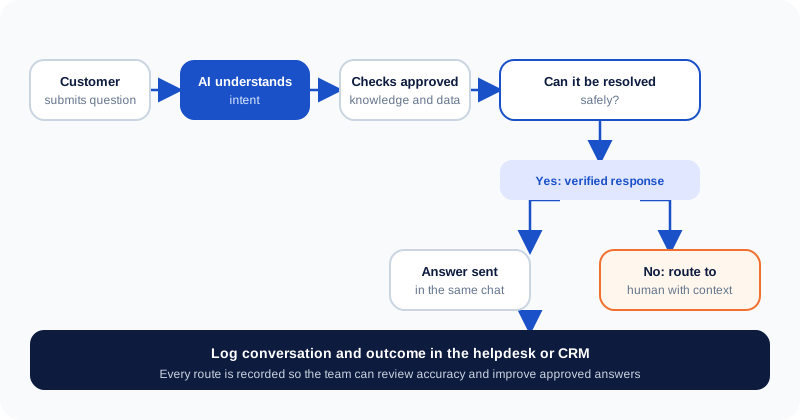
The assistant resolves what it can verify and escalates what it cannot, with the full conversation attached.

  • Order status inquiries
  • Delivery tracking
  • Shipping policy questions
  • Return eligibility
  • Refund status
  • Product troubleshooting
  • Customer account questions
  • Escalation to human support with full context
Support process: customer question, intent detection, check approved knowledge and business data, resolve safely or route to a human with context, then log the outcome
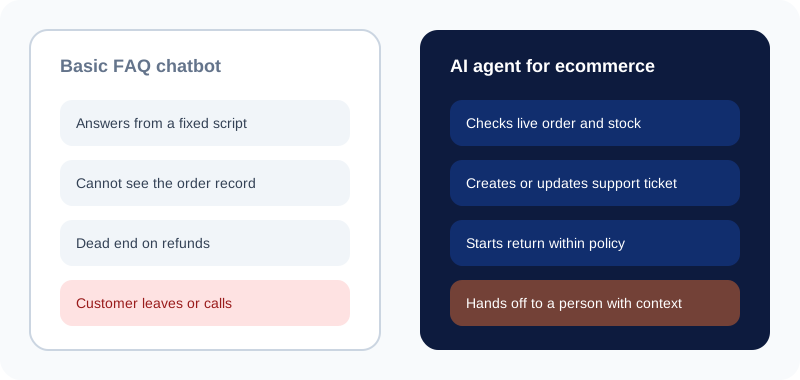
Comparison of a basic FAQ chatbot with an AI agent that checks live orders, updates tickets, starts returns and hands off to a person

AI agent development for ecommerce

Go beyond chatbots with AI agents that execute approved ecommerce workflows

A chatbot answers questions. An AI agent can also complete authorized tasks through your business systems, with rules for what it may do.

  • Retrieve customer order details after identity verification
  • Create a support ticket with the conversation summary
  • Check return eligibility against the policy
  • Initiate an approved return request
  • Update CRM records with the conversation outcome
  • Route a qualified lead to the sales team
  • Trigger an authorized notification

Every agent action runs within defined permissions. Actions with financial or customer impact can require confirmation or human approval, and every step is written to an audit log.

Platform and business integrations

AI chatbot integration with your existing ecommerce platform

Integration feasibility depends on each platform's API availability, your app permissions and your existing software architecture. We confirm these during the architecture stage, before any build begins.

Platforms we integrate with

  • Shopify AI chatbot integration
  • Shopify Plus AI chatbot development
  • WooCommerce AI chatbot integration
  • Magento and Adobe Commerce chatbot integration
  • BigCommerce AI chatbot integration
  • Custom ecommerce website chatbot development
  • Headless commerce AI integration
SystemIntegration purpose
CRMCustomer context and lead management
ERPBusiness and order information
OMSOrder status and order workflows
PIMProduct information management
InventoryReal-time availability
Shipping APIsDelivery tracking
HelpdeskSupport ticket creation and escalation
AnalyticsPerformance measurement
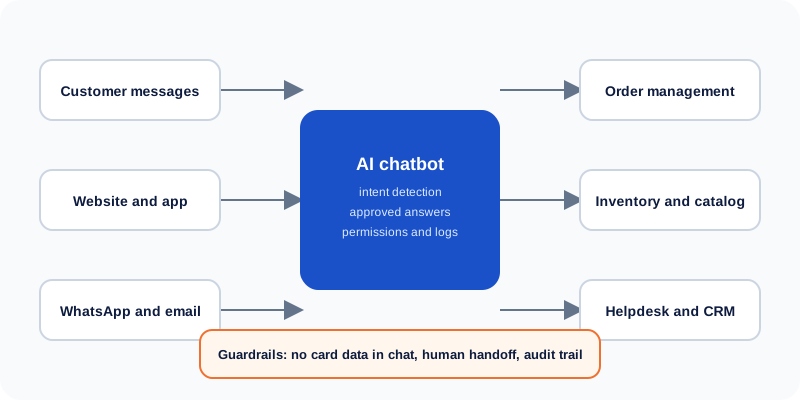
AI chatbot connected to storefront, order management, inventory, helpdesk, CRM and messaging channels, with guardrails

Industry-specific solutions

AI chatbot solutions for different ecommerce industries

Each industry has its own questions. These workflows show where the assistant starts and where a person stays in control.

Fashion and apparel

Problem: Customers struggle with size, fit, colour and product selection.

AI workflow: The assistant retrieves product attributes, guides size selection from approved sizing information and compares available options.

Electronics and consumer technology

Problem: Customers need detailed technical comparisons before buying.

AI workflow: The assistant retrieves specifications, compatibility data and warranty information to support the purchase decision.

Beauty and skincare

Problem: Ingredient, usage and routine questions are frequent and must be answered carefully.

AI workflow: The assistant answers from approved product content, recommends products by stated preference and routes any health or reaction concern to a qualified person.

Furniture and home improvement

Problem: Large-item delivery windows, assembly and room measurements create doubt at checkout.

AI workflow: The assistant checks delivery availability, shares approved assembly guides and collects dimensions for a fit check.

Grocery and online retail

Problem: Delivery slots, substitutions and allergen questions drive support volume.

AI workflow: The assistant shows slot availability, explains the substitution policy and uses verified allergen data, sending allergy concerns to a person.

B2B and wholesale ecommerce

Problem: Buyers need account-specific pricing, reorder help and quote requests.

AI workflow: The assistant checks account terms, supports reorders and captures quote requests into the sales workflow.

AI technology and architecture

Enterprise AI chatbot technology built for ecommerce

These components work together. The language model understands the question, retrieval grounds the answer in approved data, integrations supply live facts, and orchestration decides what the system may do next.

Large language models (LLMs)

Understand varied customer wording and write clear replies.

Retrieval-augmented generation (RAG)

Grounds answers in your approved content and live records, so the chatbot cites a source rather than guessing.

NLP and intent detection

Identifies whether the shopper wants a product, an order, a return or a person.

Vector databases

Store product and policy content as searchable meaning, so related questions find the right passage.

Product catalogue indexing

Keeps product attributes searchable and current, with each field traceable to its source.

API integrations and webhooks

Connect the chatbot to orders, inventory, CRM and helpdesk through approved interfaces.

AI agents and workflow orchestration

Plan multi-step tasks, apply permission rules and wait for approval where required.

Cloud deployment

Run the system on infrastructure that fits your security and scaling needs.

Authentication and access control

Verify customers before showing account data and limit staff access by role.

Monitoring and analytics

Track answer quality, handoffs, failed actions and conversion impact.

Security, privacy and enterprise readiness

Secure AI chatbot development for ecommerce customer data

Encryption or a secure cloud service does not make a chatbot automatically compliant. Compliance depends on what data is collected, why, how long it is kept, who can see it and how customers are told. We review these questions for each project with your legal and security advisers.

  • Customer data protection: collect only what each conversation needs
  • API security: scoped credentials, least-privilege access and rate limits
  • Encryption in transit and at rest for conversation logs and customer records
  • Role-based access for staff who review transcripts or manage content
  • Consent and transparency: customers know they are speaking with an AI system
  • Payment data boundaries: card details never enter the chat; payments stay in secure checkout
  • Data retention rules agreed with the client and applied automatically
  • Audit trails for every automated action
  • Human oversight for refunds, complaints and sensitive cases

Privacy rules to review by market

Summaries for planning. Confirm each obligation with qualified counsel for your business.

United States
State privacy laws apply, including California's CCPA as amended by the CPRA. Payment handling follows PCI DSS requirements through your payment provider.
United Kingdom
UK GDPR and the Data Protection Act 2018 govern personal data, including consent and transparency for AI-powered conversations.
Canada
PIPEDA applies federally, and provincial laws such as Quebec's private-sector privacy law add further obligations.
Australia
The Privacy Act 1988 and the Australian Privacy Principles govern collection, use and disclosure of personal information.
United Arab Emirates
Federal Decree-Law No. 45 of 2021 on personal data protection sets obligations for processing personal data in the UAE.

Development process

Our ecommerce AI chatbot development process

Each phase ends with a tangible deliverable and a decision for your team.

1

Business discovery and workflow assessment

Deliverable: Written workflow map, priority use cases and success metrics.

2

AI solution architecture

Deliverable: Architecture document covering models, data flows, integrations and permissions.

3

Knowledge base and data preparation

Deliverable: Approved content library, catalog data review and an owner for each content area.

4

Chatbot and AI agent development

Deliverable: Working assistant with defined actions, handoff rules and a test set.

5

Ecommerce platform and API integration

Deliverable: Connected systems tested with live sandbox data and documented permissions.

6

Testing, deployment and optimization

Deliverable: Test report, staged launch plan, monitoring dashboard and a monthly optimization review.

Business outcomes and ROI

Measure what your ecommerce AI chatbot actually improves

We agree on a baseline before launch, then measure the same metrics afterward. We do not publish performance promises that are not backed by measured results.

  • Assisted conversion rate
  • Cost per resolved query
  • Customer support workload
  • First response time
  • First-contact resolution
  • Cart recovery
  • Average order value
  • Customer satisfaction
  • AI response accuracy

Net ROI calculation framework

Net return = labour hours saved × loaded staff cost + recovered revenue × margin − (build cost spread over the agreed period + monthly running costs).

  • Labour hours saved come from the change in repetitive ticket volume against the baseline.
  • Recovered revenue comes from measured chat-assisted orders and cart recovery, not estimates.
  • Running costs include model usage, infrastructure, monitoring and content updates.

Why Cor Advance Solutions

Why ecommerce businesses choose us for AI chatbot development

We compete on business problems, technical depth and long-term support, not on unverified claims.

AI and machine learning expertise

Experience across AI and automation work, with more than 100 projects delivered and five years in the field.

AI agent development

Agents with defined permissions, approval steps and audit logs, not only chat widgets.

Enterprise integration experience

Planning around each system's API limits, permissions and architecture before any build.

Data engineering capabilities

Clean, governed product and order data, which determines how accurate the chatbot can be.

Secure AI architecture

Scoped access, payment boundaries, retention rules and human oversight designed in from the start.

Support and optimization

Monitoring, content updates and monthly reviews after launch, as agreed in the support terms.

Client case studies, architecture samples and testimonials will be published only with the client's permission and once they are verified. Until then, we walk you through our method on a discovery call, using examples that are clearly labeled.

Pricing factors

How much does ecommerce AI chatbot development cost?

There is no universal price, because cost follows scope. A project assessment turns your requirements into a written estimate with its assumptions listed.

Request an AI Solution Assessment
  • Basic chatbot versus advanced AI shopping assistant
  • Number and complexity of integrations
  • Catalogue size and data quality
  • LLM and infrastructure usage costs
  • Number of supported channels and languages
  • AI agent capabilities and permissions
  • Data security and governance requirements
  • Maintenance, monitoring and content updates

Frequently asked questions

AI chatbot development for ecommerce: common questions answered

What are AI chatbot development services for ecommerce?+

They are services that design, build, integrate and maintain conversational AI for online stores. The chatbot can recommend products, answer customer questions, track orders, support returns and hand complex cases to staff. Good services connect the chatbot to your existing systems and measure its results.

How much does ecommerce AI chatbot development cost?+

Cost depends on the scope: the type of assistant, the number of integrations, catalogue size, channels, languages and security requirements. We do not publish a fixed price. A project assessment produces a written scope and estimate with its assumptions listed.

How long does it take to build an ecommerce AI chatbot?+

A focused first use case, such as order tracking or product questions, can usually be scoped and tested in phases. Timelines depend on integrations and data readiness, so we set them after the discovery and architecture stages.

Can you develop an AI chatbot for Shopify and WooCommerce?+

Yes, integration is possible where the platform offers the APIs, permissions and extension options we need. We confirm feasibility for your specific store and plan during the architecture stage, because what is possible depends on your platform setup and apps.

Can an ecommerce AI chatbot integrate with CRM and ERP systems?+

It can, through supported APIs, webhooks or approved connectors, within the permissions each system allows. Integration feasibility depends on each system's API availability and your software architecture, which we review before committing to a scope.

Can an AI chatbot recommend products using a live catalogue?+

Yes. The assistant retrieves product attributes from your catalogue or product information system, checks availability where inventory data is connected, and explains recommendations using those fields. It should not recommend products it cannot verify.

Can AI agents automate ecommerce orders and returns?+

AI agents can complete defined steps, such as checking return eligibility and starting an approved return request. Actions that affect money, such as refunds above a set limit, should require approval, and every action should be logged.

What is the difference between an ecommerce chatbot and an AI shopping assistant?+

A chatbot usually answers support questions. An AI shopping assistant also helps customers choose products by understanding their needs, comparing options and checking availability. Many stores start with support and add shopping features later.

Can AI chatbots reduce ecommerce customer support costs?+

They can reduce the volume of repetitive questions that reach human agents, which frees staff for complex cases. The actual effect depends on your question mix, the quality of approved content and how well escalation is designed. We measure it against a baseline.

Is ecommerce chatbot integration secure?+

Security depends on the design: scoped API credentials, encryption, role-based access, payment boundaries, retention rules and audit logs. Encryption alone does not make a system compliant, so we review the design against the privacy rules that apply to your customers.

Can an AI chatbot support international ecommerce customers?+

Yes, for the languages and regions you have tested. Multilingual support uses approved translations, regional shipping and return rules, and local privacy requirements. We confirm the scope for each market before launch.

How do you measure the ROI of an ecommerce AI chatbot?+

We compare a baseline with results after launch, using metrics such as cost per resolved query, first response time, assisted conversion, cart recovery and accuracy. Net return subtracts build and running costs from the measured savings and recovered revenue. Results depend on your starting point.
Ready to build an AI-powered ecommerce experience?

Tell us about your ecommerce platform, your support challenges, the product discovery problems you see, the systems you need to connect, and your security and scalability requirements. We will identify the first use case worth building.

  • Existing ecommerce platform
  • Customer support challenges
  • Product discovery problems
  • Required integrations
  • AI automation opportunities
  • Security and scalability requirements
Get in Touch

Start Your ProjectWith Us

Tell us about your business goals and challenges. Our experts will get back to you within one business day with a free, no-obligation consultation.

  • Expert GuidanceDiscuss your ideas directly with our specialists
  • Tailored SolutionsGet a customized plan for your business
  • Quick ResponseWe reply within 1 business day
  • 100% ConfidentialYour information is always safe with us

100+ Projects Delivered

5+ years expertise

Free Consultation

Let's Discuss Your Project

Fill out the form and our team will get in touch with you shortly.

By submitting this form, you agree to our Privacy Policy. We never share your information.

Free

Consultation

Quick

Response

Dedicated

Support