AI Product Recommendation Chatbot: A Solution Architecture Case Study for Ecommerce
From product browsing to confident buying decisions: how an AI-powered discovery assistant simplifies ecommerce shopping.
This is a solution architecture case study. It describes a proposed implementation and its demonstration flow. It is not a completed client engagement, and it contains no client names or measured results. Example products and conversations are labeled as illustrations.
The problem: customers have plenty of products but struggle to choose
Many ecommerce websites do not lack products. They lack a fast way to choose the right one. Take a customer who wants a laptop for video editing. They need at least 16GB of RAM, a processor suited to editing, 1TB of storage, a budget near $1,000 and fast delivery.
The website has hundreds of laptops with different specifications. The customer applies filters, reads product descriptions, compares specifications one by one and checks reviews. Three problems follow: product discovery takes too long, similar products are hard to tell apart, and some customers leave with no purchase at all.
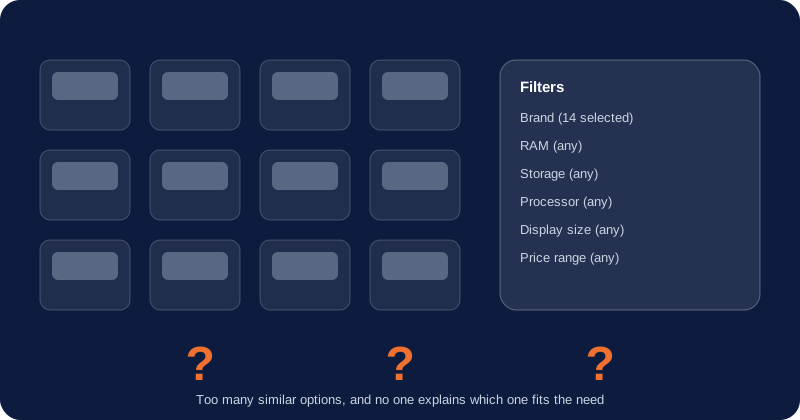
The challenge: customers could not find the right products
| Business problem | Customer impact | Business impact |
|---|---|---|
| Too many similar products | Confusion | Delayed decisions |
| Complex product specifications | Difficulty comparing | More support queries |
| Generic filters | Irrelevant results | Poor discovery experience |
| Unclear product differences | Purchase hesitation | Potential lost sales |
| No guided shopping assistance | Customers browse alone | Missed recommendation opportunities |
Why traditional ecommerce search was not enough
Filters help customers narrow a list, but they do not explain which product best matches a real need. A customer who wants a laptop for travel and video calls does not think in terms of a filter for GPU type. They think in terms of what they will do with the device.
Key insight
Traditional filters narrow the catalogue. A recommendation assistant explains which products fit the customer's actual needs, and why.
Our solution: an AI-powered product discovery assistant
The proposed assistant understands requirements written in plain language, recommends products from the live catalogue and explains the differences between them. It does more than name products. It tells the customer which items match their requirements, how similar products differ, which option fits the budget, which features matter most for the use case, and which product information is verified.
Recommendations come only from the live catalogue, approved product attributes, current prices, inventory and configured business rules. The assistant does not invent specifications or availability.
This is the kind of system our AI chatbot development services for ecommerce are designed to deliver, with the catalogue, integration and handoff work planned before any build starts.
How the AI product recommendation workflow works
This is how a single customer question moves through the system.
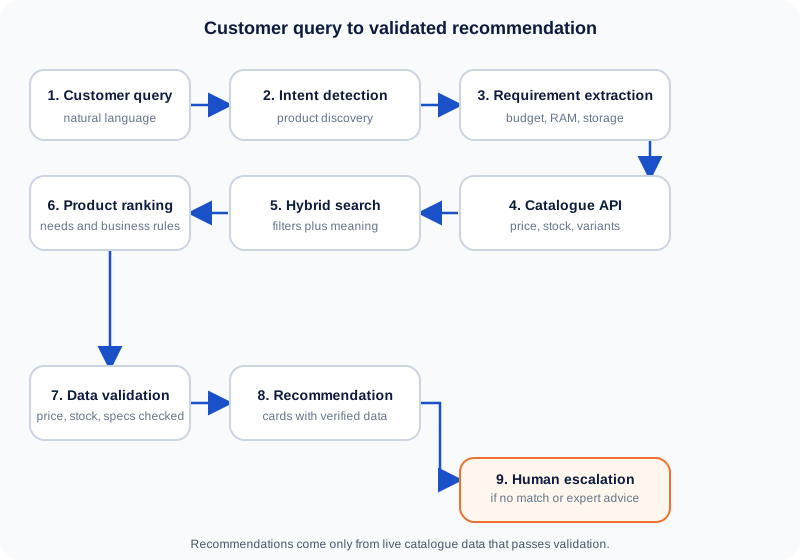
- 1
Customer describes requirements
Example: I need a laptop for video editing under $1,000 with at least 16GB RAM and 1TB storage.
- 2
Intent detection and requirement extraction
The assistant identifies product discovery and extracts the category, primary use, budget, RAM and storage.
- 3
Clarification when needed
If a key requirement is missing, the assistant asks one short question, such as Windows or macOS. It does not ask questions it can already answer.
- 4
Live catalogue search
Structured filters and search terms query the catalogue, checking attributes, current prices, stock status and eligibility rules.
- 5
Product matching and ranking
Products that fail essential requirements are removed. The rest are ranked by relevance, budget fit, intended use and approved ranking rules.
- 6
Verified product comparison
The shortlist is compared using catalogue data. The assistant explains meaningful differences and why each option may suit the customer.
- 7
Recommendation with next steps
The customer sees product cards with verified prices, specifications, stock information where available and product page links.
- 8
Human escalation when needed
If information is incomplete, no match exists or the customer asks for expert advice, the case goes to support or sales with the collected requirements.
Inside the AI recommendation engine
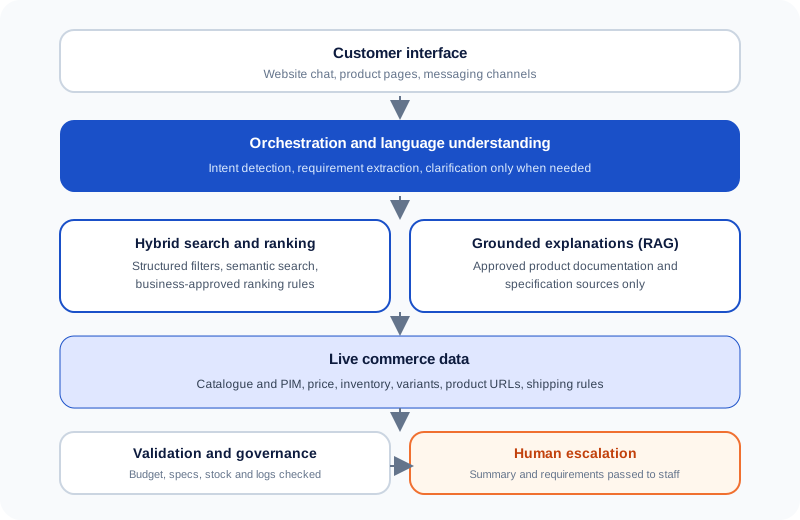
Natural language understanding
The system turns a shopper's words into structured requirements.
| Customer says | The assistant extracts |
|---|---|
| I need a phone for photography | Use case: photography |
| Under $700 | Maximum budget: $700 |
| Good battery life | Battery preference: high |
| At least 256GB | Minimum storage: 256GB |
Product catalogue integration
The assistant connects to actual product data. The fields it uses include:
- Product name, category, brand and model
- Description and technical specifications
- Price, discounts and active status
- Inventory and availability
- Product variants
- Product URL and images
- Approved customer reviews, where integrated
Integration options include Shopify, WooCommerce, Magento or Adobe Commerce, BigCommerce, custom platforms and product information management (PIM) systems. Feasibility depends on each system's APIs and permissions.
Hybrid product search
Product selection should not rely on generative AI alone. A stronger design combines structured filtering for exact attributes such as budget, RAM and storage, semantic search for meaning, ranking rules that reflect customer needs and business priorities, and a language model that explains the results in simple words.
Retrieval-augmented generation (RAG)
RAG grounds explanations in approved product descriptions, specifications, compatibility information and documentation. Rapidly changing data, such as price and stock, should be checked against live commerce sources rather than an older vector database.
Recommendation validation
Before a product is shown, it must pass these checks:
- Is the product within the budget?
- Does it match every mandatory specification?
- Is the product active and purchasable?
- Did the price come from a current source?
- Are variant and stock details correct?
- Is every explanation supported by an actual attribute?
If a product does not meet every mandatory requirement, it is not presented as a perfect match.
How customers discover and compare products
A short conversation shows what the customer experiences. The example below is illustrative.
Customer: I need a laptop for video editing under $1,000.
Assistant: I can help you compare suitable laptops. Do you have any minimum RAM or storage requirements?
Customer: At least 16GB RAM and 1TB SSD.
Assistant: Understood. I will look for laptops within your budget that meet those specifications.
Assistant: All three options match your minimum RAM and storage requirements. Would you like me to compare their processors, display quality and graphics capabilities for video editing?
The value here is not only showing three products. It is explaining the difference between them, so the customer can decide.
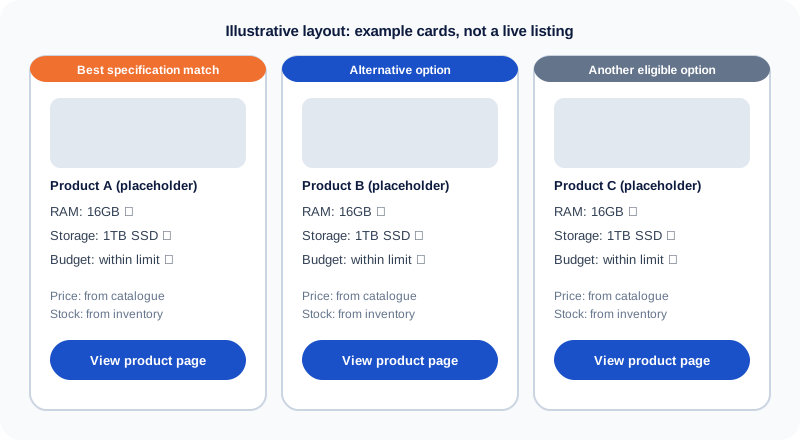
These cards are layout examples. In a production demo, every price, stock status and link comes from the live catalogue.
Connecting AI with live ecommerce product data
The assistant is only as useful as the data behind it. Before launch, the team confirms which fields are complete, which are updated in real time, which variants exist and which attributes are missing or inconsistent. Missing attributes are treated as a data quality task, not something the AI fills in by guessing.
Integration can use APIs, webhooks or approved connectors, within the permissions each system allows. The architecture review confirms the feasibility for each platform before any build begins.
When AI hands the conversation to a human expert
A useful assistant knows when not to decide. It escalates when:
- The requirement is not available in the catalogue
- Product specifications are incomplete or conflicting
- The customer asks for technical compatibility advice
- No product meets the mandatory requirements
- The customer explicitly asks for a human expert
The handoff package gives the human agent everything needed to continue without repeating the conversation:
- The customer's original query
- Extracted requirements
- Products already recommended
- Missing or conflicting information
- The customer's unresolved question
- Conversation history and relevant product links
Security, accuracy and recommendation controls
| Control | Why it matters |
|---|---|
| API authentication | Controlled access to ecommerce systems |
| Role-based permissions | Sensitive operations limited to approved roles |
| Data minimization | Only the customer data the search needs is processed |
| Secure data transmission | Customer and business data protected in transit |
| Catalogue validation | Prevents incorrect product claims |
| Price and stock verification | Avoids outdated information |
| Conversation monitoring | Surfaces poor recommendations for review |
| Human escalation | Expert support for uncertain situations |
Customer information should not be exposed to the AI model unnecessarily. Data retention, consent, vendor access and privacy obligations should be configured for each market where the store operates. Encryption and secure hosting are necessary, but they do not by themselves make a system compliant.
How to measure AI shopping assistant performance
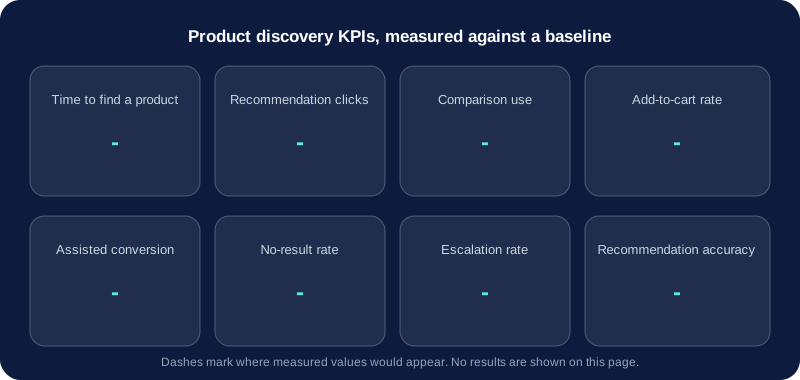
The key question is whether the assistant improved the shopping experience and business results. Measure these KPIs before and after launch, using real analytics and order data.
| KPI | What it measures |
|---|---|
| Product discovery time | Time taken to find a suitable product |
| Recommendation click-through rate | Share of users who open recommended products |
| Product comparison engagement | Share of customers who use the comparison |
| Add-to-cart rate | Share of recommendations added to cart |
| Product page conversion rate | Share of product visitors who purchase |
| Assisted conversion rate | Purchases from AI-assisted sessions |
| No-result rate | Searches where no suitable product was found |
| Human escalation rate | Conversations that needed agent help |
| Recommendation accuracy | Recommended products that meet mandatory criteria |
ROI calculation framework
Incremental revenue = additional orders × average order value
Net ROI (%) = (incremental profit − AI costs) ÷ AI costs × 100
Do not treat every AI-assisted purchase as chatbot-generated revenue. Use a control group, or a comparable period, to estimate the real effect.
What ecommerce businesses can learn from this approach
- Start from the customer's decision, not the chat widget. The question is which product fits the need.
- Keep recommendations tied to verified catalogue data, so the assistant never sells what it cannot deliver.
- Design the handoff before launch, so uncertain cases reach a person with full context.
- Measure discovery time and assisted conversion against a baseline, not only conversation counts.
Build an AI product recommendation chatbot for your store
Turn product browsing into smarter buying decisions
Your customers should not have to scan hundreds of listings to find what they need. We help ecommerce businesses plan AI-powered product discovery, intelligent recommendations, live catalogue integration and conversational shopping experiences.
Cor Advance Solutions · AI & Machine Learning services. Read more about our AI and machine learning services.
Frequently asked questions
How does an AI product recommendation chatbot work for ecommerce websites?
The chatbot turns a shopper's natural-language request into structured requirements such as category, budget and specifications. It searches the live catalogue, removes products that fail essential requirements, ranks the rest and explains the differences using verified product data.
Can an AI chatbot recommend products using live inventory and pricing data?
Yes, when it is connected to your inventory, pricing and catalogue systems through approved APIs. Price and stock should always come from those live sources, not from a stored copy in a vector database.
Can an AI shopping assistant compare multiple products based on customer requirements?
Yes. The assistant compares shortlisted products on the attributes the customer cares about, such as RAM, storage, battery or display, and explains which option fits which use case.
How can an AI product recommendation chatbot integrate with Shopify and WooCommerce?
Integration depends on each platform's APIs, app permissions and your existing setup. We confirm the feasibility for your store during the architecture stage, then connect the catalogue, inventory and checkout data the assistant needs.
Can an ecommerce AI chatbot understand natural-language shopping queries?
Yes. Language models interpret varied wording, such as I need something light for travel under a set budget, and map it to structured search criteria. Uncertain requests trigger a short clarifying question.
How do businesses measure the ROI of an AI product recommendation chatbot?
Compare a baseline with results after launch, using discovery time, click-through, add-to-cart, assisted conversion and escalation rate. Attribution should use a control group or a comparable period, not automatic credit for every purchase.
What happens when an AI chatbot cannot find a suitable product?
It says so clearly, explains which requirement was not met, and offers closest alternatives only if they are verified. If the customer needs more help, the conversation goes to a human with the requirements and products already discussed.