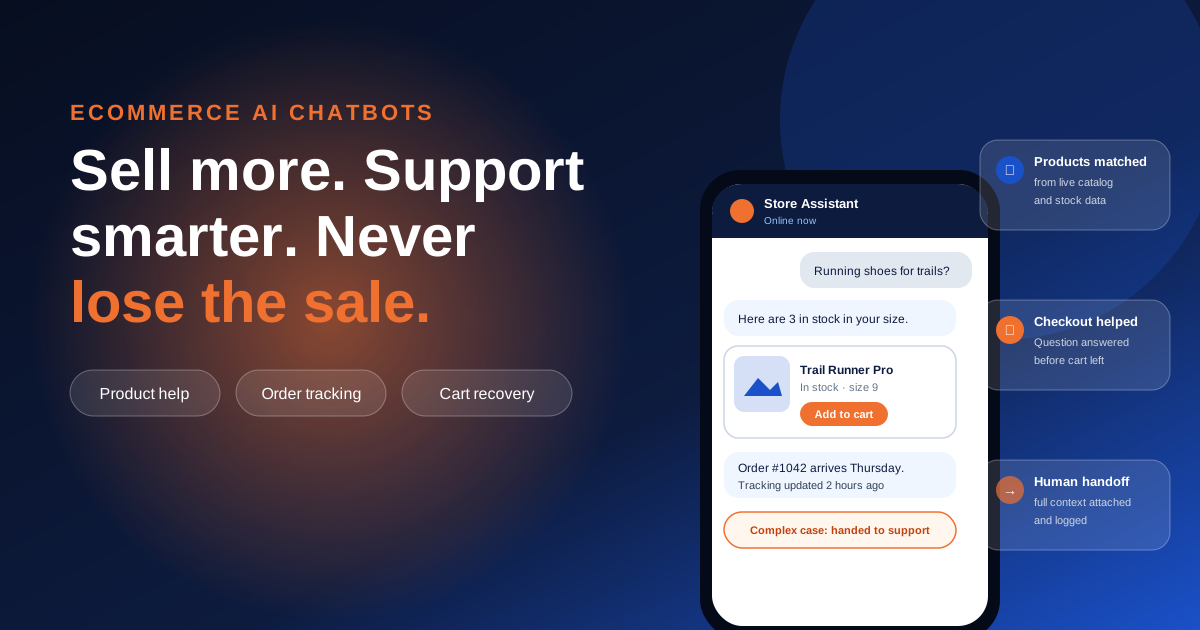
An AI chatbot for an ecommerce website answers shopper questions at any hour, checks real order and stock data, helps customers choose products, recovers abandoned carts and hands complex cases to your team with full context. Done well, it lowers support costs, shortens the path to purchase and keeps customers from leaving while they wait for an answer. Done badly, it repeats generic replies, invents stock levels and frustrates the people it was meant to help.
This guide explains what an ecommerce AI chatbot should do, what the latest data says about shopper behavior in the United States, the United Kingdom, the United Arab Emirates and India, how the technology is built, where it can fail, and how to measure whether it pays off.
What is an AI chatbot for an ecommerce website?
An AI chatbot for an ecommerce website is a conversational assistant that understands a shopper's question, finds the right information in your systems and responds in plain language. Unlike a fixed FAQ widget, an AI chatbot can interpret varied wording, such as "will this jacket fit a wider frame" or "where is my parcel from last Tuesday," and act on the answer. The most useful versions connect to your catalog, inventory, order management and helpdesk, so the reply reflects what is actually true for that shopper.
Why ecommerce businesses are paying attention now
Shopping behavior is changing quickly, and the data is clear enough to plan around.
In the United States, the Pew Research Center reported in June 2026 that 49 per cent of US adults use AI chatbots, up from 33 per cent in 2024. The survey was fielded from 17 to 23 February 2026. Pew notes that the 2024 question was asked only of people who had heard at least a little about chatbots, so part of the rise reflects a change in who was asked. Even with that caveat, the direction is clear: a large share of your customers already expects to talk to software.
In the United Kingdom, the Office for National Statistics reported in July 2026 that about 35 per cent of UK businesses with 10 or more employees used at least one AI technology in June 2026, up from about 12 per cent in September 2023. Usage is growing among merchants too, but the ONS also notes that the average number of AI technologies per business has barely moved, which suggests most firms are still at an early stage.
In the United Arab Emirates, DHL's global E-Commerce Trends Report 2026 found that 51 per cent of UAE online shoppers use AI-powered chat tools while shopping. The survey covered 29,000 online shoppers and 5,800 businesses across 29 countries. A separate report cited by Khaleej Times in June 2026 said 91 per cent of e-commerce businesses have integrated some form of AI into their platforms, although that figure comes from the wider sample rather than UAE firms alone.
In India, Adobe's 2026 AI and Digital Trends Report found that 60 per cent of Indian consumers use AI for instant customer service or support, and 65 per cent use it to search for personalized product recommendations. Adobe also reports that 60 per cent of Indian consumers are interested in creating a personal AI agent, the highest level in Asia Pacific.
Taken together, these numbers say something useful for store owners. Shoppers are already comfortable using AI for discovery and support. The businesses that win will be the ones that give those conversations accurate answers and a clean handoff to people.
The real problem: lost sales and overloaded support teams
Most ecommerce teams do not have one problem. They have four, and they feed each other.
Slow answers cost sales. A shopper who asks whether a product is in stock in their size and waits several hours for a reply has often bought somewhere else. Questions that arrive late at night or on weekends are the most likely to go unanswered.
Repetitive questions drain the team. Order status, delivery windows, return policy, size guidance and payment options make up a large share of most support queues. These are important questions, but they rarely need a senior agent. When they fill the queue, complex complaints wait longer.
Inconsistent answers damage trust. When one agent says a return is allowed and another says it is not, the customer notices. A chatbot that works from one approved source gives the same answer every time, but only if it is built that way.
Abandoned carts go unrecovered. Many shoppers leave because of one unanswered question, such as delivery cost, a sizing doubt or a payment concern. A helpful reply at the right moment can keep them in the funnel.
An ecommerce AI chatbot addresses all four, but only when it is connected to the right data and has clear rules for what it can and cannot do.
What a good ecommerce chatbot does
The most valuable chatbots handle a small number of jobs very well. Here are the use cases that deliver the most value for most stores.
1. Product discovery and guided selling
The chatbot asks two or three short questions, such as what the product is for, the budget and any must-have features, then recommends items from the live catalog. It explains why each item fits, and it shows only products that are in stock and available in the shopper's location.
2. Sizing, fit and product detail questions
Fit questions are one of the biggest sources of pre-sale doubt. The chatbot uses the size guide, past returns data for the product where it is available, and the customer's stated measurements to suggest a size, and it says clearly when it is not certain.
3. Order tracking and delivery questions
Order status is the most common post-purchase question. The chatbot reads the order record, shows the current status and carrier information, and explains the expected delivery window. If the order is delayed, it says so and offers the next step.
4. Returns and exchanges
Returns are a major source of friction. The chatbot checks the order date and the return policy for the item, explains the options, starts the return request where your system allows it, and gives the customer a clear next step. For cases outside policy, it routes the request to the returns team with a summary.
5. Cart recovery and checkout help
When a shopper pauses at checkout, the chatbot can answer the question that is blocking them, such as delivery cost, available payment methods or a discount code's terms. It should never ask for full card details inside the chat.
6. Multilingual and multichannel support
Many stores sell to customers who prefer different languages or messaging apps. A well-built chatbot can answer in the languages you have tested for your use case, and it can work across the website, email and messaging channels your customers actually use. Confirm each channel's rules and approval requirements before you launch on it.
7. Handoff to a person
Some conversations should always reach a human: complaints, damaged items, fraud concerns, legal questions and anything emotional. A good chatbot recognizes these cases early, tells the customer what will happen next, and passes the full conversation to the right agent so the customer does not have to repeat themselves.
Chatbot or AI agent? The difference matters
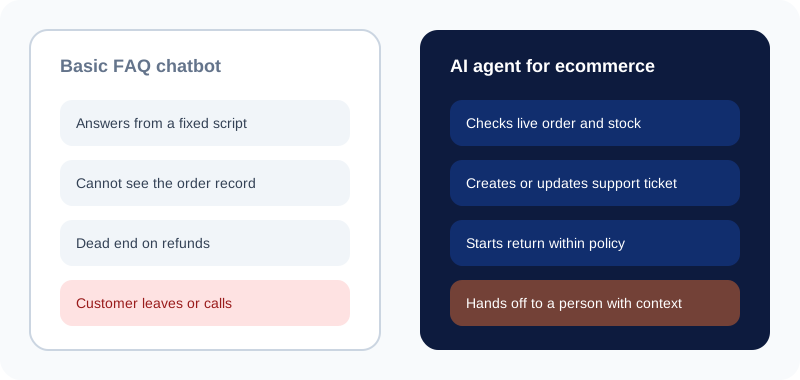
A basic chatbot follows a script. It recognizes a fixed set of questions and returns pre-written answers. That is useful for simple FAQs, but it cannot check an order or start a return.
An AI agent goes further. It understands the goal behind the question, reads live data from your systems, takes permitted actions and records what it did. That is the difference between telling a customer "our returns policy is 30 days" and checking whether their item is still inside the window and starting the return.
The trade-off is design effort. An agent needs clear permissions, approved content, system connections and monitoring. For a small catalog with a short list of questions, a simple chatbot may be enough. For a store with thousands of products, several carriers and a real returns process, an agent usually pays off faster.
How an ecommerce AI chatbot works behind the scenes
The architecture below shows the parts a store needs. Each component can be built in stages, starting with the highest-value use case.
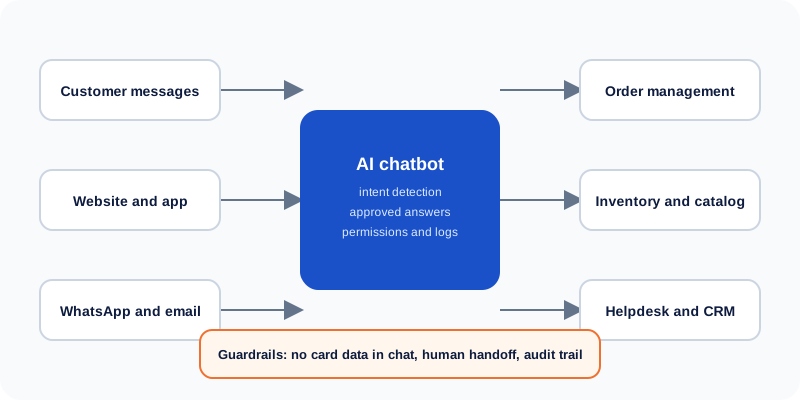
Customer channels. The chatbot runs on your website, app, email or messaging channels, through the vendors you choose.
Language understanding. A language model interprets the shopper's message and identifies the intent, such as order status, sizing or a return.
Approved knowledge. Policies, product information and help content come from a governed source. The chatbot answers from this source and shows where its answer came from.
System connections. Read access to the catalog, inventory, orders and shipping data lets the chatbot answer with facts. Write access, such as starting a return, should be limited to specific actions with clear rules.
Handoff and logging. Every conversation is logged. Cases that need a person are routed to the right queue with a summary.
Monitoring. The team reviews answer quality, failed actions, handoff rates and customer feedback on a regular schedule.
Where ecommerce chatbots fail, and how to prevent it
Most failures are predictable. Here is what goes wrong and what to do about it.
Invented stock or prices. A chatbot that is not connected to live inventory may say an item is available when it is sold out. Prevent this by reading stock and price from the system of record, never from a cached or generated answer.
Wrong policy answers. If the returns policy changes and the chatbot still uses last year's version, customers receive wrong information. Keep one approved policy source and assign an owner who updates it.
Endless loops. A shopper who cannot get a useful answer after two or three tries will leave. Build a rule that offers a handoff when the conversation is not progressing.
Sensitive data in chat. Shoppers sometimes type card numbers or identity details into a chat window. Design the chatbot to refuse these, warn the customer, and avoid storing them.
Tone problems. Overly cheerful replies to an upset customer make things worse. Train the tone rules with examples of complaints and escalate them quickly.
No human path. The most common complaint about automated support is that there is no way to reach a person. Make the handoff visible from every conversation.
Privacy, security and compliance
Customer conversations contain personal information. The rules that apply depend on where your customers live and where your business operates, so confirm them with qualified counsel. Some practical principles apply almost everywhere:
- Collect only the information the task needs.
- Tell customers they are talking to an AI, and explain how their information is used.
- Keep payment card data out of chat. Use your payment provider's secure checkout for any payment step.
- Limit staff access to conversation logs by role, and set a retention period.
- Check vendor contracts for how they store, use and delete conversation data.
For stores that serve customers in India, the Digital Personal Data Protection Act, 2023 and the DPDP Rules, 2025 set obligations on how personal data is collected, used and protected. Our DPDP compliance guide for ecommerce websites covers the practical steps for online stores.
A practical roadmap to launch
A phased launch reduces risk and produces evidence early. The steps below work for most stores.
Step 1: Choose one high-volume question. Order status or sizing questions are good starting points because the answers are measurable and the data is usually available.
Step 2: Map the data sources. List every system the chatbot needs to read, including the catalog, inventory, orders and helpdesk, and note who owns each one.
Step 3: Write the approved answers. Work with customer service and legal to write answers for the chosen questions, and set rules for when the chatbot must hand off.
Step 4: Build and test with real questions. Use real past tickets to test the chatbot. Include difficult, ambiguous and abusive messages.
Step 5: Launch to a small share of traffic. Start with a controlled rollout and watch the transcripts daily for the first few weeks.
Step 6: Expand carefully. Add returns, cart recovery or a second language only after the first use case is stable and measured.
Our AI agent development team designs and builds ecommerce agents with permissions, approval steps and monitoring, and our generative AI services cover the language and retrieval layer behind the chatbot.
How to measure whether the chatbot is working
Set baselines before launch, then compare the same measures afterward. The most useful metrics include:
- First response time for the questions the chatbot handles.
- Share of conversations resolved without a human, with a clear definition of resolved.
- Handoff rate and handoff quality, including whether the human agent had the context they needed.
- Accuracy of answers, checked by sampling transcripts against the approved source.
- Failed actions, such as return requests that did not reach the returns system.
- Conversion from chat, meaning shoppers who asked a question and then purchased.
- Cart recovery rate for shoppers who received a chat answer at checkout.
- Customer satisfaction for chat conversations, measured on the same scale as other support channels.
- Staff time spent on repetitive questions before and after launch.
Report accuracy and handoff quality alongside efficiency. A chatbot that closes conversations quickly but gives wrong answers has not saved money.
What affects the cost
Costs depend on the scope of the project rather than a fixed price. The main factors are:
- The number of channels and languages
- The number and complexity of system connections
- The size and quality of the approved knowledge base
- The actions the chatbot is allowed to take
- The security, privacy and logging requirements
- Testing, monitoring and ongoing content updates
- Usage volume and the underlying model costs
We provide a written scope with the assumptions listed, so you can see how each factor changes the estimate.
Common mistakes to avoid
- Launching everywhere at once. A focused first use case gives you evidence and a cleaner rollout.
- Treating the chatbot as a one-time project. Policies, products and carriers change. The chatbot needs an owner.
- Skipping the handoff. Customers forgive a limit. They rarely forgive being trapped.
- Measuring only deflection. Count accuracy, satisfaction and sales, not just how many conversations were closed.
- Ignoring the data. A chatbot is only as reliable as the catalog, order and policy data behind it.
An illustrative example
This example is hypothetical and does not describe a real client. Imagine a mid-sized fashion store that receives many order-status and sizing questions outside business hours. The team starts with those two use cases. The chatbot reads live order data and the store's size guide, answers from approved content, and hands off delivery complaints to the support team with the order details already attached. The team reviews a sample of transcripts each week, tunes the answers and adds returns only after order status is stable.
The value in this approach is not a single headline number. It is a set of answers that are accurate, consistent and available at any hour, with a clean path to a person when needed.
Industry examples: where chatbots help most
Every store has its own pattern of questions. These examples show where a chatbot usually earns its place, and where a person should stay in control.
Fashion and apparel. Sizing, fit, color availability and exchanges dominate the queue. A chatbot that reads the size guide and the store's approved fit notes can answer most of these questions in seconds. Exchanges within policy can be started automatically, while fit complaints after wear go to a stylist or returns team.
Electronics. Shoppers ask about compatibility, warranty status, delivery of a specific model and the difference between two similar products. The chatbot can compare specifications from the catalog, check warranty dates from the order record and explain the setup steps from approved manuals. Technical faults that need diagnosis should reach a support engineer.
Beauty and personal care. Product usage, ingredient questions and sample requests are common. The chatbot should answer only from approved product content and avoid giving medical or skin-condition advice. Any message that describes a reaction or a health concern should be routed to a qualified person at once.
Home and furniture. Large items raise delivery questions: which days are available, whether a team will carry the item upstairs, and how assembly works. The chatbot can show delivery windows from the logistics system and share approved assembly guides. Damaged-on-arrival claims should go straight to a human with photos attached.
Grocery and everyday goods. Delivery slots, substitution rules and order changes drive most questions. Allergen information must come from verified product data, never from a general answer. Allergy concerns should always reach a person.
Chatbot, live chat or email? Choosing the right channel
A chatbot does not replace every channel. The right mix depends on what your customers ask and how quickly they expect an answer.
| Channel | Best for | Main limit | Typical speed |
|---|---|---|---|
| AI chatbot | Repetitive, data-driven questions at any hour | Needs approved data and clear handoff rules | Instant |
| Live chat with agents | Complex, emotional or high-value conversations | Staff must be available during opening hours | Minutes, when agents are online |
| Detailed requests and documentation | Customers expect faster replies than email gives | Hours to days |
Most stores get the best results by using the chatbot as the first responder on every channel, then handing off to live chat or email when the case needs judgment. The handoff should carry the full conversation so the customer never repeats their question.
Questions to ask any chatbot vendor
Before you choose a vendor or an in-house build, ask these questions and check the answers in a demonstration with your own data:
- Can the chatbot read live stock and order status from our systems, and how often is that data refreshed?
- Where does the approved answer library live, and who can change it?
- What happens when the chatbot is unsure? Show us the handoff in action.
- Can it start a return or exchange, and what checks does it run first?
- How are conversation logs stored, how long are they kept, and who can read them?
- Does the vendor use our customer conversations to train models for other clients?
- What reports will we receive about accuracy, handoffs and failed actions?
- What does a typical change to the approved answers take, and who approves it?
Vendors that answer these questions clearly, with examples, are usually easier to work with over the long term.
Integration checklist before launch
Use this list to confirm the chatbot is ready for real shoppers:
- Catalog, price and stock data are connected and tested with real products
- Order status comes from the system of record, with a fallback when the connection fails
- Returns and exchange rules are written down, approved and tested with edge cases
- The handoff queue has named owners and response times
- Payment steps stay in the secure checkout, and the chatbot refuses card data
- Privacy notices explain that the shopper is talking to an AI and how their data is used
- Monitoring alerts the team when failure rates or complaints rise
- Staff know how to correct a wrong answer and where to report it
Frequently asked questions
What is an AI chatbot for an ecommerce website? It is a conversational assistant that understands a shopper's question, reads information from your store systems and replies in plain language. The most useful versions can check orders, recommend products and start returns within clear rules.
How is an AI chatbot different from a basic FAQ bot? A basic FAQ bot returns pre-written answers to a fixed list of questions. An AI chatbot interprets varied wording, reads live data and, when permitted, takes actions such as starting a return.
Can an ecommerce chatbot check real-time stock and order status? Yes, if it is connected to your inventory, order management and shipping systems with the right permissions. Without those connections, it should not state stock levels or delivery status.
Will an AI chatbot replace my customer service team? It is more accurate to say it takes over repetitive questions so your team can focus on complex cases. Complaints, damaged goods and sensitive situations should always reach a person.
How long does it take to launch an ecommerce chatbot? It depends on the number of systems, the quality of the data and the approvals required. A focused first use case can usually be scoped and tested in phases. We set timelines after reviewing your systems.
Is it safe to let a chatbot handle customer data? It can be, if the design limits data collection, restricts system access, keeps payment details out of chat, logs activity and follows the privacy rules that apply to your customers. Review the design with qualified legal and security advisers.
What metrics should I track for an ecommerce chatbot? Track first response time, resolution without a human, handoff quality, answer accuracy, failed actions, chat-assisted conversions, cart recovery, customer satisfaction and staff time saved, all compared against a baseline.
Which ecommerce questions should a chatbot handle first? Order status, delivery windows, return policy, sizing and product availability are common starting points, because the answers are repetitive and the data is usually available.
Start with the questions that cost you the most
An ecommerce AI chatbot works when it is built around your real customer questions, connected to accurate data and designed with a clear path to a person. The shoppers in the United States, the United Kingdom, the United Arab Emirates and India already expect quick, helpful answers. The stores that meet that expectation will keep more customers and free their teams for the work that needs human judgment.
Our AI chatbot development services for ecommerce cover this work end to end. If you want to see where a chatbot would help most in your store, contact our team for a short discovery call. We will review your top support questions, your systems and your handoff rules, and we will tell you honestly which use case to start with.