How AI-Powered Demand Forecasting Helps Manufacturers Reduce Excess Inventory Without Increasing Stockout Risk
Learn how machine learning demand forecasting eliminates the guess-work from inventory planning, reduces waste, and keeps you in stock when customers need you.
A manufacturing manager stares at two problems. The warehouse is full of products that aren't selling—inventory that costs money to store and will likely become obsolete. At the same time, a customer calls asking for a product that's out of stock. The company just lost a sale. The customer is frustrated. The manufacturing team feels the pressure from both directions.
This is the eternal inventory dilemma: hold too much and waste money. Hold too little and lose sales. Most manufacturers guess. They use spreadsheets and intuition. They look at last year's sales and assume this year will be similar. When demand changes unexpectedly—and it always does—they scramble. They rush orders. They miss shipments. They disappoint customers.
AI-powered demand forecasting changes this equation. Instead of guessing, machine learning models analyze your actual sales patterns, recognize trends, understand seasonality, and predict what customers will buy next month with remarkable accuracy. The result: manufacturers can reduce excess inventory by 15-25% while simultaneously reducing stockouts by 30-50%. You hold exactly what you need—not more, not less. Your cash isn't tied up in excess stock. Your customers get what they want when they want it. This is the power of AI-powered demand forecasting for manufacturing.
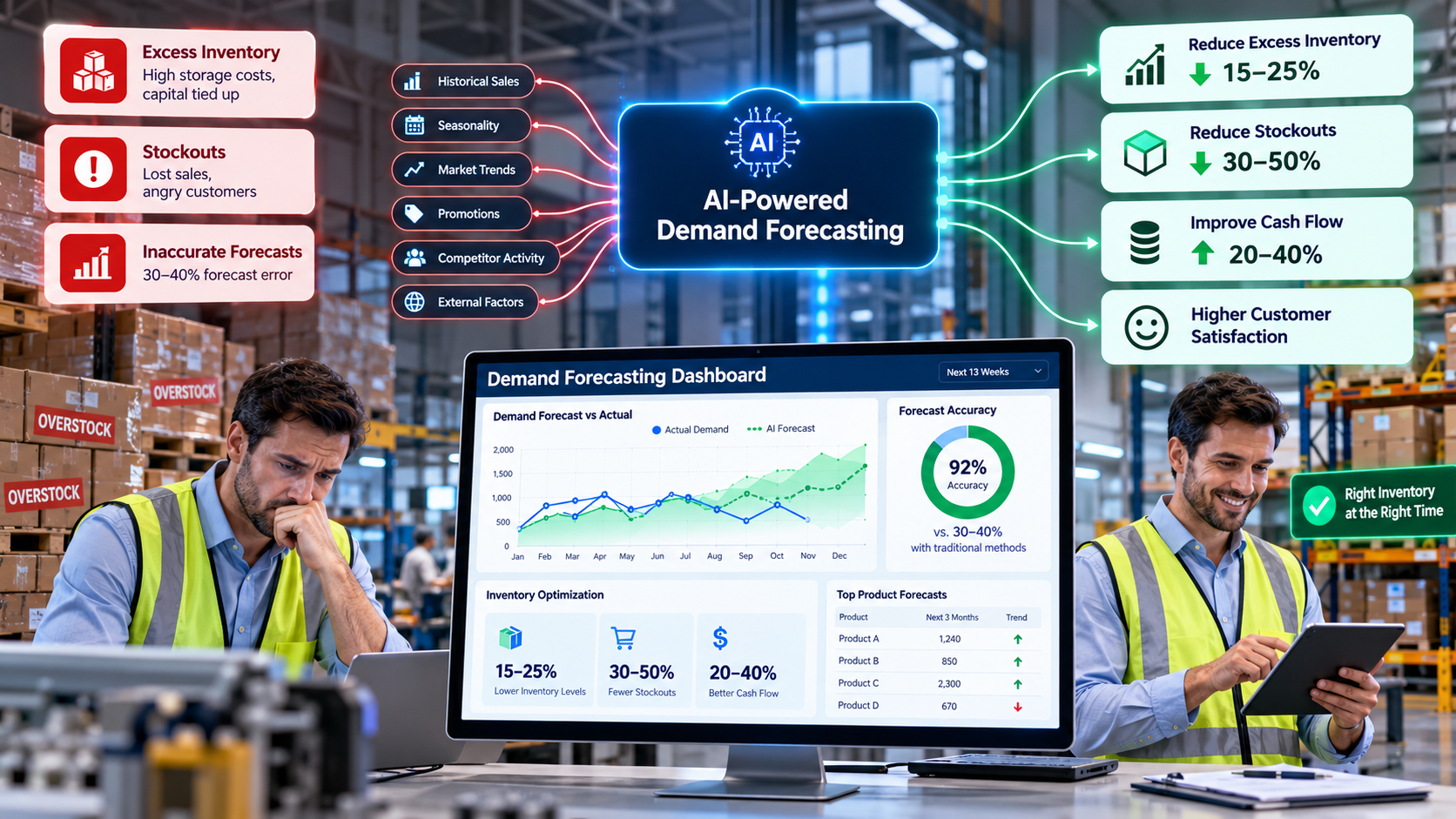
The Inventory Paradox: Why Manufacturers Can't Win
Excess Inventory Destroys Profitability
Excess inventory is like carrying extra weight. It slows you down. Every unit you make and don't sell costs money. Storage space costs money. Handling costs money. Insurance costs money. Obsolescence—when products become outdated or unsellable—costs money.
Consider a mid-size manufacturer with $10 million in annual inventory. If they're carrying 20% excess inventory (which is typical), that's $2 million tied up in stock that won't sell. Storage costs might be 25% of inventory value annually—that's $500,000 per year just to keep excess stock sitting in a warehouse. When 10% of that excess inventory becomes obsolete, that's another $200,000 loss.
Stockouts Cost Even More Than Excess Inventory
But holding too little inventory is worse. A customer wants to buy and you can't fulfill the order. That's a lost sale. But the damage goes deeper. The customer is frustrated. They remember this failure. They might buy from a competitor next time. They might tell other customers about the bad experience. One stockout can cost multiple future sales.
Research shows that a single stockout costs manufacturers 2-3x the profit from a single sale. If you miss a $1,000 sale due to stockout, the real cost isn't $1,000—it's $2,000-$3,000 when you factor in lost customer trust and potential lost future sales.
Traditional Forecasting Creates Uncertainty
Traditional demand forecasting relies on intuition, historical averages, and spreadsheets. A manager looks at last year and says "we sold 1,000 units, so we should order 1,000 units." This approach ignores that demand is constantly changing. Market conditions shift. Competition changes. Customer preferences evolve. Seasonal patterns vary.
Most manufacturers operate with 30-40% forecast error. This means if they forecast selling 1,000 units, actual demand is typically between 600 and 1,400 units. That wide range forces them to keep safety stock (extra inventory) to protect against the downside risk. Safety stock itself costs money. And even with safety stock, they still have stockouts.
What Is AI-Powered Demand Forecasting?
Definition: Machine Learning Discovers What Humans Miss
AI-powered demand forecasting is machine learning software that analyzes your historical sales data, identifies patterns, and predicts future demand with high accuracy. Unlike traditional forecasting (which uses averages), AI recognizes complex patterns that humans miss.
The AI learns that certain products sell more in spring than winter. It learns that sales spike around holidays. It learns that when you run a promotion, demand increases not just during the promotion but for several weeks afterward. It learns that when a competitor launches a new product, your sales of similar products decline. It learns hundreds of patterns and uses those patterns to predict what customers will buy.
How AI Demand Forecasting Works
Step 1: Data Collection
The AI system connects to your ERP, sales database, and operational systems. It pulls in years of historical sales data showing what was sold, when it was sold, and how much was sold. The more data, the better the model.
Step 2: Pattern Recognition
Machine learning algorithms analyze the data and identify patterns. Seasonal patterns. Day-of-week patterns. Holiday patterns. Promotional patterns. Competitor activity patterns. External event patterns. The AI identifies correlations that human analysts would take months to discover.
Step 3: Model Training
The AI uses 80% of historical data to train the model, and tests it on the remaining 20% to verify accuracy. The model learns which patterns are most predictive of future demand. It adjusts its internal parameters thousands of times to find the best combination that predicts actual sales accurately.
Step 4: Continuous Prediction
Once trained, the model makes predictions for future periods. Usually daily or weekly forecasts for the next 13 weeks. As new sales data comes in, the model updates continuously, becoming more accurate over time.
Why AI Demand Forecasting Works So Well
85-95% Forecast Accuracy Instead of 60-70%
Traditional forecasting achieves 60-70% accuracy. This means forecast error is 30-40%. AI achieves 85-95% accuracy, with forecast error of just 5-15%. According to McKinsey research on demand forecasting, companies using AI forecasting see 20-30% improvement in forecast accuracy compared to traditional methods.
This accuracy improvement has cascading benefits. More accurate forecasts mean you need less safety stock. Less safety stock means less excess inventory. Less excess inventory means lower carrying costs and less obsolescence risk.
15-25% Reduction in Excess Inventory
With better forecasts, you don't need to hold as much safety stock. Most manufacturers using AI forecasting reduce excess inventory by 15-25% within the first year. This frees up warehouse space, reduces carrying costs, and eliminates obsolescence risk.
30-50% Reduction in Stockout Frequency
Paradoxically, while reducing inventory, AI forecasting actually increases product availability. Stockout frequency decreases by 30-50% because the AI places orders based on predicted demand, not guesses. You have the right product in stock more often.
Real-Time Adjustments to Changing Conditions
AI forecasting updates daily. If a sudden trend appears, the model recognizes it quickly. If demand shifts unexpectedly, the forecast adjusts. Traditional forecasting is static—you plan once per month or quarter. AI forecasting is dynamic—it adapts continuously.
Better Planning for Seasonality
Products with strong seasonal demand are difficult to forecast manually. Demand changes dramatically between seasons. AI models trained on multiple years of seasonal data predict seasonal swings accurately. This lets you increase production before the high season and reduce it before the slow season.
AI Demand Forecasting in Action: Real Example
Consider a manufacturer that makes industrial fasteners. They have 500 SKUs (different products). Demand varies by season, by customer, by product type. Traditional forecasting treated each SKU independently. The forecast was crude: "SKU A sold an average of 1,000 units per month, so order 1,000 units."
The AI model learned much more. It discovered that SKU A sales follow a weekly pattern (higher on Mondays, lower on Fridays). It learned that sales spike in January and March. It learned that when the company runs a promotion on SKU B (a complementary product), SKU A sales increase 15%. It learned that when steel prices rise, customers buy more fasteners (worried about future price increases).
With these insights, the AI forecasts not "1,000 units," but "900 units next week, 1,100 units week after, 1,200 units in January." This precision lets the manufacturer plan better. They produce the right quantities at the right times. They reduce inventory by 18% while improving on-time delivery from 92% to 97%.
How to Implement AI Demand Forecasting
Phase 1: Assessment (2-4 weeks)
Understand your current forecasting process. What data do you have? How far back? How accurate are your current forecasts? What are your biggest challenges? Define success metrics: what does success look like for your business?
Phase 2: Data Preparation (3-6 weeks)
Most time in AI projects goes to data preparation. Historical sales data needs to be clean, complete, and consistent. External data (promotions, pricing, holidays, events) needs to be collected and organized. Poor data quality is the #1 reason AI forecasting projects fail.
Phase 3: Model Building (4-8 weeks)
Data scientists build the forecasting model. They try different algorithms, test accuracy, and optimize performance. They validate the model on historical data to ensure it would have predicted well in the past.
Phase 4: Pilot Testing (4-6 weeks)
Deploy the model in a pilot with a subset of products or locations. Generate forecasts and compare them to traditional forecasts. Monitor accuracy. Gather feedback from planners and procurement staff. Make adjustments.
Phase 5: Full Rollout (2-4 weeks)
Once the pilot proves the model works, expand to all products and locations. Train staff on using the forecasts. Update procurement processes to use AI forecasts instead of manual methods.
Best Practices for AI Demand Forecasting Success
Start With Good Historical Data
AI models need data to learn from. Ideally 2-3 years of historical sales data. If you don't have good data, you'll get poor forecasts. Clean your data before starting. Remove errors. Fill gaps.
Include External Data
The best forecasts use both internal data (your sales history) and external data (promotions, pricing, competitor activity, weather, economic conditions). The more data the model has, the better it learns.
Collaborate Between Teams
Supply chain automation only works when teams collaborate. The sales team has insights about customer demand. The procurement team has supplier information. The planning team understands constraints. Get everyone involved in the implementation.
Blend AI Forecasts With Human Judgment
AI forecasts should inform human decisions, not replace them. If the sales team knows a major customer is about to place a large order, that information should adjust the forecast. If you know a product is being discontinued, that should be factored in. Best results come from AI + human judgment.
Monitor and Update Continuously
Don't deploy and forget. Monitor forecast accuracy weekly. Look for patterns where forecasts are consistently off. Retrain the model monthly with new data. Update the model when business conditions change significantly.
ROI and Financial Impact
Investment: AI demand forecasting typically costs $200K-$400K to implement, including software, data preparation, model building, and training.
Year 1 Benefits:
- Excess inventory reduction (15-25%): $300K-$500K savings
- Reduced carrying costs: $100K-$200K savings
- Fewer stockouts (better customer service): $200K-$400K revenue gain
- Reduced safety stock: $150K-$300K freed up cash
Total Year 1 Impact: $750K-$1.4M
Payback Period: 3-6 months
Year 2 and beyond, benefits repeat without additional investment. The ROI compounds as you optimize processes around the forecasts.
Frequently Asked Questions About AI Demand Forecasting
How accurate is AI demand forecasting?
AI demand forecasting typically achieves 85-95% accuracy when trained on good historical data. Accuracy varies by product type and seasonality. Products with consistent demand patterns are easier to forecast than products with highly variable demand. According to Gartner supply chain research, AI forecasting outperforms traditional methods by 20-35%.
Can AI forecasting handle seasonal products?
Yes. AI models specifically trained to recognize seasonal patterns can forecast seasonal products well. The key is having at least 2-3 years of historical data showing the seasonal pattern. The AI learns when demand typically peaks and valleys, then applies those patterns to future predictions.
How long does it take to implement AI forecasting?
Most AI forecasting implementations take 3-6 months from start to full deployment. The timeline includes data preparation (often the longest phase), model training, testing, and staff training. Quick pilots can be live in 4-8 weeks.
What data do we need for AI demand forecasting?
At minimum: historical sales data (2-3 years), product information, and seasonality patterns. Better results come from also including marketing spend, pricing changes, competitor activity, and external events that affect demand. The more comprehensive your data, the better the forecasts.
Can AI forecasting prevent all stockouts?
No. AI can reduce stockouts by 30-50% through better forecasting, but some stockouts are unavoidable due to unexpected demand spikes or supply disruptions. The goal is to prevent the stockouts that bad forecasting causes.
How much can we save with AI demand forecasting?
Manufacturers typically see 15-25% reduction in excess inventory, 20-30% improvement in forecast accuracy, and 10-20% reduction in carrying costs. These savings often pay for the AI system in 6-12 months, with benefits recurring indefinitely.
The Future of Manufacturing: Data-Driven Decisions
The manufacturing industry is transforming. Companies that still use spreadsheets and intuition for demand planning are falling behind. Companies using AI demand forecasting are running more efficient operations, serving customers better, and making more profit.
The choice is becoming clear: forecast smarter or lose competitive advantage. AI demand forecasting isn't just about reducing inventory or preventing stockouts. It's about running your business smarter. It's about making decisions based on data, not guesses. It's about understanding your market better than ever before.
If your manufacturing company is still fighting the excess inventory vs. stockout dilemma, it's time to explore AI demand forecasting. The technology is proven. The ROI is clear. The implementation is manageable. The only question is: when will you start?
Ready to Forecast Smarter?
Our AI demand forecasting experts help manufacturers implement machine learning forecasting that reduces inventory and prevents stockouts. Let's discuss how AI can improve your demand planning.
Schedule Free Consultation