Data & Analytics
Data Analytics for E-commerce: Increase Conversions with Real-Time Insights
18 min read
Walk into the data team of almost any retail or e-commerce company today and you'll hear the same complaint: "Our warehouse can't keep up." Reports that used to take minutes now take hours. Inventory numbers on the dashboard don't match what's actually on the shelf. Marketing wants real-time customer behavior data, but the pipeline only refreshes overnight.
This isn't a one-off IT problem. It's a structural issue with how traditional data warehouses were designed — and it's the reason a growing number of retail companies are replacing them with unified data platforms built on lakehouse architecture, data mesh principles, and zero-ETL integration.
In this guide, we'll break down exactly why this shift is happening, what a unified data platform actually looks like, and how retailers are using it to cut costs, speed up decisions, and personalize the customer experience at scale.
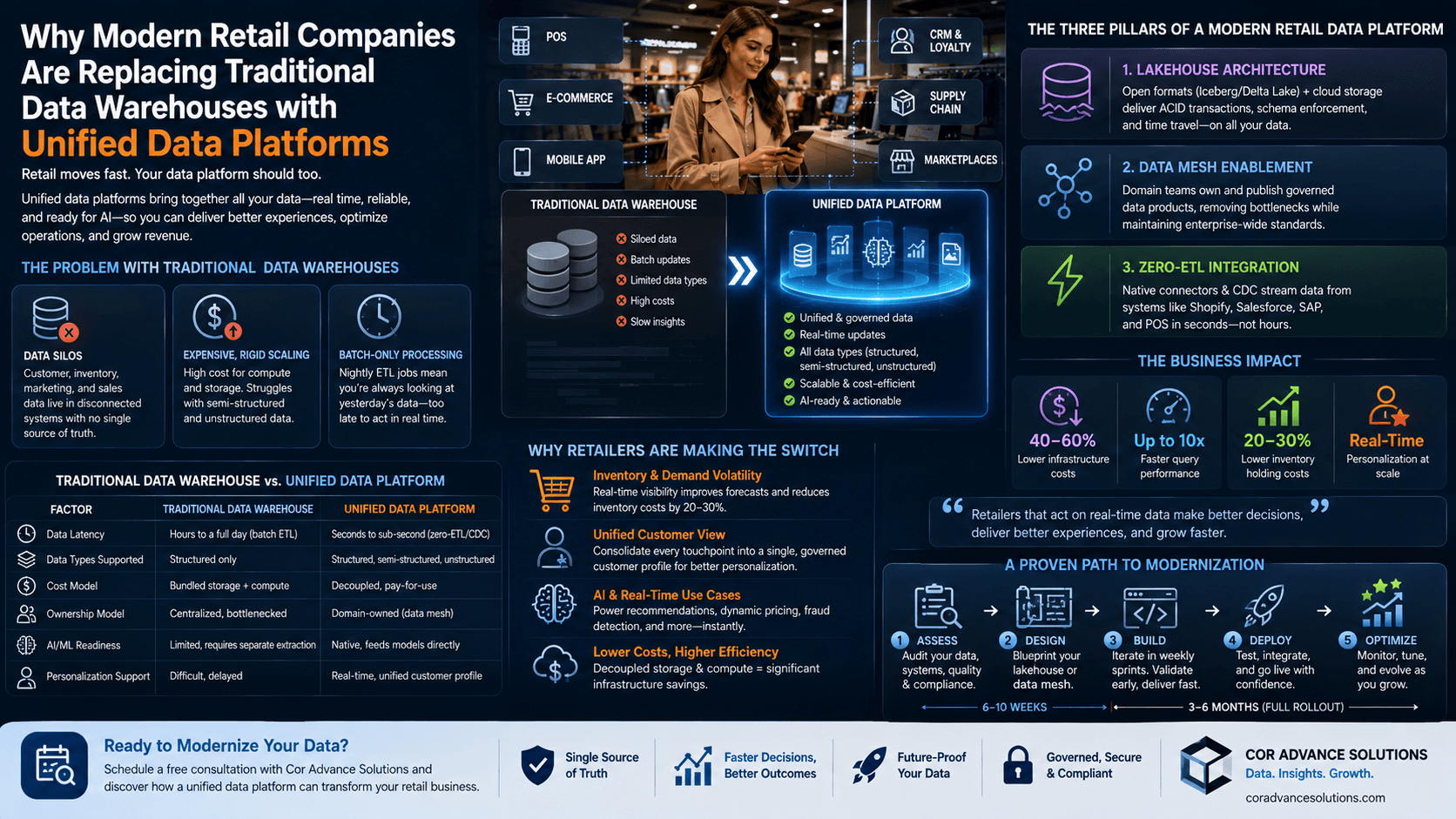
A traditional data warehouse stores structured, pre-processed data optimized for SQL reporting. For decades, this model worked well enough for retailers running batch reports once a day. But modern retail doesn't operate in batches anymore — it operates in real time, across dozens of systems: point-of-sale, e-commerce platforms, mobile apps, CRM, marketing automation, supply chain, and third-party marketplaces.
That creates three compounding problems for legacy warehouses:
Every system stores data in its own format, in its own location, updated on its own schedule. Customer behavior lives in one place, inventory in another, and marketing spend in a third — with no single source of truth connecting them.
Traditional warehouses charge a premium for compute and storage bundled together, and struggle to handle the semi-structured and unstructured data (clickstreams, images, reviews, IoT signals) that modern retail generates.
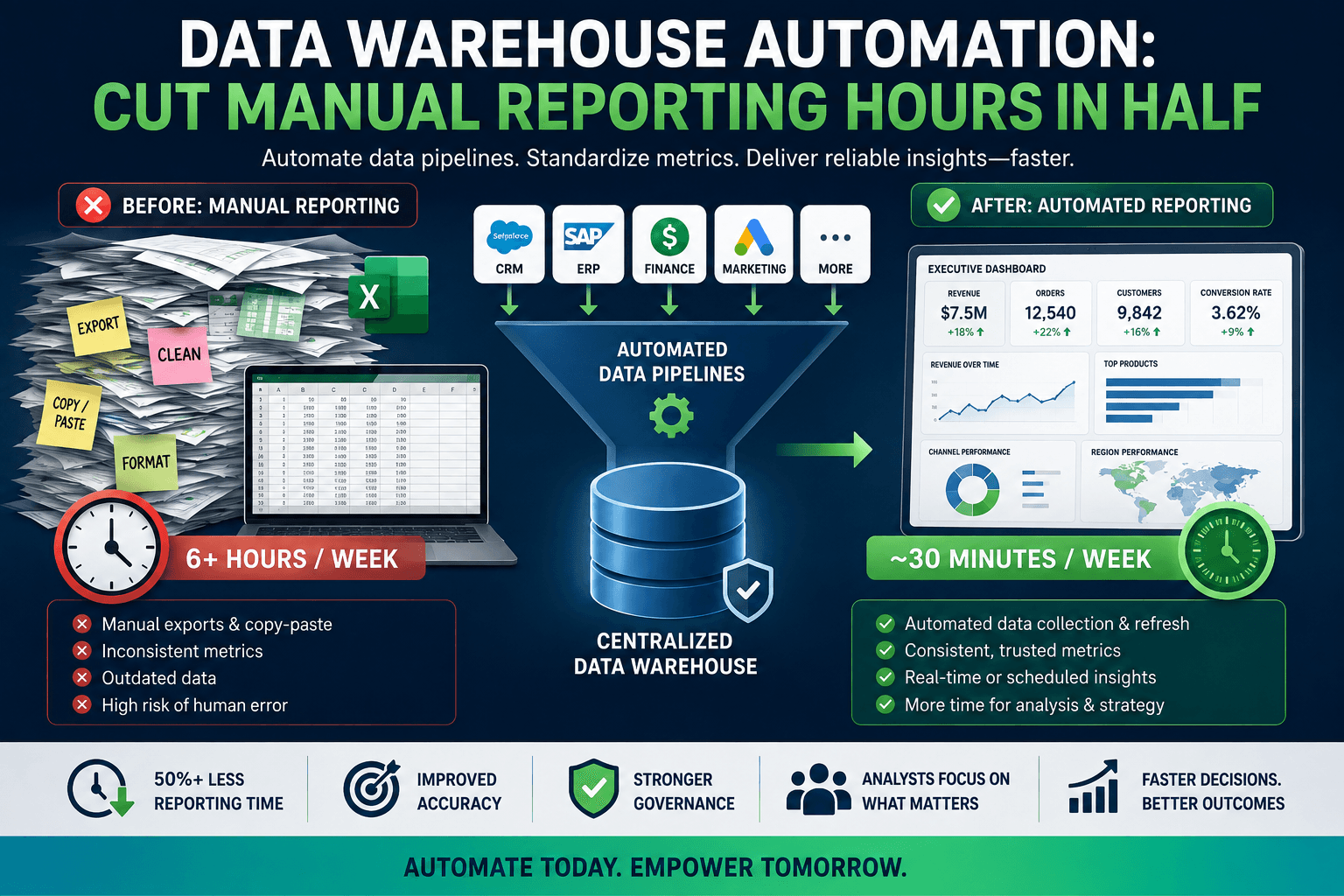
Nightly ETL jobs mean decision-makers are often looking at yesterday's data — a serious liability during flash sales, inventory shortages, or fraud spikes.
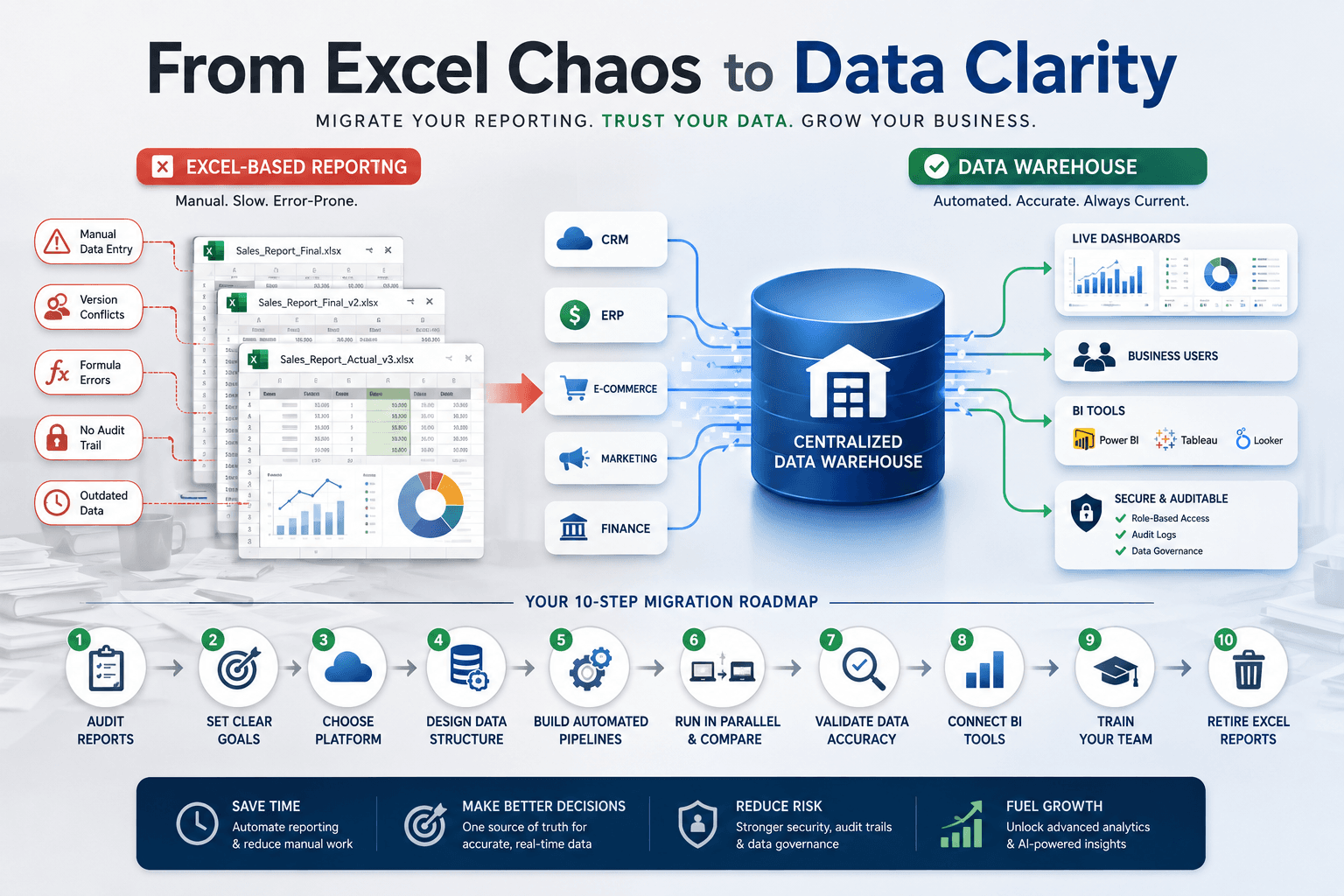
A unified data platform solves these problems by combining the flexibility of a data lake with the performance and governance of a data warehouse — commonly known as a lakehouse architecture — and layering in real-time integration so data doesn't have to wait for a nightly batch job to become useful.
Instead of dozens of disconnected systems feeding disconnected reports, a unified platform gives retailers one governed, real-time source of truth that powers dashboards, AI models, and customer-facing personalization simultaneously.
Cor Advance Solutions' Data Warehousing & Analytics practice is built specifically around this shift — helping retail and e-commerce businesses move from fragmented legacy warehouses to governed, cloud-native lakehouse platforms without the multi-year enterprise transformation timeline that used to be required.
By combining open table formats like Apache Iceberg or Delta Lake with cloud object storage, retailers get ACID transactions, schema enforcement, and time-travel queries on raw data — without maintaining separate storage tiers for "warehouse data" and "lake data." The result is a single platform that supports both historical reporting and real-time operational analytics.
Instead of funneling every data request through a central, overloaded data team, data mesh lets individual domains (merchandising, marketing, supply chain, customer experience) own and publish their own governed data products. This removes the bottleneck that slows down most large retail organizations while preserving enterprise-wide standards and discoverability.
Rather than building and maintaining brittle extract-transform-load pipelines, zero-ETL uses native integrations and change data capture (CDC) to stream data from source systems — Shopify, Salesforce, SAP, POS systems — directly into the analytics layer in seconds instead of hours. This alone eliminates one of the most common causes of stale or broken dashboards.
Retail and e-commerce have a few characteristics that make legacy warehouses especially painful — and unified platforms especially valuable.
Seasonal spikes, viral products, and supply chain disruptions mean that yesterday's data is often not good enough. Retailers running AI-driven demand forecasting need near real-time visibility into sales velocity, stock levels, and external signals like promotions or weather. Cor Advance Solutions' work in the e-commerce & retail industry practice has shown that pairing a unified data platform with demand forecasting models can reduce inventory holding costs by 20–30%, simply because the forecasting engine is working from current data instead of a stale nightly snapshot. See how one e-commerce retailer cut inventory holding costs by 28% with AI-driven demand forecasting for a real-world example of this in practice.
A single customer might interact with a retail brand through a mobile app, a website, an email campaign, a loyalty program, and an in-store POS terminal — and in a legacy warehouse, each of those touchpoints often lives in a different system with no shared identifier. A unified data platform consolidates these into a single governed customer profile, enabling accurate attribution, lifetime value modeling, and the kind of real-time personalization that today's shoppers expect.
Recommendation engines, dynamic pricing, fraud detection, and personalized search all depend on low-latency access to fresh data. A batch-oriented warehouse simply cannot feed these systems fast enough. Retailers building or scaling AI initiatives — covered in more depth in Cor Advance Solutions' AI & Machine Learning services — almost always need to modernize the underlying data platform first, since even the best model is only as good as the data feeding it.
Traditional warehouses bundle storage and compute, forcing retailers to pay premium rates even for data that's rarely queried. Cloud-native lakehouse architectures decouple storage from compute, so retailers only pay for the processing power they actually use. In practice, this has translated into measurable savings: organizations moving to modern, cloud-native data platforms have seen cost reductions in the range of 60%, alongside query performance improvements of up to 10x, according to implementation data from Cor Advance Solutions' data platform engagements.
| Capability | Traditional Data Warehouse | Unified Data Platform |
|---|---|---|
| Data latency | Hours to a full day (batch ETL) | Seconds to sub-second (zero-ETL/CDC) |
| Data types supported | Structured only | Structured, semi-structured, unstructured |
| Cost model | Bundled storage + compute | Decoupled, pay-for-use |
| Ownership model | Centralized, bottlenecked | Domain-owned (data mesh) |
| AI/ML readiness | Limited, requires separate extraction | Native, feeds models directly |
| Personalization support | Difficult, delayed | Real-time, unified customer profile |
Moving off a legacy warehouse doesn't have to mean a disruptive, multi-year rebuild. The retailers that succeed typically follow a structured path:
Auditing existing systems, data quality, and compliance requirements to identify the highest-value opportunities before choosing an architecture.
Blueprintinga lakehouse or data mesh deployment within the retailer's existing cloud environment (AWS, Azure, or GCP), with governance and cost modeling built in from day one.
Delivering working pipelines and dashboards in weekly sprints so business teams can validate value early, rather than waiting for a "big bang" go-live.
Rigorous testing of data quality and performance, with full integration into existing ERP, CRM, and e-commerce systems.
Ongoing cost monitoring, query tuning, and data lineage tracking to keep the platform efficient as data volume grows.
A focused implementation — for example, migrating a single domain like customer data or inventory to a lakehouse — typically takes 6–10 weeks. A full, multi-domain platform rollout with self-serve analytics usually spans 3–6 months, depending on data complexity. You can see how this plays out in practice in Cor Advance Solutions' retail and e-commerce case studies, including an engagement where a mid-market retailer unified 50,000+ SKUs of inventory data and generated a $12M revenue impact within a year.
A well-scoped migration runs in parallel with existing systems and is validated in stages, so reporting and operations continue uninterrupted until the new platform is proven.
Open-source-first architectures (Apache Iceberg, dbt, Airflow) avoid vendor lock-in and are designed to be handed off to internal analytics and engineering teams, not permanently outsourced.
No — this is one of the biggest misconceptions. Cloud-native lakehouse platforms are priced to scale down, making them accessible to growing mid-market retailers, not just Fortune 500 chains.
A traditional data warehouse stores only structured, pre-processed data and typically updates on a batch schedule. A unified data platform (often built as a lakehouse) combines structured, semi-structured, and unstructured data in one governed environment, with near real-time updates that support both reporting and AI applications.
Cost varies by data volume and complexity, but because lakehouse architectures decouple storage from compute, most retailers see 40–60% lower ongoing infrastructure costs compared to traditional warehouses, in addition to the one-time migration investment.
Data mesh is typically most valuable for larger retail organizations (500+ employees) with multiple distinct business domains and data teams. Smaller or mid-market retailers are usually better served by a well-governed, centralized lakehouse rather than a fully distributed data mesh.
Yes. Modern data platforms use native connectors and change data capture to integrate with major e-commerce platforms (Shopify, Magento, WooCommerce, BigCommerce), ERPs (SAP, Oracle), and CRMs (Salesforce, HubSpot, Microsoft Dynamics) without requiring custom-built pipelines for each source.
Focused implementations typically show measurable results — faster queries, lower infrastructure costs, more accurate inventory forecasts — within 6–10 weeks of going live, with full-platform ROI often realized within 12 months.
The shift away from traditional data warehouses isn't a trend — it's a response to how retail actually operates today: real-time, omnichannel, and increasingly powered by AI. Retailers that continue to rely on batch-oriented, siloed warehouses will keep making decisions on stale data while competitors act on what's happening right now.
Unified data platforms give retail companies the real-time visibility, cost efficiency, and AI-readiness needed to compete — without requiring a multi-year enterprise transformation to get there.
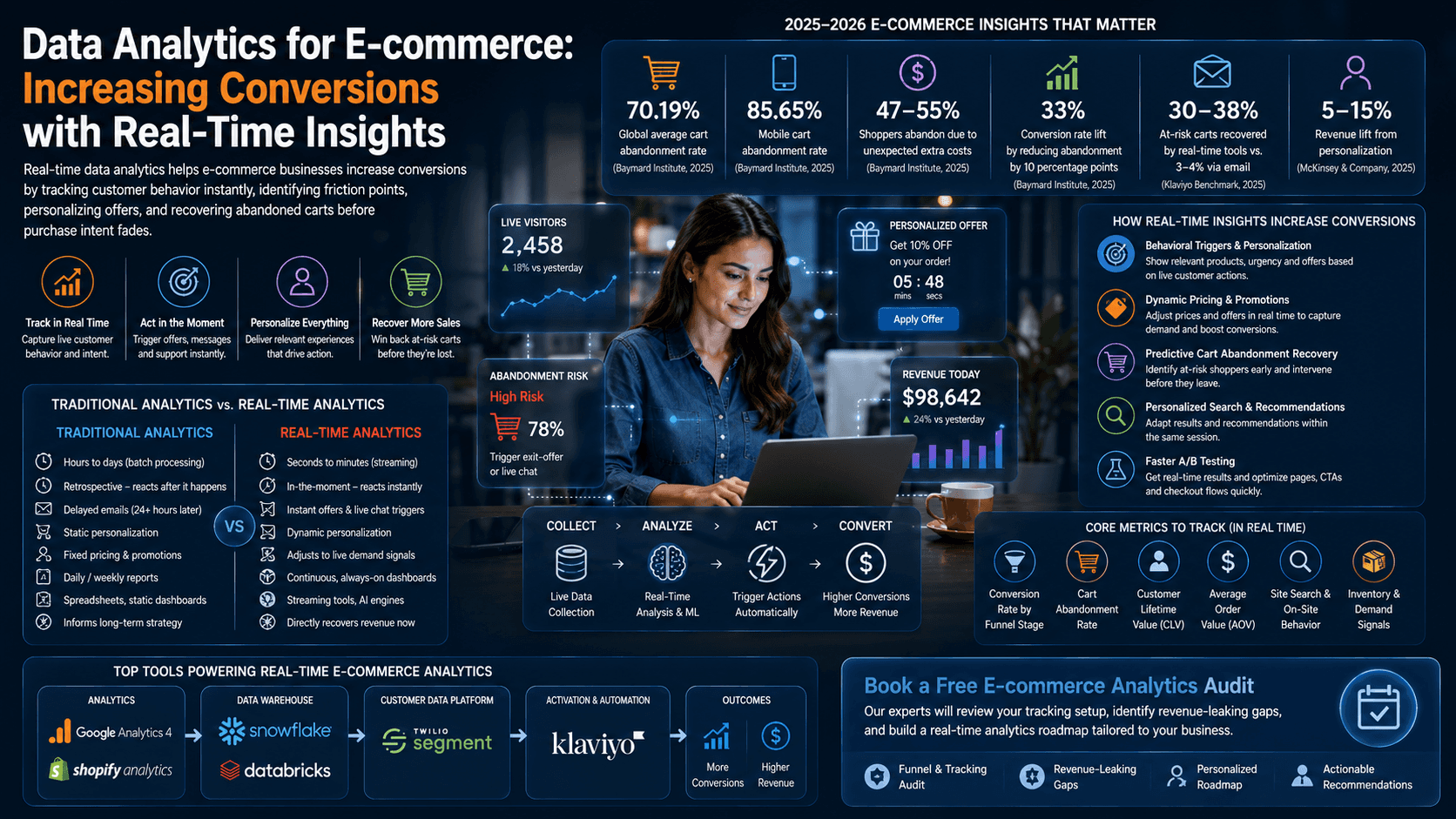
Once that data foundation is in place, the next lever is turning real-time data into revenue — see our guide on using real-time analytics to increase e-commerce conversions.
If your team is still wrestling with fragmented reporting, slow queries, or a data warehouse that can't keep up with your growth, it may be time for a data landscape assessment. Schedule a free consultation with Cor Advance Solutions to find out what a unified data platform could look like for your business.
Disclaimer: This article is for general informational purposes only and does not constitute professional advice. Consult with data platform architects and compliance professionals for implementation guidance.
Let's discuss how these insights apply to your specific challenges.
Get in Touch