Data & Analytics
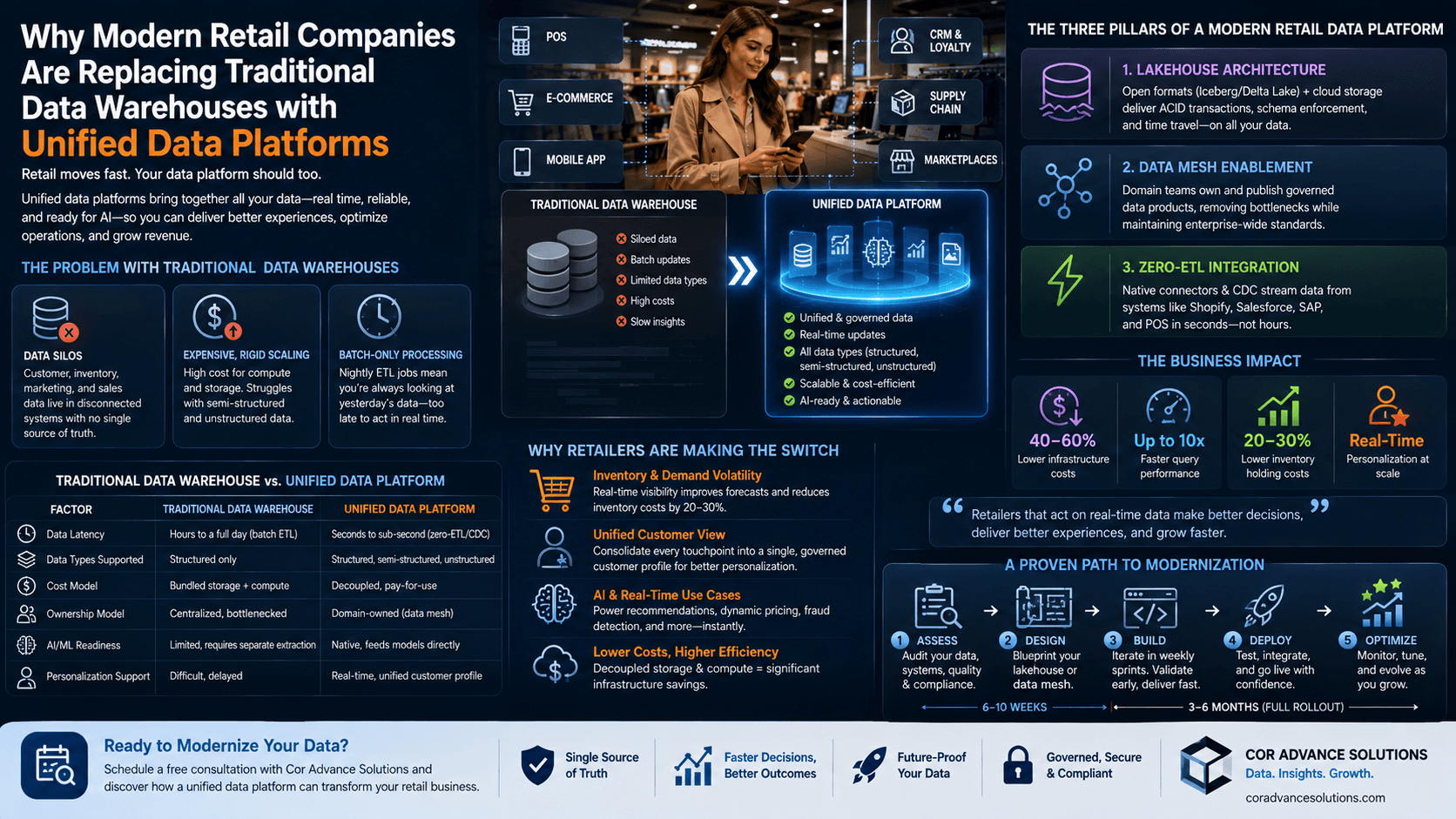
Why Modern Retail Companies Are Replacing Traditional Data Warehouses with Unified Data Platforms
16 min read
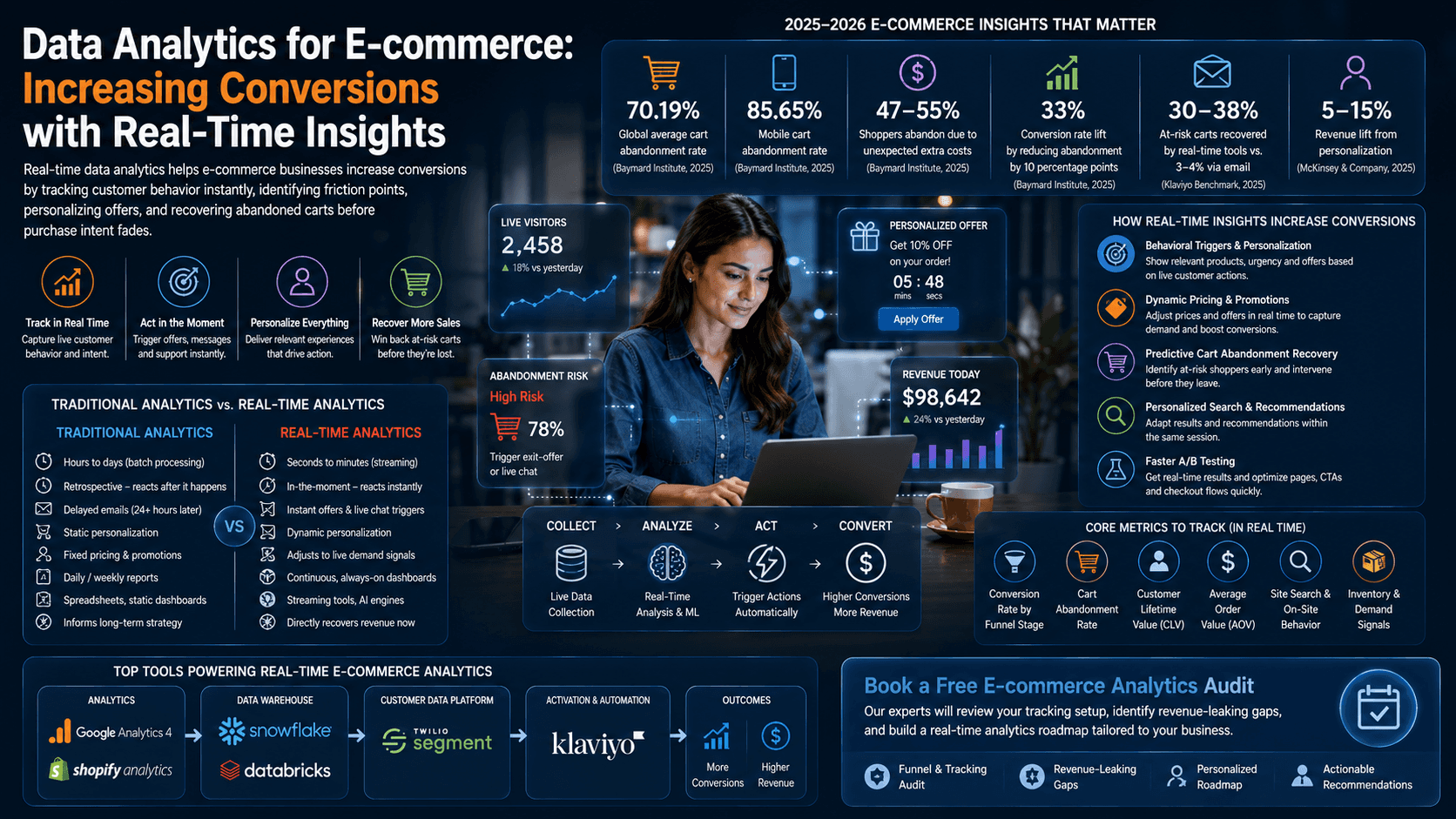
Real-time data analytics helps e-commerce businesses increase conversions by tracking customer behavior instantly, identifying friction points, personalizing offers, and recovering abandoned carts before purchase intent fades. This makes it one of the highest-ROI investments for online retailers looking to grow revenue without increasing ad spend.
Traditional analytics tells you what happened last week. Real-time analytics tells you what's happening right now — and gives you the chance to act before a customer leaves your site for good.
Consider a shopper who adds a jacket to their cart, browses the size chart twice, then pauses. Historical analytics would flag this as a cart abandonment statistic days later. Real-time analytics can trigger a size-guide chatbot prompt or a limited-time free shipping offer in that exact moment — while intent is still high.
This shift from retrospective reporting to in-the-moment action is the single biggest driver of conversion improvement in modern e-commerce.
Every hour between a customer's action and your business's response is an hour of lost intent. Common consequences of slow analytics include:
Before diving into strategy, here's what the latest research shows about the scale of the opportunity:
Note: Cart abandonment and personalization figures vary by study methodology, industry, and region — treat these as directional benchmarks, not universal guarantees, and validate against your own analytics.
| Factor | Traditional Analytics | Real-Time Analytics |
|---|---|---|
| Data latency | Hours to days (batch processing) | Seconds to minutes (streaming) |
| Decision-making | Retrospective — reacts to what already happened | In-the-moment — reacts while it's happening |
| Cart abandonment response | Delayed email, often 24+ hours later | Instant exit-intent offers, live chat triggers |
| Personalization | Static, based on past purchase history | Dynamic, based on current session behavior |
| Pricing & promotions | Fixed, updated periodically | Adjusts to live demand and inventory signals |
| Reporting cycle | Daily, weekly, or monthly dashboards | Continuous, always-on dashboards and alerts |
| Best suited for | Long-term trend analysis, strategic planning | Conversion recovery, on-site personalization, fraud detection |
| Typical tools | Spreadsheets, standard web analytics reports | Streaming pipelines, CDPs, AI-driven engines |
| Business impact | Informs quarterly strategy | Directly recovers revenue in real time |
Both approaches matter — traditional analytics guides long-term strategy, while real-time analytics captures revenue that would otherwise be lost in the moment. The highest-performing e-commerce brands run both in parallel.
Real-time behavior tracking allows dynamic content changes without a page reload — surfacing relevant product recommendations, urgency messaging (like low-stock alerts), or targeted discounts based on what a shopper is doing right now.
Retailers with real-time demand and competitor-pricing data can adjust prices or promotions within minutes, capturing price-sensitive shoppers without permanently discounting for everyone.
Machine learning models scoring abandonment risk in real time enable earlier, better-timed interventions — an exit-intent offer, a live chat prompt, or a same-session email — rather than a generic 24-hour-later reminder.
Real-time behavioral signals (not just purchase history) allow recommendation engines to adapt within a single session, which tends to outperform static "customers also bought" widgets.
Real-time dashboards shorten the time between launching a test and having statistically meaningful results, allowing teams to iterate on landing pages, checkout flows, and CTAs far faster than monthly reporting cycles allow.
Not all data is equally valuable. Focus on metrics that connect directly to revenue and customer experience.
Track conversion at each step — product view → add to cart → checkout start → purchase — rather than a single blended number. This reveals exactly where customers drop off.
Abandonment is one of the highest-leverage metrics in e-commerce. Segmenting abandonment by device, payment method, and shipping cost visibility often reveals fixable friction points.
Real-time CLV modeling helps you decide, in the moment, whether a customer deserves a retention discount or a premium experience — rather than treating every visitor the same.
Track how bundling, real-time recommendations, and dynamic thresholds ("Spend $20 more for free shipping") shift AOV as they happen.
Search queries with no results, repeated filter changes, and rage clicks are early warning signs of friction that standard conversion reports miss entirely.
Live stock-level data prevents overselling and lets you shift marketing spend toward products with rising demand before competitors catch on.
You don't need to build everything from scratch. Here are the categories and tools most e-commerce teams rely on:
Most mature analytics stacks combine a tracking layer (GA4/Shopify Analytics) → a warehouse (Snowflake/Databricks) → a CDP (Segment) → an activation layer (Klaviyo), so behavioral data flows from collection to action with minimal manual work.
Not sure which tools fit your store, budget, and traffic volume? Book a Free E-commerce Analytics Audit with Cor Advance Solutions — our team will review your current tracking setup, flag revenue-leaking gaps (like slow abandonment recovery or missing funnel data), and map out a real-time analytics roadmap tailored to your business.
You don't need an enterprise budget to start. Here's a practical, phased approach.
Real-time data analytics refers to collecting, processing, and acting on customer behavior data (browsing, cart activity, purchases) as it happens, rather than analyzing it in a delayed report. This allows businesses to respond to intent signals within seconds or minutes instead of days.
It identifies exactly where customers drop off in the funnel, reveals which products or messages drive purchases, and enables timely interventions — like personalized offers or abandonment recovery — that recover sales that would otherwise be lost.
Common tools include Google Analytics 4 (GA4) and Shopify Analytics for on-site behavior tracking, Snowflake and Databricks for data warehousing and processing at scale, Segment for unifying customer data as a CDP, and Klaviyo for activating that data through real-time email/SMS flows like abandoned cart recovery.
No. Many analytics and CDP tools now offer scalable pricing, and even small stores can start with event tracking and abandonment-triggered emails before investing in more advanced predictive systems.
Traditional analytics summarizes past performance (daily, weekly, or monthly reports). Real-time analytics processes data continuously, enabling in-the-moment personalization, alerts, and automated responses while the customer is still active on the site.
Data analytics isn't just a back-office reporting function anymore — for e-commerce, it's a direct lever on revenue. Brands that shift from historical reporting to real-time, action-oriented analytics consistently see improvements in conversion rate, average order value, and customer retention, because they're meeting shoppers with the right message at the exact moment intent is highest.
Start small: instrument your funnel, build one real-time abandonment trigger, and measure the lift. Then expand into personalization and predictive modeling as your data foundation matures. If your underlying data infrastructure needs modernizing first, read our breakdown of why retailers are moving to unified lakehouse data platforms.
If you're not sure where your funnel is leaking revenue, don't guess — audit it. Our team at Cor Advance Solutions will review your current tracking setup, flag revenue-leaking gaps (like slow abandonment recovery or missing funnel data), and map out a real-time analytics roadmap tailored to your business.
Look to implement AI-powered personalization or build advanced data infrastructure for your e-commerce business? Let's build your competitive advantage together.
Disclaimer: This article is for general informational purposes only and does not constitute professional advice. Consult with data analytics experts and compliance professionals for implementation guidance.
Let's discuss how these insights apply to your specific challenges.
Get in Touch