AI voice agents qualify real estate leads by responding to or calling property enquiries, asking structured questions about budget, preferred location, property type and purchase timeline, identifying buyer intent, recording the answers in the CRM, and routing qualified prospects to the right sales representative. The goal is not to make more calls. It is to decide, consistently and quickly, which enquiries deserve a person's time, and to give that person a clear summary before the first conversation.
This guide explains the qualification workflow step by step, the questions an agent should ask and why, how to score and prioritise leads, how the CRM record should look, how difficult scenarios are handled, and how to measure whether the approach is working. Our real estate AI voice agent service describes how this is designed for individual businesses. The examples below are illustrative.
Short answer: An AI voice agent asks each property enquirer the same core questions, records the answers in a structured format, checks them against your approved criteria, assigns a priority and passes high-intent buyers to a representative with context. It does not decide who will buy, and it does not guarantee a sale.
Why real estate teams struggle to qualify every property lead
Property businesses rarely lack enquiries. For the service side of this, see our AI voice agent development services. The problem is what happens after they arrive.
Leads come in from property portals, paid advertisements, project landing pages, referrals and walk-ins. Each source brings a different mix of serious buyers, casual browsers and people who are not yet ready to purchase. Sales representatives are then asked to call them all. Many calls go unanswered. Many conversations start from the beginning, because nobody recorded what the buyer already said. Different representatives ask different questions and record the answers in different formats, so a sales manager cannot easily compare one lead with another.
The result is familiar. Interested buyers lose momentum while waiting for a callback. Representatives spend time on people who were never going to visit a project. High-intent prospects get the same treatment as early-stage researchers, and managers cannot see which leads are actually moving.
Key takeaway: More leads do not automatically mean more sales. The qualification process decides how well your team uses its time.
What is an AI voice agent for real estate lead qualification?
An AI voice agent for real estate is a conversational system that talks with property enquirers by phone, asks configured questions, understands the answers and records them. It can handle inbound calls and, where the lead source and contact rules allow it, outbound follow-up for eligible enquiries.
It differs from two older approaches:
- A prerecorded robocall plays the same message regardless of what the listener says. It cannot respond to a question or adapt to an answer.
- A basic IVR presents a menu. The caller must choose from fixed options, and the system does not understand what the caller wants to say.
A well-designed voice agent is different in four ways. It holds a two-way conversation, it asks follow-up questions based on the answers it has already received, it writes structured data to your systems, and it hands the lead to a person when the rules require it.
AI voice agent vs. traditional telecaller vs. IVR
| Capability | Traditional telecaller | Basic IVR | AI voice agent |
|---|---|---|---|
| Conversational responses | Human-led | Mostly menu-based | AI-led conversation |
| Consistent qualification | Depends on the process and the person | Limited | Configurable qualification logic |
| CRM data capture | Manual, or integrated where the team has set it up | Varies | Can be automated through an integration |
| Complex questions | Human judgment | Limited | Handles supported questions and escalates the rest |
| Working hours | Shift-based | Always on, but limited in what it can do | Configured hours, following your contact rules |
These differences depend on the solution, the integrations and how it is configured. A telecaller brings judgment, persuasion and relationship skills that an automated call does not replace.
How AI voice agents qualify real estate leads step by step
This is the core of the process. Each step below describes the trigger, the action, what the patient or buyer experiences, and what happens when the step does not work.
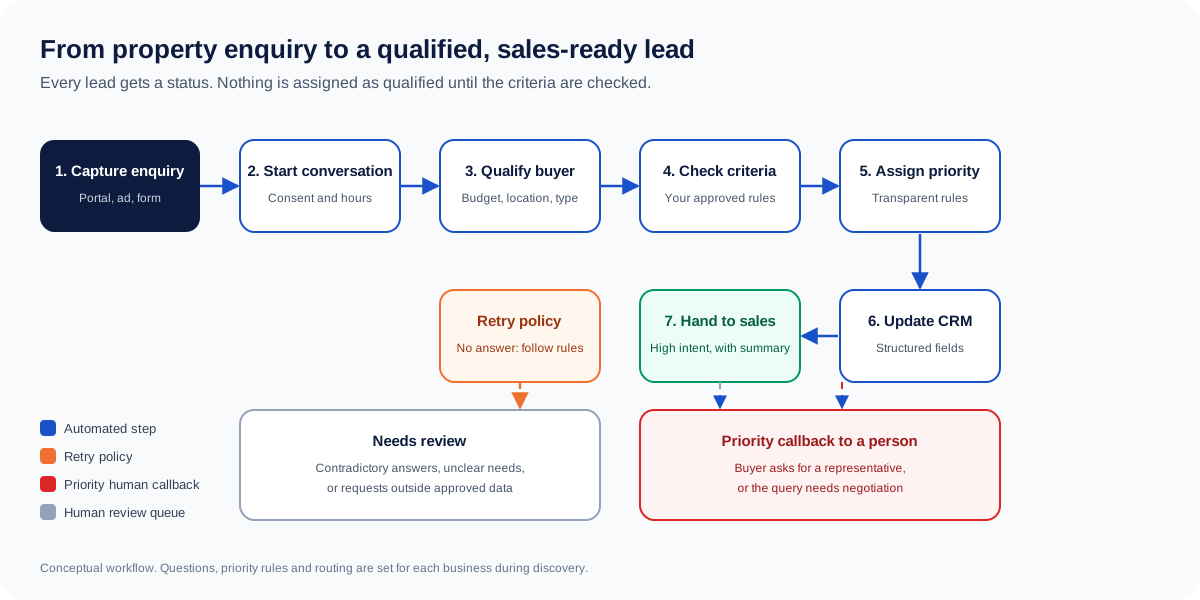
Step 1: Capture the new property enquiry
A lead enters the system from a website form, a paid campaign, a property portal or the CRM itself. A configured integration creates the record, checks for duplicates against existing contacts, and triggers the appropriate action, such as an immediate call, a callback task or a delayed follow-up.
If it fails: If the lead cannot be saved, it is queued and an alert is sent to the operations contact. The enquiry is not dropped.
Step 2: Start a contextual conversation
The agent identifies itself as an automated assistant and explains why it is calling. A good opening refers to the project or property the buyer enquired about, so the call feels relevant rather than generic. The agent asks whether this is a convenient time to talk, and it respects the contact preferences and calling hours your business has set.
If it fails: If the person does not answer, the retry policy applies. If the person asks not to be contacted, the record is updated and no further calls are made.
Step 3: Ask relevant qualification questions
The agent asks the questions in your framework, which are covered in detail below. It asks only what it needs, and it skips questions the buyer has already answered.
If it fails: If an answer is unclear, the agent asks once more. If the buyer still cannot answer, the lead is marked for review rather than given a score.
Step 4: Check requirements against business criteria
The answers are compared with your approved project criteria and the information you have made available. The agent does not assume a lead is suitable merely because the call was completed.
If it fails: If the buyer asks about a price, availability or a project detail that is not in the approved information, the agent does not invent an answer. It either passes the question to a representative or records it for a follow-up.
Step 5: Assign a priority and next action
Your rules assign the lead to a priority level and a next action. This is covered in the scoring section below.
If it fails: If the rules cannot classify the lead, it goes to the review queue with a note explaining why.
Step 6: Update the CRM
The structured answers, lead status, a short conversation summary, the next action and any reminder are written to the CRM.
If it fails: If the CRM update does not succeed, it is retried. If it still fails, the operations contact is alerted, and the call summary is kept so that the record is not lost.
Step 7: Transfer high-intent prospects to sales
The representative receives the relevant context before calling the buyer. If the prospect wants a site visit, the system can offer available slots when calendar integration supports it. If not, a representative receives a priority callback task.
If it fails: If no slot is available, the buyer is offered a callback, and the representative is told what the buyer asked for.
The qualification framework: what should the AI actually ask?
This section is the practical core of the article. A qualification framework works best when each question has a purpose, a clear way to record the answer, and a rule for what happens next.
1. What is your budget range?
Purpose: Establish affordability and identify suitable inventory.
Example: "What price range would you prefer for your property purchase?"
The response can be compared with your approved price bands. The agent should not make promises about financing, loan eligibility or the final price, because those depend on the buyer's circumstances and your sales process.
2. Which location or neighbourhood are you considering?
Purpose: Identify geographic fit.
Record preferred areas, commute needs and acceptable alternatives where they matter to the buyer. A single answer is often too narrow, so the agent can ask whether a nearby area would also work.
3. What type of property are you looking for?
Purpose: Match the enquiry to the right inventory.
Record the configuration (for example, a 2 BHK or 3 BHK apartment), villa, plot, rental, commercial space or another relevant category. The answer determines which project and sales team the lead should go to.
4. Are you buying for personal use or as an investment?
Purpose: Understand the buyer's motivation.
The purpose can change which listings, questions and next steps are relevant. A buyer looking for a family home may care most about schools, layout and possession timing. An investor may ask about rental potential or resale. Your team decides what the agent should say in each case.
5. When are you planning to purchase?
Purpose: Separate an immediate requirement from a longer search.
Let the buyer answer in their own words, such as "in the next few months" or "just exploring for now", and map that answer to your timeline categories afterwards. Forcing a rigid choice can make the buyer feel pressured.
6. Will you be using financing?
Purpose: Understand readiness, where it is relevant to your sales process.
Capture whether financing is being considered or already arranged. The agent should not assess creditworthiness, suggest a loan product or guarantee approval.
7. Are there other requirements we should consider?
Purpose: Capture preferences that could change the recommendation.
This may include possession timeline, size, amenities or accessibility needs. Ask only what is relevant to the property type, and allow the buyer to decline.
8. Would you like to arrange a property viewing?
Purpose: Identify the most useful next step.
If the buyer is interested, offer valid appointment slots. If booking cannot be completed automatically, arrange a human callback instead.
These questions should not feel like an interrogation. The agent adapts to answers already given, asks follow-ups only where they add value, and lets the buyer decline a question. The framework covers the factors most real estate teams already use in their own qualification: budget, location, need, timeline and financing readiness.
How to score and prioritise real estate leads
A lead score should reflect your sales criteria, not an arbitrary judgment produced by the AI. Agree the rules with your sales leaders before the system goes live, and review them against real outcomes.
| Priority | Typical signals | Recommended next step |
|---|---|---|
| High priority | Strong project fit, clear near-term intent, interested in a viewing | Prompt human follow-up, or an available slot booked during the call |
| Medium priority | Suitable requirements, but uncertain timing or unanswered questions | Relevant follow-up and permission-based nurturing |
| Early stage | Exploring options or planning a future purchase | Lower-frequency, preference-based follow-up where permitted |
| Needs review | Contradictory details, unclear requirements or a complex request | Human review before any decision |
An illustrative scoring model can give each signal a weight. For example, you might score budget fit, location fit, purchase timeline, stated intent and viewing readiness, with the weights set by your team. The total is a way to sort the queue. It is not a prediction that someone will buy.
An important distinction: an unanswered call is not automatically a low-quality lead. It is an uncontacted lead, and it needs its own status so that it is not confused with a buyer who declined.
What an effective qualification call sounds like
The script below is an illustrative example of an original conversation. It is not a claim that every implementation supports live inventory or calendar access, and it is not a real customer transcript.
AI Agent: Hello, I'm the virtual assistant calling on behalf of [Real Estate Company]. You recently enquired about [Project Name]. Is this a convenient time for a quick conversation?
Buyer: Yes, I have a minute.
AI Agent: Thank you. To help our property team suggest suitable options, may I ask what budget range you are considering?
Buyer: Around 80 lakh to 1 crore.
AI Agent: Understood. Are you mainly looking for a home for your family, or a property for investment?
Buyer: For my family.
AI Agent: Got it. Which location would work best for you, and are you looking for a 2 BHK or a 3 BHK?
Buyer: A 3 BHK near [Preferred Area].
AI Agent: Thank you. Are you hoping to purchase in the next few months, or are you still exploring options?
Buyer: In the next two or three months.
AI Agent: Understood. Based on the preferences you have shared, our team can check suitable options. Would you like me to look for an available site-visit slot, or would you prefer a sales representative to call you first?
Buyer: A site visit would be good.
AI Agent: Certainly. I will check the available appointments and confirm a suitable slot if one is available.
After the call, the record should show what was captured, why each question was asked, and where a representative should take over. In this example, the buyer's family purpose, budget, location, configuration and timeline are captured. The visit request is a high-intent signal, so the agent should either confirm a slot that the calendar has verified or hand the lead to a representative for a priority callback.
What the CRM should record after each qualification call
A useful CRM record is structured. Sales representatives should be able to see the key facts in a few seconds, without reading a long transcript.
| CRM field | Example |
|---|---|
| Lead source | Property landing page |
| Property interest | 3 BHK apartment |
| Budget | 80 lakh to 1 crore |
| Preferred location | Buyer's stated area |
| Buying purpose | End use |
| Purchase timeline | 2 to 3 months |
| Viewing preference | Requested |
| Qualification status | High priority, pending human review |
| Next action | Check availability and contact buyer |
| Call summary | Requirements and unanswered questions |
A structured record is far more useful than a transcript, because it can be filtered, reported and acted on. A transcript can be kept for audit and quality review, but it should not be the main way a salesperson learns what the buyer wants. Field names, field mapping and write permissions must be confirmed for your actual CRM before any integration is promised.
How AI voice agents handle difficult qualification scenarios
Generic content often ignores the situations where qualification is hardest. These are the scenarios a good system needs to handle.
- The buyer asks for a price that is not approved. The agent provides only verified information, or passes the question to a representative. It does not estimate a price.
- The requested property is unavailable. If inventory is connected, the agent checks it. If it is not, the agent collects the buyer's preferences and arranges a callback.
- The buyer is interested but not ready. The agent captures the expected timeline and sets a follow-up that your contact rules permit.
- The buyer does not answer. The agent follows your retry policy rather than calling repeatedly.
- The buyer has already spoken to sales. If CRM context is available, the agent reads it, so the buyer is not asked the same questions again.
- The buyer wants a human immediately. The call is transferred, or a priority callback task is created with the requirements captured so far.
- The buyer speaks another language. The call is handled only in languages that have been tested, including local phrasing and mixed-language sentences. If recognition confidence is low, the call goes to a person.
- The buyer gives contradictory answers. The agent asks a clarifying question once. If the contradiction remains, the record is flagged for human review.
How AI voice agents qualify leads from property portals and paid ads
Each lead source starts the conversation in a different place, and the agent should use that context.
- Property portals and listing enquiries. The buyer usually asked about a specific listing. The first question should refer to it.
- Search and paid search campaigns. The buyer may have searched for a location or a property type. The agent can confirm the search intent before asking about budget.
- Social lead-generation campaigns. These leads may be less far along in their search. Shorter qualification and a clear opt-in matter more here.
- Website forms and project landing pages. The enquiry usually names a project. The agent should confirm that project first.
- Referrals and existing CRM contacts. These can be contacted only where the appropriate permissions exist, and the conversation should reflect the existing relationship.
A lead asking about a particular project should not receive a generic call that ignores that enquiry. Source context is one of the simplest ways to make the conversation feel relevant.
Technical note: Automated calling depends on supported portal integrations, webhooks or APIs, CRM access and telephony configuration. None of these should be assumed. Each one is verified for the specific portal or platform in use.
How AI voice agents help developers, brokers and real estate agencies
Each type of business has a different qualification problem.
- Property developers qualify campaign leads and route each prospect to the sales team for the relevant project. The qualification set is usually specific to the project.
- Real estate brokerages capture buyer preferences and help agents prioritise the enquiries that match their listings and areas.
- Commercial real estate teams capture the business type, space requirements, location and whether the enquiry is for a lease or a purchase. These enquiries need a longer set of questions.
- Rental and property management businesses screen rental enquiries against preferences and arrange viewings when supported. Maintenance and tenancy issues go to the operations team, not the sales pipeline.
- Luxury property agencies collect detailed preferences and prioritise personalised follow-up from a senior agent. The agent's role is to capture the detail, not to replace the relationship.
AI voice agents vs. manual real estate lead qualification
Compare the two approaches fairly. Human salespeople provide judgment, negotiation and relationship-building. AI voice agents can support repetitive, structured interactions at a scale that is hard to staff for manually.
The comparison should consider:
- Response workflow and coverage: how quickly a lead is first contacted, and whether that happens outside office hours where your rules allow it.
- Consistency: whether every lead is asked the same core questions and recorded in the same way.
- Data-entry workload: how much time representatives spend typing up notes.
- CRM visibility and handoff quality: how much context the representative has before the first conversation.
- Complex questions and objections: where a person is needed, and how quickly the handoff happens.
- Personalisation and judgment: the things a person does better.
- Operating costs and oversight: the cost of the system, plus the time needed to review and improve it.
AI is not always cheaper, and it does not always convert better. Results depend on lead volume, contact rates, the quality of the implementation and the sales process behind it.
How to measure the ROI of AI-powered lead qualification
Measure the funnel, not just the number of calls.
| KPI | What it tells the business |
|---|---|
| Contact rate | How often eligible leads are reached |
| Qualification completion rate | How often useful buyer requirements are captured |
| Qualified-lead rate | The share of contacted leads that meet your defined criteria |
| Time to first contact | How quickly the first response happens |
| Qualified lead-to-site-visit rate | How well qualified prospects move to viewings |
| Site-visit attendance rate | Whether scheduled viewings actually take place |
| Sales acceptance rate | Whether representatives find the handoffs useful |
| Cost per qualified lead | What it costs to produce a qualified opportunity |
| CRM completeness | Whether the sales team has usable information |
Measure a baseline before launch. Then run a pilot and compare equivalent lead sources and time periods. Keep booked visits, completed visits and closed sales as separate measures, because a booking is not the same as a visit and a visit is not the same as a sale.
Common mistakes to avoid when implementing AI voice agents
- Treating every answered call as a qualified lead. Answering is not qualifying. Keep the statuses separate.
- Asking too many questions in the first conversation. Long interrogations lose buyers. Start with the most important questions.
- Using one script for every property type. A villa, a commercial unit and a rental need different questions.
- Scoring leads without agreed business rules. If the sales team does not agree with the rules, the scores will be ignored.
- Sending only transcripts instead of structured fields. Representatives need data they can filter and act on.
- Letting the AI invent prices, inventory or project details. Only approved, current information should be used.
- Ignoring consent, do-not-call and recording rules. Contact permissions must be checked before any outbound call. In India, telemarketing rules set by TRAI should be reviewed with your legal adviser. In other countries, check the calling and privacy rules that apply to you.
- Failing to provide a human escalation path. Every workflow needs a clear route to a person.
- Measuring call volume instead of qualified opportunities. A high call count with few visits is not a success.
- Launching across every project at once. Validate one use case, one project or one lead source first.
How to choose an AI voice agent for real estate
Use this checklist when you evaluate a vendor:
- Natural conversations that handle interruptions well.
- Configurable questions and qualification rules that your team controls.
- CRM integration, with structured field updates rather than only transcripts.
- Calendar and appointment-booking support that checks availability before confirming.
- Verified listing and project information, with a rule against inventing details.
- Human transfer and failure handling that is tested, not only described.
- Supported languages, with accent and mixed-language testing.
- Contact permissions, privacy, and call recording controls.
- Call logs, outcome tracking and reporting.
- A measurable pilot with agreed success criteria.
Ask for a working demonstration of the full workflow, including the failure cases. Be cautious about any vendor that cannot show you how a lead moves from enquiry to CRM record to visit.
How COR Advance Solutions can help build a real estate AI voice agent
We help property businesses scope and develop AI voice agents that qualify leads and schedule site visits, subject to technical feasibility for each integration. Our work typically covers:
- Mapping the current property lead journey, from source to visit.
- Defining buyer qualification questions and priority rules with your sales leaders.
- Designing the voice conversation and escalation logic.
- Connecting supported lead sources, CRM systems and calendars.
- Configuring structured lead summaries and sales routing.
- Testing real call scenarios and measuring pilot performance against a baseline.
We do not invent customer names, statistics, testimonials or performance guarantees. Where we describe a demonstration or an example, it is labeled as one.
Explore our real estate AI voice agent service
Discuss your real estate AI voice agent workflow
Frequently asked questions
How do AI voice agents qualify real estate leads?
They collect buyer requirements by asking configured questions, check the answers against your business rules, record structured details in the CRM and route each lead to the appropriate next step.
What questions should an AI voice agent ask property buyers?
Budget, preferred location, property type, buying purpose, purchase timeline, financing needs where relevant, other requirements and readiness for a viewing.
Can AI voice agents tell serious buyers from casual enquiries?
They can apply rule-based priorities using intent signals, such as timeline and a visit request. No automated score can guarantee a purchase, so the rules should be reviewed against real outcomes.
Can an AI voice agent book real estate site visits automatically?
Yes, when it is connected to a working calendar or booking system with correct availability and confirmation logic. Where booking cannot be completed automatically, a human callback is arranged.
Can AI voice agents integrate with a real estate CRM?
Often, through supported APIs, webhooks or connectors. Field mapping, write permissions and error handling must be verified for your CRM before implementation.
Can AI voice agents call leads from property portals and advertising campaigns?
This depends on the lead source, its integration options, contact permissions and your calling setup. It should not be assumed for every portal or campaign platform.
What happens when a property buyer wants to speak with a human?
The call is transferred, or a priority callback is created with the requirements and conversation context captured so far.
Can AI voice agents qualify property leads in multiple languages?
Only in languages that have been tested with the speech and language models you use, including local terminology and mixed-language speech.
How can real estate businesses measure AI lead qualification performance?
Track contact rate, qualification completion, qualified-lead rate, site-visit conversion, sales acceptance and cost per qualified lead against a baseline measured before launch.
Do AI voice agents replace real estate salespeople?
No. They can automate repetitive early-stage tasks such as first response, qualification and reminders. People remain essential for complex advice, negotiation, relationship-building and closing.