The UAE is one of the most AI-ready consumer markets in the world. Microsoft's latest global AI diffusion data ranks the UAE first, and a growing share of online shoppers say they already use AI chat tools when they buy. For ecommerce store owners, the question is no longer whether customers will talk to an AI assistant. It is whether your store can answer them accurately, quickly and in the right language.
This article brings together the most reliable 2026 data on AI use in the UAE, explains what it means for online retailers, and sets out a practical way to decide where a chatbot would help most.
Bottom line for UAE store owners: Customers already expect AI help while they shop. Stores that win will be the ones that answer accurately, follow local rules and hand off cleanly to people.
The headline: the UAE leads global AI use
Microsoft's global AI diffusion report for 2026 reports that the UAE continued to lead at 70.1 per cent of its working-age population using generative AI in the first quarter of 2026. The global average in the same report is 17.8 per cent, up from 16.3 per cent in the previous period. In other words, a typical UAE customer is several times more likely to have used a generative AI tool than the average person worldwide. Microsoft also reports that global AI usage rose by 1.5 percentage points during the quarter, from 16.3 per cent to 17.8 per cent of the world's working-age population, and that 26 economies now exceed 30 per cent. The United States moved up from 24th to 21st place on Microsoft's National AI Leaderboard, with 31.3 per cent of its working-age population using AI.
This matters for ecommerce because the habit is already formed. Customers who use AI at work and at home will expect a store to answer questions the same way. A store that replies only with a static FAQ page may feel slow by comparison.
Shoppers are already using AI chat tools
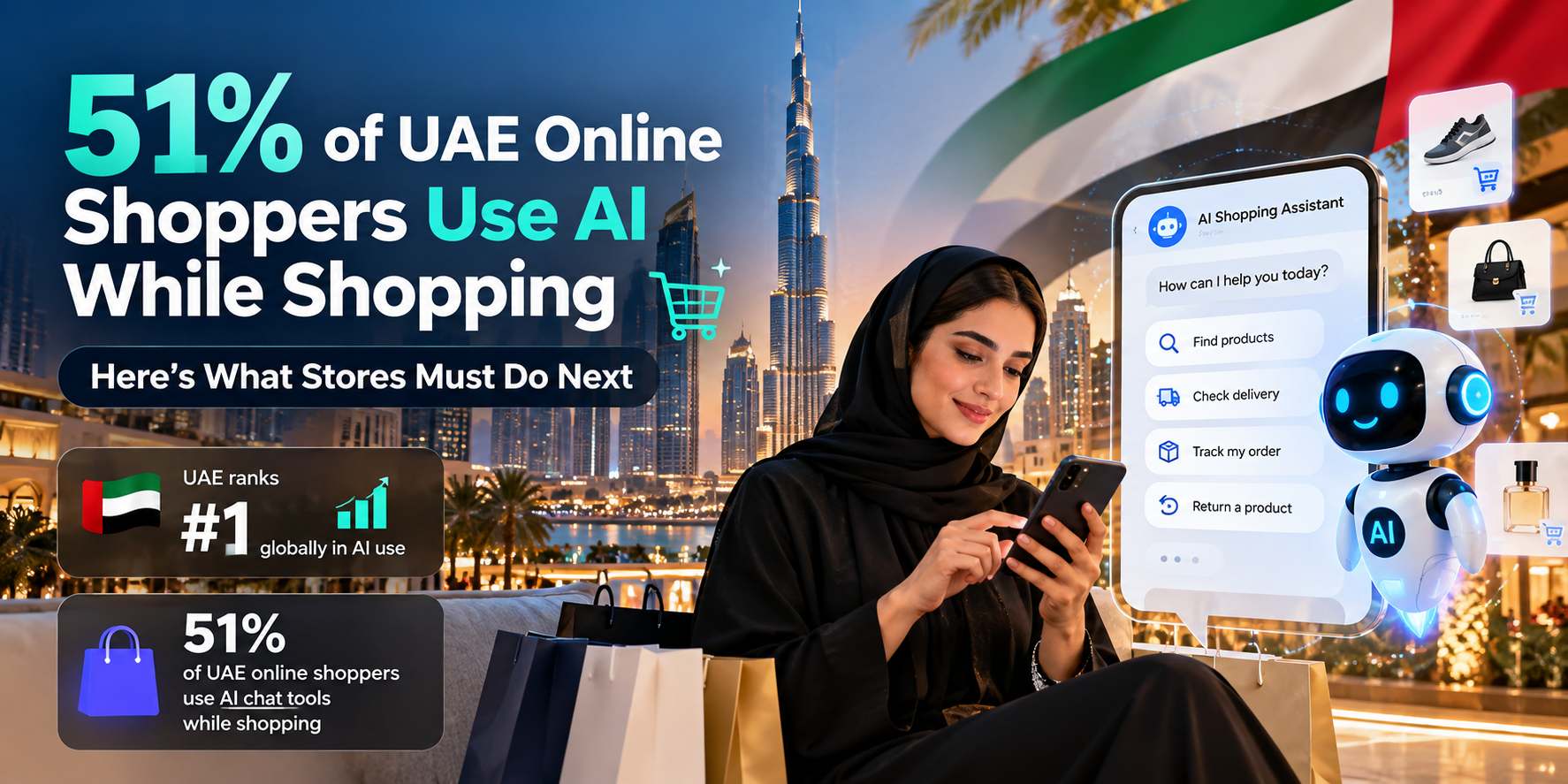
DHL's E-Commerce Trends Report 2026 surveyed 29,000 online shoppers and 5,800 businesses across 29 countries. Its UAE findings show that 51 per cent of UAE online shoppers use AI-powered chat tools while shopping, placing the UAE among the highest-adoption markets in the survey.
Two points help interpret this figure. First, it measures shopping use of chat tools, not general AI use. Second, the survey covers many countries, so the UAE result describes shoppers in the UAE rather than a sample of UAE businesses. Both points support the same conclusion: shoppers expect AI help while they browse and buy.
Businesses are integrating AI into their platforms
On the business side, Khaleej Times reported in June 2026 that 91 per cent of e-commerce businesses have integrated some form of AI into their platforms, citing the DHL report. The article describes this figure as coming from the wider survey sample, so it should be read as a broad indicator rather than a count of UAE firms alone.
The practical lesson is that AI is no longer a differentiator on its own. What separates stores is the quality of the AI: whether it uses current stock and price data, whether it can complete approved actions, and whether it hands a conversation to a person when it should.
Government is setting the pace
Public-sector adoption is also moving quickly. The UAE government's agentic AI framework sets a target of using agentic AI across 50 per cent of government sectors, services and operations by 2028. Press reports describe a broader private-sector plan, including a reported goal of equipping 295,000 firms with agentic AI within two years. That reported target has not been confirmed in a full official release, so it should be checked against Dubai government announcements before it is quoted.
For businesses, the signal is clear. Suppliers, partners and customers are likely to expect automated, auditable workflows. Stores that build those capabilities early will have an easier path when the expectation becomes standard.
What this means for an ecommerce store in the UAE
Three practical implications stand out.
Language and local rules matter. A UAE store often serves customers who prefer Arabic, English or both. A chatbot needs more than translation. Delivery coverage, return policies and currency presentation must match the market the customer is in.
Live data is the difference between helpful and misleading. A chatbot that guesses stock or delivery dates will create support problems. Reliable answers come from connected catalogue, inventory, order and shipping systems.
Human handoff is part of the design. Complaints, refunds outside policy, allergy or product-safety questions and any request for an expert should reach a person with the conversation attached.
Start small: Pick one high-volume question group, measure its baseline, then expand. Proof from one workflow beats a large plan with no data.
A simple way to decide where to start
Do not start with the technology. Start with the questions your team answers most often.
- List the top ten questions from your support inbox, live chat and checkout data over the last three months.
- Group them into product questions, order questions, policy questions and complaints.
- Mark which ones can be answered from approved data, and which need a person.
- Choose one high-volume group, such as order status or sizing, for the first workflow.
- Set a baseline for response time, resolution rate and cost per resolved query before launch.
This approach keeps the first project focused and measurable. It also makes it easier to add product discovery, cart support or returns once the first workflow is reliable.
The data gaps to watch
Not every figure in this area is equally strong. Microsoft's usage data and the DHL survey are the most useful sources for the UAE, but they measure different things, and neither measures the performance of a specific store's chatbot. Before you use these numbers in a business case, check the original publications and measure your own baseline. External benchmarks show direction. Your own data shows whether a chatbot is worth building.
For a store-specific view, read our AI chatbot development services for ecommerce in Dubai, or contact our team to discuss your support questions and integrations. We will start with your data, not with a generic plan.
Sources
Sources are linked in the text above: Microsoft's global AI diffusion report (May 2026), the DHL E-Commerce Trends Report 2026 as republished by Zawya (June 2026), the Khaleej Times report on UAE e-commerce AI integration (June 2026), and the UAE government's agentic AI page on u.ae.