AI Customer Support Automation for E-commerce Businesses in the USA

Automate Repetitive Customer Support Tasks. Connect Your Systems. Give Your Team More Time for Complex Customer Issues.

Running an e-commerce business means answering questions about order status, shipping delays, product details, returns, refunds, and delivery updates. As your store grows, these repetitive requests can put pressure on your support team and make it harder to focus on complex customer needs.

Cor Advance Solutions helps e-commerce businesses explore and implement custom AI customer support automation built around existing systems, workflows, and business requirements. From AI-powered chatbots to connected AI agents and helpdesk workflow automation, we help identify where AI can support routine inquiries, retrieve approved information, organize support requests, and route complex cases to the right team member.

Whether you run a Shopify store, a direct-to-consumer (DTC) brand, or a multi-channel retail business in the United States, our approach starts with your current support process. For Shopify stores, we can design a custom AI customer support solution around your store data, support policies, and team workflow.

Every implementation is scoped around your business requirements, available integrations, data access, and operational needs. Capabilities and expected outcomes are assessed before the solution is finalized.

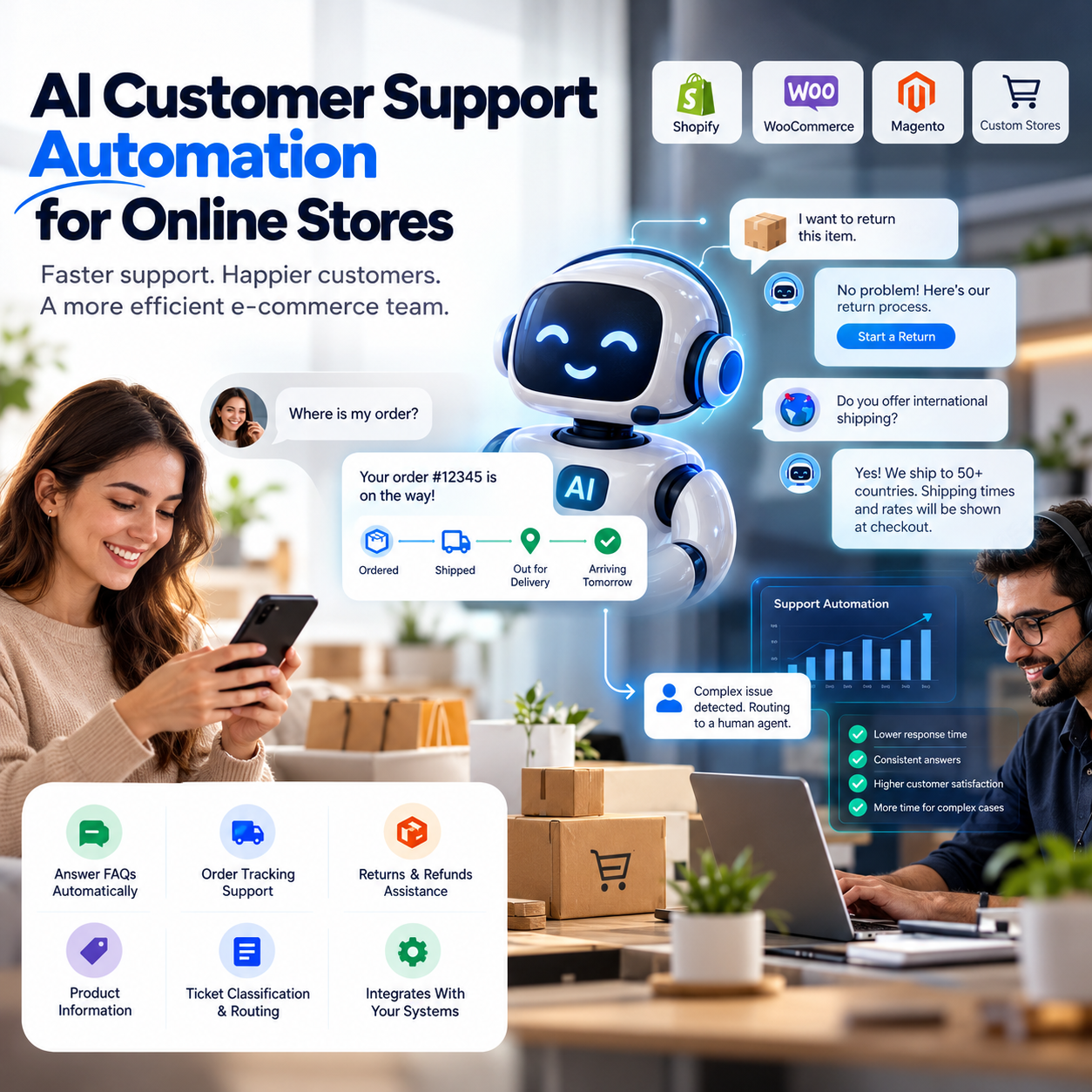
AI assistant handling order tracking, return requests, and routing complex cases to a human agent for an online store

The challenge

Why e-commerce businesses need AI customer support automation

As an online store grows, support becomes more complex. More orders bring more shipping questions, return requests, product inquiries, and update requests. When employees handle all of this manually, repetitive work takes time away from issues that need real attention.

1. Repetitive Customer Inquiries Consume Support Time

Customers frequently ask questions such as:

  • Where is my order?
  • When will my package arrive?
  • What is your return policy?
  • Is this product available?
  • How do I request an exchange?
  • How can I contact your support team?

When employees repeatedly answer the same questions, they have less time for complaints, unusual orders, and situations that need individual attention.

How AI can help

An AI customer support assistant can answer supported routine questions using approved product information, store policies, and connected business data. When the information is unavailable or the question falls outside the approved scope, the workflow asks for clarification or routes the inquiry to a human agent.

2. Order Tracking and Shipping Questions Create Extra Work

Customers contact your business when tracking information is unclear, a shipment appears delayed, or an order status has not changed. Finding the right answer can mean checking the store platform, the shipping service, the order system, and the support tool separately.

How AI can help

An integrated AI assistant can retrieve available order and shipment information from supported systems and prepare a response based on that data. If tracking is missing, conflicting, or needs investigation, the workflow escalates the case instead of guessing about delivery status.

3. Returns, Refunds, and Exchanges Require Multiple Steps

Return and refund requests often involve checking order details, reviewing store policies, collecting missing information, and coordinating with other departments. These steps are hard to keep consistent when requests arrive through several channels.

How AI can help

AI-assisted workflows can collect request details, identify the applicable policy, check defined eligibility conditions, and prepare the next action for review. Refund approvals, disputed claims, and financial actions follow your business rules and authorization process. Automation should not bypass those controls.

4. Disconnected Systems Make Customer Support Harder

Customer information may be spread across several applications, including:

  • E-commerce platforms
  • Customer relationship management (CRM) systems
  • Helpdesk and ticketing software
  • Shipping and tracking services
  • Inventory and order management systems
  • Internal knowledge bases

When these systems do not work together, support employees may switch between applications or ask customers to repeat information.

How AI can help

Custom integrations can bring approved information into a more connected support workflow. The right approach depends on the systems you use, their APIs, permissions, data quality, and technical constraints.

5. Inconsistent Answers Can Affect the Customer Experience

Different employees may interpret policies differently or rely on outdated information. This matters most for product specifications, return eligibility, warranties, shipping conditions, and refund policies.

How AI can help

An AI assistant can retrieve information from approved knowledge sources and follow defined response rules. Testing, monitoring, and escalation criteria help your team catch inaccurate answers. The goal is consistent, information-based responses, not automating every customer interaction regardless of risk.

The goal is consistent, information-based responses. It is not to automate every customer interaction regardless of risk.

Our services

AI customer support automation services for e-commerce

We help businesses assess, design, and implement AI-powered support workflows based on their operational needs. As an ecommerce customer support workflow automation company, we also work on custom AI support automation for growing online stores, including an AI agent for ecommerce order management integration where the systems and permissions allow it.

1. Custom AI Customer Support Chatbot Development

An AI customer support chatbot helps customers find answers to common questions through supported digital channels. Depending on the agreed scope, it may support:

  • Answering frequently asked questions
  • Providing approved product information
  • Explaining shipping and return policies
  • Guiding customers through supported service processes
  • Collecting information needed to resolve an inquiry
  • Escalating questions that require human assistance
  • Connecting customer conversations with existing support workflows

Knowledge sources, response rules, and permissions are defined before deployment, so it is clear which questions the chatbot answers and when it hands off to a person.

2. AI Agents for E-commerce Customer Service

AI agents support more involved workflows when they have the right integrations, permissions, and defined action rules. For example, an order question may require the system to identify the request, retrieve the order record, check tracking information, and prepare a relevant response. Depending on the implementation, custom AI agents may assist with:

  • Retrieving available order details
  • Checking shipment information
  • Classifying incoming support requests
  • Collecting return or exchange details
  • Routing inquiries to the appropriate team
  • Preparing draft responses or recommended actions
  • Coordinating approved steps across connected systems

Not every task should be fully automated. Financial decisions, disputed orders, sensitive cases, and actions outside predefined rules may need employee review or approval.

3. AI Order Tracking and Delivery Support Automation

Order tracking is a practical starting point for businesses that receive frequent delivery questions. A connected workflow can be designed to:

  • Identify the customer's order-related question
  • Collect the order reference or other identifying information
  • Retrieve order and shipment records from supported systems
  • Prepare an answer using the available tracking information
  • Escalate missing information or delivery exceptions for investigation

The workflow does not invent shipment updates or claim a package was delivered unless the connected data supports that statement.

4. Returns, Refunds, and Exchange Workflow Automation

Returns and refunds involve repetitive administrative steps that can be assessed for automation. Depending on your store policies and technical setup, an AI-assisted workflow may:

  • Collect order and return details
  • Identify the type of request
  • Retrieve the applicable return policy
  • Check predefined eligibility conditions
  • Identify missing information
  • Prepare a response for review
  • Route exceptions to authorized employees

Automatic approvals or financial actions are enabled only when they are explicitly authorized, suitable for the workflow, and thoroughly tested.

5. AI Helpdesk and E-commerce System Integration

Support automation becomes more useful when it can access the business information needed to resolve an inquiry. We assess integration opportunities with supported systems such as:

  • Shopify and other e-commerce platforms
  • CRM and customer management tools
  • Helpdesk and ticketing platforms
  • Shipping and order tracking services
  • Inventory and order management systems
  • Approved internal documentation and knowledge bases

Integration feasibility is confirmed during discovery. API availability, permissions, vendor limitations, data quality, and your existing architecture all affect what is possible.

6. AI Support Agent Assist

Some businesses prefer to assist employees rather than automate customer conversations directly. AI agent assist can help support teams:

  • Find relevant policies and product information
  • Summarize conversation history
  • Categorize and prioritize tickets
  • Prepare draft responses
  • Identify missing information
  • Suggest appropriate next steps

Employees keep control of the final response and the resolution wherever the workflow requires human judgment. It is a practical starting point for teams evaluating AI support while keeping people directly involved.

Related services: AI automation, AI agent development, and AI chatbot development for ecommerce.

For a step-by-step view of the returns side, read our guide on how to automate ecommerce returns and refund workflows.

How it works

How AI customer support automation works

A reliable solution begins with a defined workflow, accurate information, and clear rules about what the system can and cannot do.

  1. 1

    Step 1: A customer submits a question

    A customer contacts your business through a supported channel, such as website chat or an integrated helpdesk. The system identifies the general purpose of the request, such as order tracking, product information, shipping, or a return.

  2. 2

    Step 2: AI identifies the required information

    The AI interprets the request and determines what information or workflow is needed. An order tracking question, for example, may require an order reference and access to the available shipment status.

  3. 3

    Step 3: The system retrieves approved information

    The assistant retrieves relevant information from configured knowledge sources or connected business systems. Access controls limit it to the information and actions the task requires.

  4. 4

    Step 4: The workflow determines the next action

    Defined rules decide whether the system should answer from approved information, ask for missing details, retrieve more information, create or update a ticket, prepare an action for employee approval, or escalate to a human agent. A routine policy question may get an approved answer, while a disputed refund goes to human review.

  5. 5

    Step 5: The customer receives an appropriate response

    The system prepares a response using available information and its authorized capabilities. When information is incomplete, conflicting, or outside scope, it avoids unsupported assumptions and routes the request.

  6. 6

    Step 6: Performance is reviewed

    After deployment, your team reviews agreed measures such as response accuracy, escalation rate, handling time, resolution rate, and customer satisfaction. These show whether the implementation meets its goals and where to improve.

Implementation

Our AI customer support implementation process

Every store has different support workflows, systems, policies, and integration needs. Our process assesses those differences before the solution is finalized.

Phase 1

Discovery and workflow assessment

We review how inquiries are received, processed, and resolved today. This includes common inquiry types, repetitive manual tasks, current tools, relevant data sources, risks, and technical constraints.

Deliverable: An agreed understanding of the problem, candidate workflows, and initial requirements.

Phase 2

Solution design

We define the technical and operational approach for the priority workflows, including architecture, approved knowledge sources, integration requirements, permissions, escalation rules, human approval steps, and testing criteria.

Deliverable: A proposed solution scope aligned with your business needs and technical environment.

Phase 3

Development and integration

The agreed solution is built around the selected workflows and supported systems. This may include conversation design, knowledge retrieval, system integrations, ticket classification, workflow automation, approval logic, error handling, and logging.

Deliverable: An implementation ready for the agreed testing process.

Phase 4

Testing and validation

Before deployment, the solution is tested against common questions, missing or incorrect information, unexpected requests, policy exceptions, permission checks, integration failures, unsupported answers, and human escalation behavior.

Deliverable: Documented test results and issues to resolve before launch.

Phase 5

Deployment and monitoring

The solution is deployed within the agreed scope and monitored. Monitoring covers workflow execution, response quality, integration alerts, escalation patterns, and performance reporting, along with recommendations for improvement.

Deliverable: A deployed solution with an agreed approach to monitoring and evaluation.

The final timeline, integrations, deliverables, and ongoing support arrangements are set after the initial assessment.

Who can benefit

Who can benefit from e-commerce customer support automation?

Direct-to-consumer (DTC) brands

DTC brands often receive recurring questions about orders, delivery, product details, returns, and exchanges. AI-assisted support can handle suitable routine inquiries and leave complex issues with employees.

Shopify and Shopify Plus stores

Businesses on Shopify can explore AI assistants and connected support workflows based on their store setup, available APIs, apps, permissions, and other systems.

Multi-channel retailers

Retailers selling through several channels may need to coordinate inquiries across order management, shipping, inventory, and helpdesk tools. Integration can make relevant information available within a defined workflow.

Growing e-commerce teams

Smaller teams can start with one clearly defined process, such as approved FAQs or ticket classification, rather than trying to automate every customer interaction at once.

Retailers with complex products or policies

Businesses with detailed product information, warranties, return conditions, or shipping rules can use AI to retrieve approved information and help employees give consistent responses.

The best use cases depend on your inquiry volume, current workflow, data availability, integration complexity, and risk tolerance.

Where to start

What should your e-commerce business automate first?

The best starting point is usually a frequent, well-defined task with accessible data and clear decision rules.

WorkflowPotential AI roleImportant control
Frequently asked questionsAnswer from approved knowledgeReview answers for accuracy
Order trackingRetrieve available shipment statusNever invent shipment information
Ticket classificationCategorize and route inquiriesLet employees correct errors
Return requestsCollect details and check defined conditionsEscalate exceptions
Refund requestsPrepare information and recommendationsApply required approval rules
Product questionsRetrieve approved product informationAvoid unsupported product claims
Complex complaintsSummarize and route casesPreserve human ownership of the resolution

A focused pilot lets your team evaluate feasibility, response quality, integration behavior, and operational value before expanding to more workflows.

Why Cor Advance Solutions

Why choose us for AI customer support automation?

Our work starts with the support problem and the way your team works today. The technology follows from that, with human oversight built into the design.

  • Solutions built around your workflow

    We start by understanding the support problem and your current process before deciding which tasks suit automation.

  • Custom AI and integration capabilities

    Our services include AI and machine learning, generative AI, and intelligent automation. We assess how these can work with supported business systems and approved information sources.

  • Defined rules and human oversight

    A useful implementation accounts for uncertainty, incomplete information, exceptions, and actions that need authorization. Escalation rules and approval requirements are part of the design.

  • A practical implementation scope

    We define the use cases, integration requirements, testing approach, and deliverables so you can evaluate the project before committing to a larger build.

  • Measurement before performance claims

    We agree on baseline metrics and evaluation methods before deployment. Actual results depend on the workflow, data quality, inquiry mix, integration complexity, and how the solution is used.

Measurement

How to measure the value of AI customer support automation

The value depends on the problem you are solving and how success is measured. We recommend setting a baseline before implementation and comparing results after deployment.

Routine inquiry handling time

Time employees spend on common questions before and after the workflow starts.

Human escalation rate

How often AI-assisted inquiries need employee involvement, and whether they reach the right team.

Response accuracy

Whether answers match verified order information, approved product details, and current policies.

Resolution rate

The share of inquiries resolved under a clearly defined method. The team should define which cases count as resolved.

Customer satisfaction

Feedback from customers who used the support workflow, collected through an appropriate process.

Cost per resolved inquiry

Support costs compared with inquiries resolved, using consistent definitions and accounting methods.

Not every metric suits every implementation. We select measures based on your workflow and goals, and we do not assume that every inquiry can be automated or that every project will produce the same outcome.

FAQ

Frequently asked questions about AI customer support automation

What is AI customer support automation for e-commerce?+

AI customer support automation uses AI assistants, approved knowledge sources, and connected workflows to help online stores handle suitable customer inquiries. Depending on the implementation, it can support FAQ responses, order information retrieval, ticket classification, return request collection, and escalation to human agents.

How can AI automate customer support for Shopify stores?+

AI can help Shopify stores answer supported customer questions, retrieve available order information, classify inquiries, and coordinate defined support workflows. The exact capabilities depend on the store setup, integrations, permissions, and any connected helpdesk or shipping systems.

Can an AI agent check order status and shipping information?+

An AI agent can retrieve order and shipment information when the data is available through supported systems and the agent has the right permissions. If tracking data is missing or conflicting, the workflow should avoid guessing and escalate the inquiry.

Can AI automate returns and refunds?+

AI can help collect return details, retrieve applicable policies, check predefined conditions, and prepare requests for review. Automatic refund approvals or financial actions should be enabled only when they are explicitly authorized and appropriate for the business.

Will AI replace my customer support team?+

AI support automation does not need to replace human agents. It can assist with routine inquiries and administrative tasks, while employees handle complex complaints, disputed transactions, sensitive situations, and decisions that need judgment.

How much does e-commerce customer support automation cost?+

Cost depends on the number and complexity of workflows, required integrations, data access, AI usage, testing needs, deployment scope, and ongoing support. A discovery assessment helps set a suitable scope and project estimate.

How long does implementation take?+

Timing depends on the selected use cases, system integrations, data readiness, testing, and project scope. A focused workflow usually takes less time than a solution that spans several platforms and departments. A realistic timeline is set after discovery.

Can AI customer support automation integrate with an existing helpdesk?+

Integration may be possible when the helpdesk offers suitable APIs, supported connectors, or other approved methods. We assess available capabilities, permissions, data flow, and technical constraints before confirming the scope.

How do you protect customer information?+

Customer information is handled according to the agreed architecture, access controls, data handling requirements, and applicable obligations. Before implementation, we review what information the solution accesses, where it is processed, what is logged, and who can access it. Specific security and compliance claims are confirmed against the actual implementation.

How do you measure whether AI support automation is working?+

Success can be evaluated with response accuracy, handling time, escalation rate, resolution rate, customer satisfaction, and cost per resolved inquiry. The right metrics and measurement method are agreed before deployment.

Can Cor Advance Solutions work with US-based e-commerce businesses?+

Yes, we can discuss your e-commerce support requirements and assess whether a custom solution fits your business. Project scope, delivery arrangements, integrations, and timelines are confirmed during the consultation.
Ready to explore AI customer support automation for your online store?

Your support team may be spending time on repetitive questions, manual information searches, and routine administrative tasks that AI could help with. We can help you review your current workflow, identify suitable automation opportunities, assess integration requirements, and define a practical plan.

Tell us about your online store, the systems you use, and the support challenges you want to solve. We will use that to discuss possible use cases and the next steps for assessing feasibility.

Get in Touch

Start Your ProjectWith Us

Tell us about your business goals and challenges. Our experts will get back to you within one business day with a free, no-obligation consultation.

  • Expert GuidanceDiscuss your ideas directly with our specialists
  • Tailored SolutionsGet a customized plan for your business
  • Quick ResponseWe reply within 1 business day
  • 100% ConfidentialYour information is always safe with us

100+ Projects Delivered

5+ years expertise

Free Consultation

Let's Discuss Your Project

Fill out the form and our team will get in touch with you shortly.

By submitting this form, you agree to our Privacy Policy. We never share your information.

Free

Consultation

Quick

Response

Dedicated

Support