
E-commerce support teams often check several systems to resolve one order issue. A payment may be captured while the order stays pending, inventory may show a shortage, or a shipping label may exist without any sign that the carrier has received the package. Cor Advance Solutions designed an AI agent workflow that coordinates these investigations across customer support, order management, payment, inventory, fulfilment and shipping systems. It retrieves authorised records, compares statuses, flags discrepancies, prepares structured summaries and routes unresolved cases to the right team, while financial and order-changing decisions stay with people.
Status note: This case study describes an illustrative solution approach and the workflow design. The client is not named. No measured performance results are claimed. Results and deployment details will be added only when they are backed by project records.
1. Executive Summary
When information is spread across systems, support agents must investigate each issue by hand. AI agent development and e-commerce workflow automation address this by coordinating the checks across systems. That increases handling time, delays escalation and makes it harder to give customers accurate updates.
The workflow does more than draft customer replies. It helps the team establish what is known, identify what is still unresolved, and decide the next step for each order issue.
2. Business Overview
The retailer handled enquiries about order confirmations, payment status, product availability, delayed shipments, cancellations and refunds. Resolving them often required information from several systems.
For example, a customer may report a successful payment but receive no confirmation. A confirmed order may have a stock shortfall. A shipping label may be created before the carrier accepts the parcel.
The business needed a coordinated investigation process that removes repeated system checks without removing human responsibility for financial decisions and order changes.
3. The Business Challenge
- Manual investigation across systems. Agents located orders, checked payments, reviewed stock and examined shipments separately, so even a simple enquiry needed several checks.
- Conflicting payment and order statuses. A captured payment next to a pending order could trigger extra back-and-forth between support and operations.
- Incomplete inventory visibility. An order confirmation did not prove that stock was available and reserved.
- Unclear shipping progress. A shipping label did not confirm carrier acceptance, so agents risked giving inaccurate delivery updates.
- Inconsistent ticket routing. Payment, inventory and shipping issues need different teams. Weak notes led to wrong assignments and duplicate work.
- Limited case continuity. The next agent often repeated earlier checks because findings were not recorded consistently.
The core problem was the manual coordination needed to build an accurate view of each order.
4. Project Objectives
- Retrieve relevant records from authorised business systems.
- Verify customer and order references before accessing case details.
- Compare order, payment, inventory, fulfilment and shipping statuses.
- Identify missing information and conflicting records.
- Classify tickets by issue type and priority.
- Prepare structured investigation summaries for support agents.
- Route unresolved cases to the appropriate operational team.
- Support customer communication with verified information only.
- Keep human approval for refunds, cancellations, compensation and other sensitive actions.
- Maintain a traceable record of findings, escalations, approvals and authorised changes.
5. The AI Agent Solution
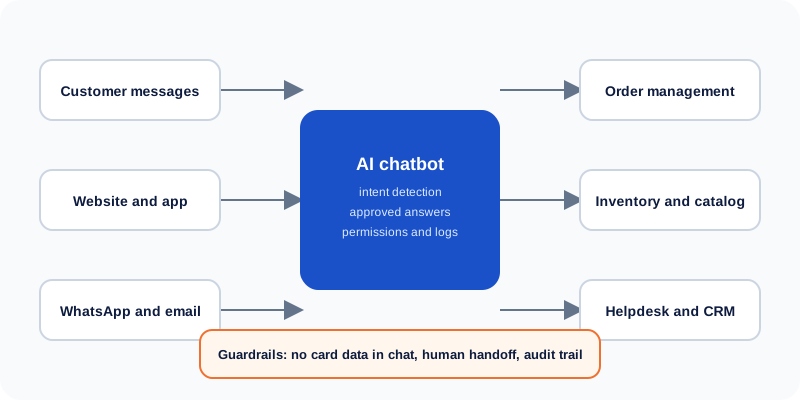
The agent does not replace the systems that hold order, payment, inventory or shipping records. It retrieves the relevant information through authorised integrations and uses it to support investigation and routing.
5.1 Ticket Understanding and Order Verification
When a ticket arrives, the agent reads the message and identifies the problem. It looks for order numbers, payment transaction references, product SKUs, shipment references and the reported issue.
The customer and order details are verified before related records are retrieved. If an essential reference is missing or cannot be matched confidently, the case is flagged for verification. It is not processed on assumptions.
5.2 Cross-System Status Validation
The agent retrieves the relevant records and compares their statuses. Examples include:
- Payment captured, but order status still pending.
- Order confirmed, but inventory information indicates a possible shortage.
- Shipping label created, but no carrier acceptance recorded.
- Refund requested, but the payment or refund status needs verification.
Confirmed information is kept separate from unresolved conditions. A missing record is treated as unknown, not as proof that an event did or did not happen.
5.3 Ticket Classification and Routing
After review, the agent classifies the issue and prepares the case for the right team:
- Payment and order discrepancies go to order operations or the payments team.
- Inventory conflicts go to inventory or fulfilment operations.
- Shipping exceptions go to the shipping team.
- Ambiguous cases go to a person for investigation.
Each summary includes the reported issue, verified references, relevant system statuses, checks already completed, unresolved discrepancies and recommended next steps. The receiving team starts from a clear position instead of repeating the whole investigation.
5.4 Customer Response Support
The agent helps prepare replies using verified information and approved guidelines. It must not present an unverified payment, stock, refund or delivery status as confirmed, and it avoids unsupported promises about delivery dates, refunds or availability. Replies follow the retailer's review and approval process.
5.5 Integration Reliability and Auditability
- Authorised interfaces only, for each ticket category.
- Record validation so order IDs, transaction references, SKUs and shipment references link to the correct case.
- Bounded retries for transient retrieval failures. If a system stays unavailable, the context is preserved and the case is flagged for follow-up.
- Uncertain actions are verified first. If a refund or cancellation returns a timeout or unclear result, its status is checked before any retry. A timeout is not treated as proof that an action failed.
- Traceable records of findings, routing decisions and approved actions.
6. Ticket Categories and Operational Rules
| Ticket category | Records to verify | Exception rule |
|---|---|---|
| Payment captured, no order confirmation | Payment transaction and order status | Flag the mismatch and route for investigation |
| Order confirmed, stock unavailable | Order items, SKU, available stock, reservation | Route to inventory or fulfilment |
| Shipment delayed | Fulfilment status and carrier tracking events | Flag missing or delayed tracking |
| Refund status unclear | Original transaction and refund status | Verify before confirming the outcome |
| Cancellation after fulfilment starts | Order, fulfilment and shipment status | Require authorised human review |
| Missing or conflicting records | Relevant order and operational records | Mark unresolved and request verification |
These rules separate routine enquiries from cases that need operational investigation.
- Payment and order mismatch: the discrepancy is recorded and routed. The agent does not start another payment or issue a refund automatically.
- Inventory conflict: flagged for inventory or fulfilment review. The agent does not change stock levels or promise shipment.
- Unconfirmed shipment: a shipping label without carrier acceptance is not presented as in transit.
- Missing records or failed systems: the missing information is identified and the case context kept. No unsupported conclusion is drawn.
7. End-to-End Operational Workflow
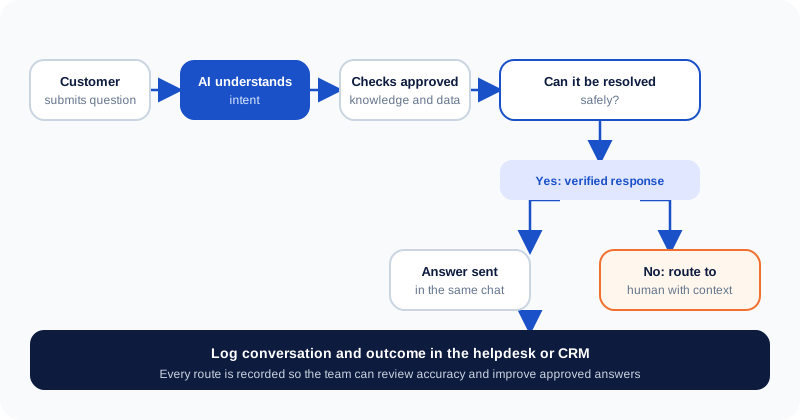
- Receive the ticket: an enquiry about an order, payment, stock, refund, cancellation or shipment arrives.
- Identify the issue: the agent classifies the ticket and extracts the references.
- Verify the order: customer and order details are checked before records are retrieved.
- Retrieve relevant data: only the authorised information for that category is requested.
- Compare statuses: agreement, conflicts and missing data are identified.
- Prepare the summary: verified facts, completed checks, discrepancies and next steps are organised.
- Route or escalate: the case goes to the right team when investigation, authorisation or correction is needed.
- Record decisions: findings, routing, approvals and authorised actions are logged.
- Support the customer reply: the agent uses verified findings to explain the current status and next steps.
8. Case Walkthrough: Payment Captured but No Order Confirmation
A customer contacts support because the payment appears to have been taken, but no confirmation has arrived.
Before the AI agent: the agent finds the order, checks the payment, reviews the order status and decides whether fulfilment has started. If the records conflict, the findings are gathered and the operations team is contacted. Repeated checks and extra messages can delay a reliable update.
With the AI agent: the agent finds the order reference and retrieves the records from authorised systems. It returns three findings:
- The payment record shows a captured payment.
- The order management record shows a pending order.
- No shipment record exists for the order.
The agent identifies the mismatch, records the checks already completed and routes the case to order operations. It does not start another payment, issue a refund or promise immediate shipment. The team confirms the correct outcome, then the case is updated and the customer receives an accurate reply.
Business value: the receiving team gets a structured investigation with a clearly identified open issue, instead of starting from separate manual checks.
9. Integration Scope, Testing and Human Approval
9.1 Integration Scope
| System area | Information required |
|---|---|
| Customer support | Ticket ID, issue description, case history, assignment, investigation notes |
| Order management | Order ID, order status, line items, fulfilment state |
| Payment processing | Transaction reference, payment status, refund status |
| Inventory management | SKU, available quantity, reservation status |
| Fulfilment and shipping | Fulfilment status, shipment reference, carrier tracking events |
The order ID is the primary reference. Transaction, SKU and shipment references connect the other records, and these links are checked before a summary is built.
The final case study should name the platforms actually connected, the data each connection retrieves, and which access is read-only versus approved write operations. These details must come from project records.
9.2 Testing and Validation
Testing covers normal handling and the situations where data is missing, inconsistent or unavailable:
- Ticket classification: supported issues are assigned to the correct category.
- Record matching: order, payment, inventory and shipment records link to the correct case.
- Status validation: matching and conflicting combinations are tested.
- Exception handling: missing records, failures and uncertain transactions trigger the right response.
- Routing accuracy: exceptions reach the right team.
- Summary accuracy: summaries are checked against the source records.
- Approval enforcement: restricted actions stay blocked until authorisation is recorded.
- Failure handling: retries are bounded and uncertain actions are not repeated blindly.
- Auditability: findings, escalations, approvals and changes can be traced.
A completed-deployment case study should report the scenarios tested, test volumes, defects found and resolved, and the acceptance criteria used. These figures must come from test and release records.
9.3 Human Approval Workflow
| Action | AI agent responsibility | Human responsibility |
|---|---|---|
| Retrieve order and payment information | Retrieve authorised records and summarise | Review conflicting or unclear evidence |
| Classify and route tickets | Apply categories and routing rules | Correct misrouted or exceptional cases |
| Prepare customer replies | Draft from verified information | Review or send under the approved process |
| Issue refunds or compensation | Present evidence and a recommendation | Approve or reject the financial action |
| Cancel an order | Check order and fulfilment status | Authorise cancellation under policy |
| Correct an order or payment state | Identify the discrepancy and prepare the case | Approve and carry out the correction |
| Handle an uncertain transaction | Retrieve status and flag uncertainty | Decide the next step if still unclear |
For approval-controlled actions, the reviewer, decision, timestamp and resulting action are recorded. Without approval, the restricted action stays blocked.
9.4 Production Readiness and Monitoring
Before a workflow is described as deployed, the following evidence should exist: production access configuration, the ticket categories enabled at launch, approved routing rules, test and release acceptance records, approval and audit logs, production ticket volumes, and before-and-after KPIs measured with consistent definitions.
10. Business Impact and Measurement
Intended operational benefits:
- Less manual investigation: relevant records and findings sit in one structured summary.
- Clearer ownership: defined categories send exceptions to the right team.
- More consistent replies: answers are based on verified order, payment, stock and shipping information.
- Better exception handling: missing or conflicting records are flagged, not treated as confirmed.
- Better case continuity: notes show which checks are done and what is still open.
- Greater traceability: findings, routing, approvals and actions can be reviewed.
| KPI | What it measures |
|---|---|
| Average ticket handling time | Time spent investigating eligible order tickets |
| First-contact resolution rate | Eligible cases resolved without another customer contact |
| Repeat contact rate | How often a customer returns about the same issue |
| Exception routing time | Time from identifying an exception to assigning it |
| Case correction rate | Cases that needed correction because of inaccurate handling |
| Ticket reassignment rate | Tickets reassigned after first routing |
| Integration failure rate | Required data retrievals that failed |
| Human override rate | Classifications or recommendations changed by a reviewer |
Before-and-after results should use comparable periods, consistent categories, documented KPI definitions and an adequate sample size. No performance improvement should be claimed until it is verified with support records, workflow logs and quality review data.
11. Conclusion
E-commerce order issues often involve several business functions at once. A customer enquiry may need checks across order management, payments, inventory, fulfilment and shipping before the team can answer accurately.
Cor Advance Solutions designed an AI agent workflow that retrieves authorised information, compares statuses, identifies discrepancies, prepares investigation summaries and routes unresolved cases. It combines AI-assisted investigation with defined exception rules, controlled access, traceable records and human approval for sensitive actions.
For e-commerce operations leaders, the value is a more structured way to investigate complex order issues, fewer repeated checks, cleaner case handoffs and more consistent customer communication.
Want a similar workflow for your store? Read our guide to automating ecommerce order processing with AI, or discuss your order operations with our team.