Manufacturing
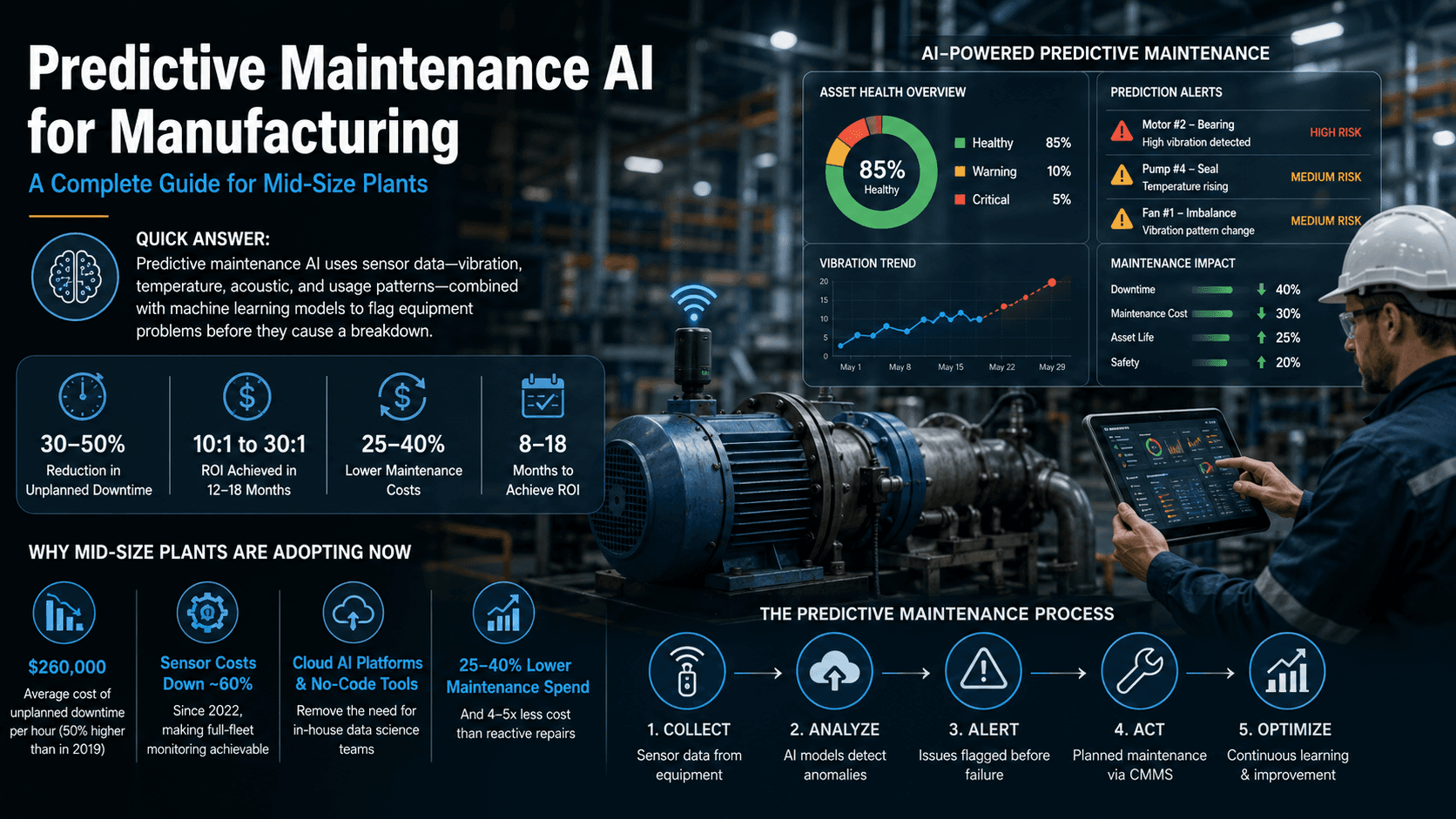
Predictive Maintenance AI for Manufacturing: A Complete Guide for Mid-Size Plants
20 min read

Quick answer: Indian manufacturers are racing to adopt AI agents in 2026 because aging equipment, tight margins, and the high cost of unplanned downtime make predictive maintenance and automated quality control immediately valuable — and because India's manufacturers are deploying AI at scale faster than the global average. EY's 2026 research found 24% of Indian organizations already have agentic AI live in production, with automotive and pharmaceutical manufacturing leading the shift.
If you run a manufacturing operation in India, you've probably already felt this shift — whether it's a competitor talking about predictive maintenance, or your own team asking why quality control still relies on manual inspection. Here's what's actually driving the rush, and what's working for the manufacturers ahead of the curve.
Direct answer: In manufacturing, an AI agent is a system that monitors equipment, quality, or production data continuously and takes or recommends action — flagging a machine likely to fail, catching a defect a human inspector would miss, or adjusting a production schedule — without needing a person to check every reading manually.
This is a meaningfully different category from the automation Indian manufacturers have used for years. A fixed automation system on a production line does the same programmed action every time. An AI agent monitoring that same line can notice a vibration pattern that historically precedes a bearing failure, flag it three days before the failure would have happened, and recommend a maintenance window — a judgment call, not a fixed rule.
Real example: A traditional maintenance schedule services a machine every 90 days regardless of its actual condition — sometimes too early, sometimes too late. An AI agent monitoring that machine's sensor data in real time can flag it for maintenance based on its actual wear pattern, whether that's at day 60 or day 120, catching problems a fixed schedule would miss entirely.
Three forces are converging to make 2026 the year Indian manufacturers moved from watching AI agents to deploying them.
First, the cost of downtime hasn't gotten cheaper. Unplanned stoppages on aging industrial equipment remain one of the most expensive line items a plant manager deals with, and predictive maintenance directly targets that cost with a clear, measurable payback.
Second, the tools got dramatically faster to deploy. The shift toward buying proven, fast-to-deploy AI agent platforms instead of building custom systems in-house — cited by 91% of Indian leaders as their deciding factor — has collapsed what used to be a multi-year data science project into something a manufacturer can pilot in weeks.
Third, India's broader enterprise AI adoption is genuinely ahead of the curve. With 40% of Indian respondents reporting significant or full AI usage at scale against a roughly 28% global average, manufacturing isn't adopting AI agents in isolation — it's riding a broader wave of Indian enterprises moving faster than their global peers on AI generally.
Important note: Fast adoption isn't the same as fully mature adoption. EY's broader research also flags that deployment speed is outpacing governance in some organizations — the technology is moving faster than some companies' internal processes for managing it responsibly. We covered the headline numbers from this same EY research in more depth in our industry update on Indian manufacturers and AI agent adoption.
Monitors equipment sensor data — vibration, temperature, sound — to flag developing failures before they cause a stoppage, rather than relying on fixed maintenance schedules that service equipment on a calendar instead of its actual condition. See our predictive maintenance AI guide for manufacturing for a full breakdown of how this works and what it typically costs to implement.
Uses camera-based AI to catch product defects automatically and consistently, at a speed and consistency manual visual inspection can't match at scale — particularly valuable on high-volume production lines where fatigue affects human inspector accuracy over a shift.
Automotive manufacturing is leading this shift in India, using AI agents to streamline assembly-line throughput and reduce rework — a sector where production runs at high volume with tight tolerances, making both predictive maintenance and quality control especially high-value. Pharmaceutical manufacturing is close behind, applying AI to drug discovery support and production-line efficiency, where consistency and defect detection carry direct regulatory and safety stakes, not just cost implications.
Manufacturing isn't the only function moving fast — at-scale AI deployment is strongest in product development (62%), strategy and operations (56%), marketing and sales (55%), and supply chain (48%), according to EY's research. That context matters for manufacturers: the AI agent adoption happening on the factory floor is usually part of a broader company-wide shift, not an isolated initiative — which means manufacturing leaders evaluating AI agents can often draw on lessons already being learned elsewhere in their own organization.
| Factor | Traditional Automation | AI Agents |
|---|---|---|
| Decision-making | Fixed, pre-programmed rules | Contextual, based on live data |
| Maintenance approach | Calendar-based schedules | Condition-based, triggered by actual wear |
| Quality control | Manual inspection or fixed-threshold sensors | Camera-based AI catching nuanced defects |
| Adapts to new patterns | No — requires reprogramming | Yes, within its trained scope |
| Best suited for | Simple, repetitive, unchanging tasks | Variable conditions requiring judgment |
| Pros | Cons |
|---|---|
| Reduces unplanned downtime with condition-based maintenance | Requires reliable sensor data infrastructure to work well |
| Catches defects more consistently than manual inspection at scale | Governance often lags deployment speed without deliberate planning |
| Fast-to-deploy platforms shorten time to value significantly | One successful pilot doesn't guarantee readiness elsewhere in the facility |
| Aligns with broader company-wide AI momentum in most Indian enterprises | Needs ongoing monitoring, not a one-time setup |
If you're evaluating where to start, our AI & Machine Learning services page walks through how we scope a first AI agent pilot around a specific, measurable manufacturing use case.
Indian manufacturers are adopting AI agents quickly because predictive maintenance and quality control directly target expensive, measurable problems — unplanned downtime and defects — and because fast-to-deploy platforms have made adoption far quicker than the custom AI projects of a few years ago.
EY's 2026 research found 24% of Indian organizations have agentic AI actively deployed in production, with manufacturing among the more active sectors alongside product development and supply chain.
Predictive maintenance (flagging equipment issues before failure) and computer-vision quality control (automatically detecting product defects) account for the largest share of active manufacturing AI deployments in India.
Automotive manufacturing is leading, using AI to streamline assembly-line throughput and reduce rework, with pharmaceutical manufacturing close behind on drug discovery support and production efficiency.
40% of Indian respondents report significant or full AI usage at scale, compared to roughly 28% globally, and Indian enterprises broadly are leading global peers in at-scale AI adoption across most business functions.
Most are buying rather than building — 91% of Indian leaders cite deployment speed as their deciding factor in buy-versus-build decisions, favoring proven platforms over custom development.
Governance lagging behind deployment speed — fast adoption without clear oversight processes is a pattern flagged across this wave of Indian enterprise AI adoption, not unique to manufacturing.
Reliable sensor data from the equipment being monitored — typically vibration, temperature, or acoustic data — collected consistently enough for the AI model to learn what a developing failure looks like before it happens.
No — fast-to-deploy platforms have lowered the barrier significantly, and mid-size manufacturers with a clear, high-cost problem (like recurring downtime on a specific line) are well positioned to start with a focused pilot.
A focused pilot on one production line, using a proven platform rather than custom development, typically shows measurable results within one full production cycle after a deployment period of several weeks.
Indian manufacturers aren't adopting AI agents because of hype — they're adopting them because predictive maintenance and quality control solve two of the most expensive, measurable problems on a factory floor, and the tools to deploy them have gotten dramatically faster in the last two years. With nearly a quarter of Indian organizations already running agentic AI in production and adoption outpacing the global average, the manufacturers still relying entirely on fixed maintenance schedules and manual inspection are increasingly the exception, not the norm.
Cor Advance Solutions builds AI agent and automation systems for manufacturers. Get in touch to talk through what a first AI agent pilot would look like on your production line.
Disclaimer: Statistics in this article are drawn from cited industry research as of 2026 and represent industry-wide estimates, which vary by company and sector. This article is for general informational purposes and does not constitute business advice.
Let's discuss how these insights apply to your specific challenges.
Get in Touch