Logistics Companies Collect Driver, Customer & Delivery Data—Where Does DPDP Risk Begin?
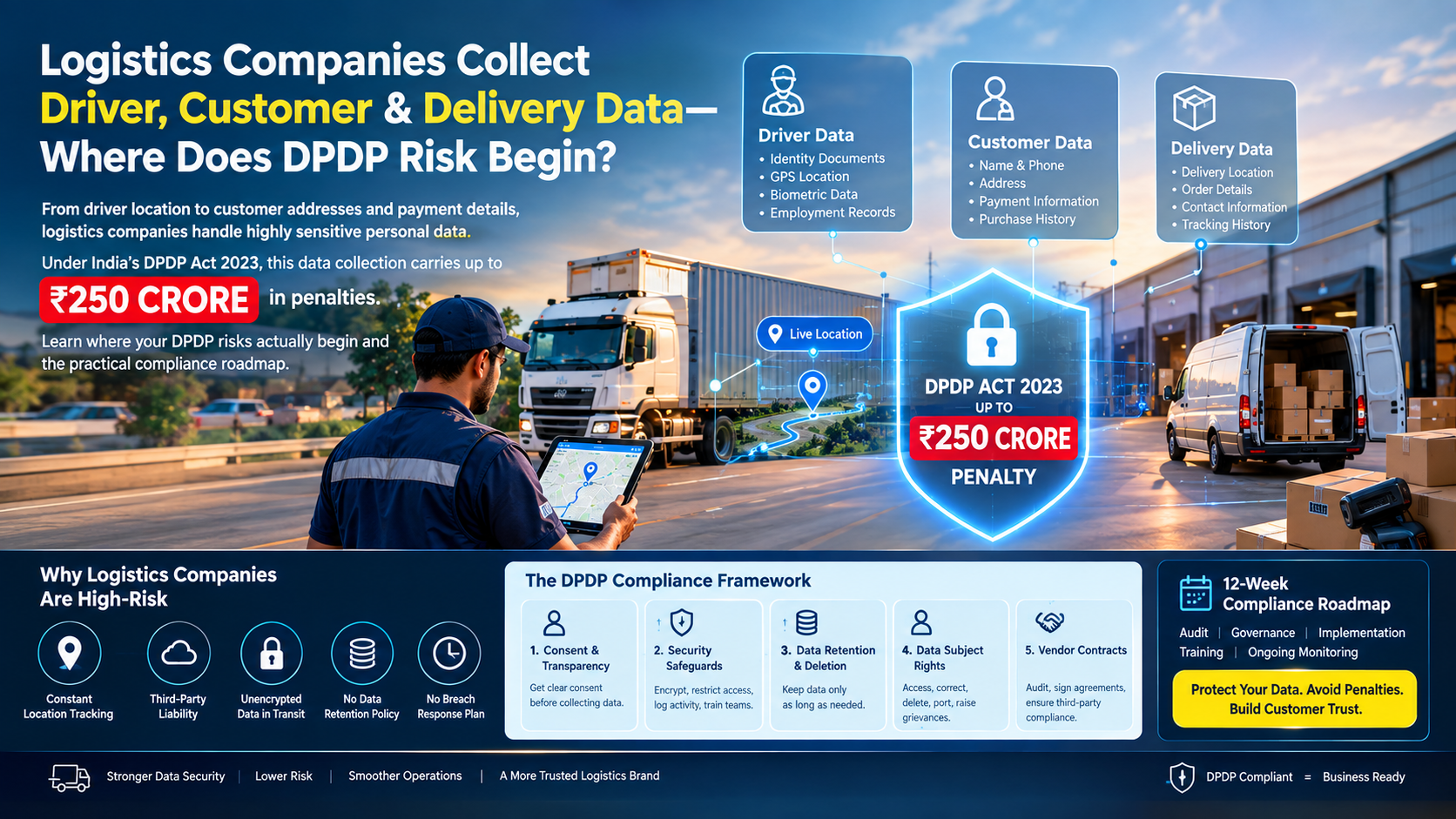
Logistics companies collect more personal data than most other industries. Every delivery order contains customer names, phone numbers, addresses, and payment information. Every driver on your payroll generates employment data, location data, and biometric information.
This data collection is essential to run a modern logistics operation. But it is also your biggest compliance risk under India's new data protection law—the Digital Personal Data Protection Act, 2023 (DPDP Act).
The DPDP Act imposes strict penalties for mishandling personal data. The highest fine is ₹250 crore. Yet many logistics businesses remain unsure about what data they actually hold, where the compliance risks begin, and what steps they need to take before enforcement rolls out in 2027.
What Personal Data Does a Logistics Company Actually Collect?
Most logistics companies collect data across five main categories:
1. Customer Data
Every customer you deliver to becomes a data point in your system:
- Full names and phone numbers
- Residential addresses and delivery locations
- Payment information (credit card, debit card details)
- Purchase history and delivery preferences
- Device data (IP addresses, app usage patterns)
- Communication history (calls, emails with support)
A typical logistics company with 1 million active customers holds 5-10 terabytes of customer data. You are responsible for protecting every data point.
2. Driver Employment Data
Your drivers generate the most sensitive data:
- Full names, dates of birth, and identification documents (Aadhaar, PAN)
- Phone numbers and personal addresses
- Bank account information for salary payouts
- Real-time GPS location data (vehicle tracking)
- Biometric data (fingerprints, face recognition)
- Health information (medical certifications, vaccination records)
- Family information (emergency contacts, dependents)
Under the DPDP Act, location data and biometric data are explicitly classified as sensitive.
3. Delivery Partner / Gig Worker Data
If you work with freelance delivery partners, you collect:
- Personal identification information
- Bank details for payment
- Background check results
- Real-time location tracking
- Performance metrics and ratings
- Communication with customers
You are processing their personal data—creating the same compliance obligations as employee data.
4. Internal Business Data
Inside your operations, you maintain:
- Employee payroll information
- HR records (attendance, leave, performance)
- Vendor and supplier information
- Internal communications
- Security footage and CCTV recordings
This is also personal data under the DPDP Act.
5. Third-Party Data
You may also process personal data on behalf of other companies:
- Customer data for e-commerce businesses
- Data shared by freight forwarders
- Data received from government bodies
You are responsible for protecting this data under the DPDP Act.
Where Does DPDP Risk Actually Begin? The Three Risk Tiers
The law creates three tiers of severity:
Tier 1: General Non-Compliance (₹50 Crore Penalty)
This applies to violations of routine DPDP obligations:
- Collecting data without clear consent
- Processing data for purposes beyond consent
- Failing to delete data when requested
- Sharing data with third parties without consent
Tier 2: Children's Data & Significant Data Fiduciary Violations (₹150 Crore Penalty)
This applies when you process children's personal data without proper consent or fail special obligations.
Tier 3: Data Breach Due to Security Failure (₹250 Crore Penalty)
This is the maximum penalty when you failed to implement reasonable security safeguards and a data breach occurred.
Why Logistics Companies Are High-Risk Under DPDP
Logistics companies face unique DPDP vulnerabilities:
- Constant Location Tracking - GPS tracking creates sensitive data that must be strictly protected
- Third-Party Liability - You remain liable if your cloud provider gets hacked
- Unencrypted Data in Transit - Many transmit data without encryption
- No Data Retention Policy - Most keep customer data indefinitely (must have clear policies)
- No Breach Response Plan - You have 72 hours to notify the DPDP Board
The DPDP Compliance Framework: Five Core Obligations
Obligation 1: Consent & Transparency
Before collecting data, clearly explain what you collect and why. Get explicit written consent.
Obligation 2: Security Safeguards
Implement reasonable security:
- Encrypt sensitive data at rest and in transit
- Use strong access controls
- Keep security logs
- Regularly test for vulnerabilities
- Train employees on data privacy
Obligation 3: Data Retention & Deletion
You cannot keep data indefinitely. Automate deletion after retention periods expire:
| Data Type | Retention | Reason |
|---|---|---|
| Customer delivery address | 30 days | Proof of delivery |
| Payment information | 3 years | Tax compliance |
| Driver location data | 30 days | Route optimization |
| Employment records | 5-7 years | Labor law |
Obligation 4: Data Subject Rights
Customers and drivers have the right to:
- Access: Know what data you hold (30-day response)
- Correction: Fix wrong information
- Deletion: Ask you to delete their data
- Portability: Download data in CSV/JSON format
- Grievance: File formal complaints
Obligation 5: Vendor & Processor Contracts
If you use third parties (cloud providers, payment processors), you must:
- Sign data processing agreements
- Audit their security practices quarterly
- Ensure they delete data on your instructions
- Remain legally responsible for their breaches
Real-World Compliance Scenarios
Scenario 1: Customer Data Breach During Holiday Rush
A logistics company uses an unencrypted temporary cloud server for peak season. A misconfigured firewall leaves it publicly accessible. A hacker downloads 100,000 customer records.
Penalty: Up to ₹250 crore for security failure leading to breach.
Scenario 2: Driver Location Data Misuse
A manager uses GPS tracking to monitor drivers after work hours, checking where they go in the evening. A driver discovers this and files a complaint.
Penalty: Up to ₹50 crore for processing data beyond the scope of consent.
Scenario 3: Vendor Breach Cascades to You
A payment processor you use gets hacked. 50,000 of your customers' payment data leaks.
Penalty: Up to ₹75 crore because you failed to vet and monitor the vendor properly.
Your 12-Week DPDP Compliance Roadmap
Phase 1: Audit (Weeks 1-2)
- Map all data you collect and where it lives
- Review current consent and security practices
- Identify all third-party data processors
Phase 2: Governance (Weeks 3-4)
- Appoint a Data Protection Officer
- Create data governance policies
- Set up data subject rights process
Phase 3: Technical Implementation (Weeks 5-10)
- Encrypt sensitive data (payment info, biometric data)
- Implement access controls
- Set up automated data deletion
- Enable data portability
Phase 4: Process & Training (Weeks 11-12)
- Create a breach response plan
- Train employees on data privacy
- Audit vendor security practices
External Resources
Refer to these authoritative sources:
- Ministry of Electronics and Information Technology - DPDP
- Data Protection Board of India
- NASSCOM Data Protection Guide
- NIST Cybersecurity Framework
- ISO 27001 Certification
- RBI Guidelines on Data Protection
- TRAI Regulations on Data Handling
Common DPDP Questions for Logistics
Q: If a customer refuses to provide their phone number, can we refuse delivery? A: A phone number is necessary for delivery, so you can refuse service if it's not provided.
Q: How long can we keep customer location data after delivery? A: Only as long as necessary for the stated purpose (typically 30 days for route optimization).
Q: If a driver asks for their location data to be deleted, what do we do? A: You must delete it within 30 days unless there's a legal reason to retain it.
Q: What if a customer's payment data is exposed in a breach? A: You must notify them within 72 hours, notify the DPDP Board, and offer identity theft protection.
Q: Do we need cyber insurance? A: Strongly recommended—it can cover legal costs and fines in some cases.
The Bottom Line
DPDP compliance is not optional. Logistics companies that start building compliance now will identify vulnerabilities before enforcement begins, build customer trust, and avoid catastrophic penalties.
The cost of compliance (₹20-50 lakhs) is far lower than the cost of a breach and penalties (₹50-250 crore plus legal fees).
Ready to assess your logistics company's DPDP compliance risk?
Schedule Your Free DPDP Compliance Assessment →
Our team specializes in helping logistics and supply chain companies build DPDP-compliant systems without disrupting operations.