Only 31.5% of US Hospitals Use Generative AI Inside Their EHR Systems: 7 Integration Challenges Healthcare Leaders Must Address
A JAMA Network Open study found that 31.5% of US acute care hospitals used generative AI integrated with their EHRs in 2024. Adoption is slow for practical reasons: fragmented data, legacy systems, validation and governance. Here are the seven challenges and how to solve them.
Introduction: the gap between generative AI adoption and real hospital integration
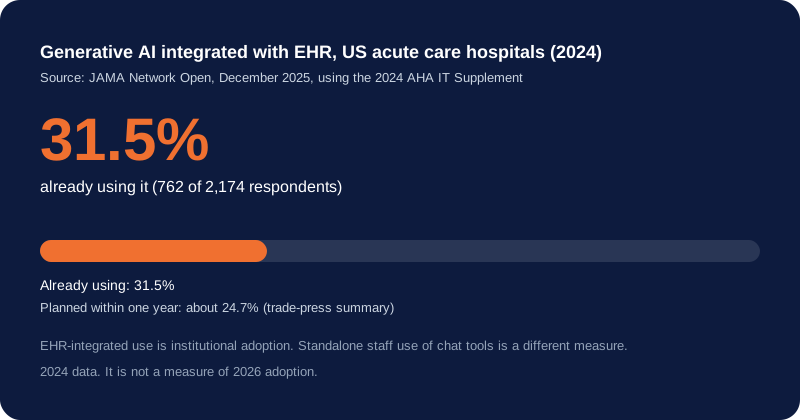
Most clinicians have tried a general-purpose AI chatbot. Far fewer hospitals have connected generative AI to the electronic health record (EHR), where clinical notes, orders, results and billing information actually live. That difference is the subject of a December 2025 study in JAMA Network Open, which found that 31.5 per cent of surveyed nonfederal US acute care hospitals reported using generative AI integrated with their EHR in 2024.
An EHR-integrated tool is different from a clinician using a standalone chatbot. It can read the authorised patient record, write documentation back into the chart and sit inside an approved workflow with an audit trail. That makes it more useful, and it also makes it more demanding to build, validate and govern.
The gap between experimenting with generative AI and integrating it into clinical and administrative work is where most hospitals currently stand. Many have run pilots. Fewer have moved a tool into production, connected it to live data and assigned clear responsibility for its performance.
The central message of this article is simple. The challenge is no longer access to generative AI models. Models are widely available. The challenge is integrating AI into hospital operations without compromising clinical accuracy, patient privacy or the workflows clinicians already depend on. Hospitals do not need another isolated tool. They need the data infrastructure, integration architecture and clinical governance that make AI usable inside their existing systems.
Key message: The real challenge is no longer access to generative AI. It is integrating AI into hospital operations without compromising clinical accuracy, patient privacy or existing workflows.
The sections below explain what the study measured, why integration is hard, seven high-value use cases, the architecture that supports them, the data and governance groundwork, a practical 90-day roadmap, how to measure return, and what to look for in an implementation partner.
What the JAMA Network Open study reveals about generative AI adoption in US hospitals
What the researchers measured
The study was published online on 12 December 2025 in JAMA Network Open. It used the 2024 American Hospital Association (AHA) IT Supplement, a national survey of hospital technology. The survey population was 4,376 nonfederal acute care hospitals. Of those, 2,253 responded to the IT survey, and 2,174 answered the AI questions.
The study defines the key measure narrowly: generative AI integrated with the EHR. It does not count individual staff members using a public chatbot on their own. That distinction matters, because institutional integration is what determines whether AI touches patient records, documentation and workflows at scale.
Understanding the 31.5% adoption figure
The headline result is that 762 of 2,174 responding hospitals, or 31.5 per cent, reported currently using generative AI integrated with their EHR in 2024. This is an adoption figure for a specific year and a specific definition.
Trade-press summaries of the study also describe a group of hospitals that planned to implement generative AI within a year, and a larger group with no immediate plans or uncertain timing. Those secondary figures should be checked against the full paper before they are quoted precisely.
Two cautions apply. First, this is 2024 survey data, so it should not be presented as the current position in 2026. Adoption has likely moved since then, and any current estimate needs fresh data. Second, the figure measures reported use, not the quality, scope or safety of that use. A hospital with an integrated tool and a hospital with a fully validated, monitored deployment both count as adopters.
Which hospitals are moving faster?
The study points to several factors associated with earlier adoption. Hospitals that already run predictive AI within their EHR were more likely to be early or near-term adopters. The authors also found higher use among hospitals on certain EHR platforms and among large teaching hospitals.
These patterns reflect readiness rather than enthusiasm alone. Hospitals with an existing AI capability already have data pipelines, validation habits and governance routines. They also tend to have larger technology teams and budgets. For smaller hospitals, the lesson is not that they are behind, but that the foundations matter more than the model.
What the research reveals about AI evaluation
One finding deserves attention from every hospital leader. The authors reported that less robust evaluation of AI tools was associated with early adoption. In other words, the hospitals that moved fastest were not always the ones that tested most rigorously.
Speed is not a problem in itself. Speed without validation is. Before an AI tool touches clinical documentation or patient records, a hospital should be able to show how it was tested against realistic clinical scenarios, what errors it makes, and who monitors its outputs after go-live. Post-deployment monitoring is not optional. A tool that performed well in a pilot can degrade when workflows, templates or source data change.
Why hospitals struggle to integrate generative AI into existing EHR systems
Seven challenges account for most of the gap between a promising pilot and a working system. Each one is technical or operational, and each one has a direct business impact.
1. Fragmented patient data across multiple healthcare systems
A patient's record is rarely in one place. Clinical information spreads across the EHR, a separate laboratory system, radiology, pharmacy, billing and sometimes legacy systems inherited through mergers. Duplicate patient records and inconsistent data formats add to the problem.
For AI, this matters because a summary or recommendation is only as complete as the data it can reach. If an AI tool cannot retrieve a recent lab result or a medication change held in another system, the output may look confident and still be misleading.
Business impact: AI applications may generate incomplete or misleading outputs when they cannot access all relevant patient information. Hospitals need a unified patient data layer before they can trust AI summaries.
2. Legacy EHR systems and integration limitations
Many hospitals run older applications with limited integration capability. Some expose only partial interfaces. Others rely on custom connections built years ago. Interoperability is improving, but support varies by vendor and by module, and the same platform may behave differently across hospital configurations.
Connecting an AI application to an EHR therefore means working within the vendor's APIs, approved integration routes and contractual limits. Each EHR environment needs its own mapping, and a design that works in one hospital may not transfer directly to another.
Business impact: Hospitals may struggle to introduce AI without disrupting existing clinical operations. Integration work often takes longer than the AI development itself.
3. Clinical documentation accuracy and AI hallucinations
Generative AI produces fluent text, and fluent text can contain errors. In a clinical setting, typical failure modes include summaries that omit a medication or allergy, misread the sequence of a patient's history, or state something the record does not support.
These errors are hard to spot because the output reads well. That is why AI-generated documentation needs clinician verification before it becomes part of the record, and why the verification step must be designed into the workflow rather than left to goodwill.
Business impact: Unvalidated AI-generated information can introduce clinical and operational risks, including incorrect records that other clinicians rely on later.
4. Patient data privacy and security risks
Any AI integration that reads or writes protected health information (PHI) raises privacy and security questions. These include who can access the tool, what data it sends to a model provider, whether vendor systems retain or reuse that data, and how access is logged.
The HHS Office for Civil Rights publishes HIPAA guidance for covered entities and business associates. Whether a particular deployment falls under HIPAA, and what agreements are required, depends on the roles of the hospital and each vendor and on the data involved. Business associate agreements are often needed where a vendor handles PHI on the hospital's behalf. No technology or vendor can make a deployment compliant on its own, so this article does not make that claim.
Business impact: Poorly governed AI integration can expose hospitals to privacy, security and compliance risks, and a single incident can damage patient trust.
5. Clinician resistance and workflow disruption
Clinicians already carry heavy documentation loads. An AI tool that adds steps, produces output that needs heavy editing, or sits outside the workflow will be ignored or worked around. Low trust is a rational response to a tool that has not earned it.
Training matters too. Clinicians need to know what the tool does well, where it fails and how to correct it. Without that, a technically successful system can still fail to achieve adoption.
Business impact: Even technically sound AI systems may fail to deliver value if clinicians do not trust or use them.
6. Limited AI governance and validation frameworks
Many hospitals have not defined who owns an AI tool once it goes live. Without clear ownership, there is no one accountable for testing, monitoring, incident response or retirement. Validation procedures may be missing, and testing may not cover the clinical scenarios where errors matter most.
The NIST AI Risk Management Framework (AI RMF 1.0) offers a voluntary structure for managing AI risk, organised around four functions: govern, map, measure and manage. It does not replace clinical or legal requirements, but it gives hospitals a common vocabulary for governance work.
Business impact: Hospitals may deploy AI tools without sufficient evidence of reliability, safety and operational value.
7. Unclear implementation costs and ROI
AI integration has costs beyond the software licence. These include EHR integration work, cloud and infrastructure, data engineering, security reviews, clinician training and ongoing maintenance. Productivity gains are real in some workflows and uncertain in others, which makes the business case hard to write.
Hospitals that define baseline metrics before deployment find it much easier to judge whether an AI investment is paying off. Section 9 covers how to do that.
Business impact: Hospitals may struggle to justify AI investments without measurable operational outcomes.
Seven high-value generative AI use cases hospitals can integrate with existing EHR systems
The use cases below are potential implementation opportunities. They are not capabilities proven by the JAMA study, and each one needs local validation before deployment. In every case, a qualified clinician or staff member makes the final decision.
1. AI-powered clinical documentation and note summarization
Problem: Clinicians spend substantial time turning encounters into structured notes.
Workflow: The tool converts a clinician-patient conversation, with appropriate consent, into a draft note, summarizes relevant history and organises the content into the documentation template.
Integrations: EHR note templates, the clinical encounter record and, where appropriate, ambient audio capture.
Human oversight: The clinician reviews, edits and approves the draft before it is saved to the record.
Outcome to measure: Documentation time per encounter, clinician correction rate and after-hours documentation time.
2. Patient record summarization across multiple systems
Problem: Preparing for a visit means searching several systems for prior diagnoses, medications and results.
Workflow: The tool retrieves information the user is authorised to see from connected systems, summarises visits, diagnoses, medications and relevant history, and links each statement to its source.
Integrations: The EHR, laboratory and imaging systems, through approved interfaces.
Human oversight: Every summary shows its sources so the clinician can verify it.
Outcome to measure: Time to prepare a chart, number of source checks needed, and unsupported statement rate.
3. AI-powered patient communication and FAQ management
Problem: Front-desk and call-centre teams answer the same administrative questions every day.
Workflow: The tool answers routine questions about appointments, preparation instructions and office procedures from approved content. It routes complex or clinical questions to appropriate staff.
Integrations: Scheduling and patient portal systems, and an approved knowledge base.
Human oversight: The tool never offers diagnosis or treatment advice. Clinical questions go to clinicians through an established route.
Outcome to measure: First-response time, share of routine questions resolved without staff time, and escalation accuracy.
4. Clinical coding and medical documentation assistance
Problem: Coders must find the documentation that supports each code, and missing information causes rework and denials.
Workflow: The tool identifies documentation relevant to coding review, flags gaps and organises supporting evidence for the coder.
Integrations: The EHR documentation and the coding workflow system.
Human oversight: Final code assignment stays with qualified coding professionals.
Outcome to measure: Coder review time, query volume and rework rate.
5. Laboratory report summarization and workflow assistance
Problem: Historical laboratory results are spread across reports, and abnormal findings can be buried in long lists.
Workflow: The tool retrieves authorised results, organises them over time and drafts a summary for clinician review. Abnormal or urgent findings follow the hospital's existing escalation procedures.
Integrations: The laboratory information system and the EHR results view.
Human oversight: Urgent findings are never delayed by an AI summary. They follow established clinical escalation.
Outcome to measure: Time to review a result history and escalation timeliness.
6. Discharge summary and referral documentation assistance
Problem: Discharge and referral documents take time to write and must be accurate for the next provider.
Workflow: The tool drafts the discharge summary, organises follow-up instructions and prepares referral summaries from the encounter record.
Integrations: The EHR encounter, medication and order records.
Human oversight: A clinician reviews and approves every document before release.
Outcome to measure: Discharge documentation time, errors found at review and time from discharge to document completion.
7. Revenue cycle and administrative workflow automation
Problem: Insurance checks and prior authorization requests are repetitive, and incomplete submissions cause delays.
Workflow: The tool checks submissions for missing administrative information, assists prior authorization preparation and routes incomplete cases to billing or administrative staff.
Integrations: Billing, scheduling and payer portal workflows, where the hospital has authorised them.
Human oversight: Staff decide on submissions, and the tool does not make coverage determinations.
Outcome to measure: Denial rate, time to submission and rework volume.
How generative AI can integrate with existing EHR systems without replacing them
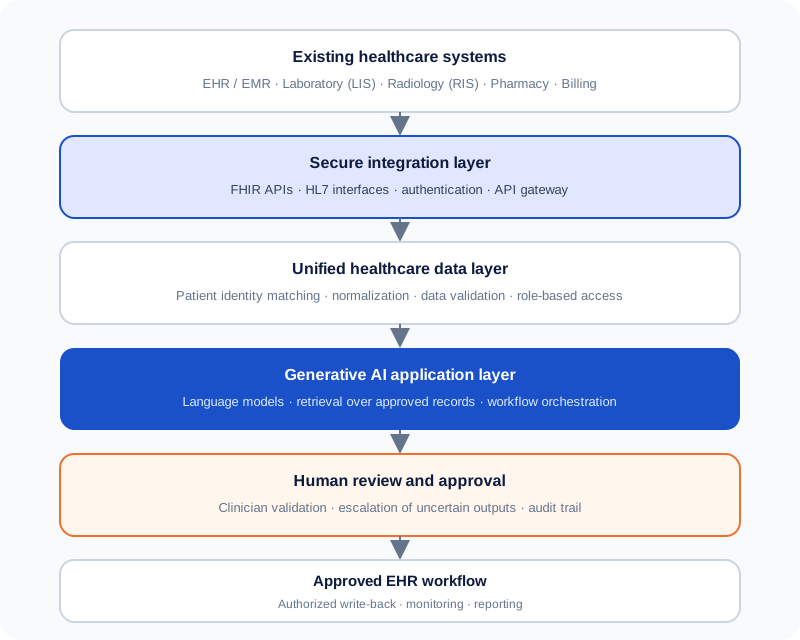
Most hospitals should not replace their EHR to add generative AI. The practical approach adds a controlled layer on top of the systems that already hold the record. The architecture below shows the layers involved. It is conceptual, and the actual design depends on the hospital's EHR vendor, infrastructure and clinical workflows.
Connect existing EHR platforms through secure integration layers
The first layer connects the AI application to the EHR and other clinical systems. This is usually done through vendor APIs, the FHIR standard where the vendor supports it, and HL7 interfaces where they are still in use. HealthIT.gov describes FHIR, the United States Core Data for Interoperability (USCDI) and related standards as the foundation of health IT interoperability.
Secure middleware, API gateways and authentication sit between the AI application and the clinical systems. These controls decide what data flows where, who can request it and how each request is logged.
Build a unified healthcare data access layer
Clinical data arrives in many formats. A unified data layer normalises it, matches records to the correct patient, validates the data and applies role-based access. Master patient identity management is especially important, because a summary built on the wrong patient is among the most serious errors an AI tool can make.
The layer should handle both structured data, such as lab values and medication lists, and unstructured data, such as clinical notes and scanned documents.
Introduce a healthcare AI application layer
The application layer is where the language model, retrieval and orchestration sit. Retrieval-augmented generation (RAG) is a common pattern here. Instead of relying only on what a model learned during training, the system retrieves relevant, authorised clinical content at the moment of the request and grounds the output in that content.
Context-aware prompt orchestration controls what the model receives for each task, and model selection and routing decide which model handles which task. Keeping these choices configurable makes it easier to replace a model later without rebuilding the whole system.
Implement human-in-the-loop approval workflows
No AI-generated clinical content should reach the record without review. Approval workflows make that review explicit. The clinician sees the draft, the sources it used and any uncertainty flags. Only approved content is written back to the EHR, and every AI-generated item is recorded in an audit trail that shows what was generated, who approved it and what changed.
Uncertain outputs should escalate to a person rather than being quietly accepted.
Monitor AI performance after deployment
Monitoring tracks whether the system remains accurate after go-live. The useful measures include output accuracy, hallucination rate, clinician correction rate, response time, user adoption, and security and access logs. Correction rates are especially informative: a rising rate often signals a change in templates, data or workflow before it shows up as a patient safety issue.
How hospitals can build an AI-ready data infrastructure before implementing generative AI
AI projects in healthcare succeed or fail on data. Hospitals that treat data engineering as a precondition, rather than an afterthought, avoid many of the problems described above.
Assess existing healthcare data infrastructure
Start with a map of the systems that hold clinical and administrative data. Identify disconnected databases, review what each EHR integration supports, document the data sources and record the known quality problems. This assessment shows where the real work sits, which is often not where the AI team expected.
Create a unified and governed healthcare data environment
Data integration pipelines move data from source systems into a governed environment, with normalisation rules, metadata and documented lineage. Governance policies define who owns each dataset and who may use it for which purpose. Secure access controls apply the same rules across every use.
Our data warehousing and analytics services cover the integration, modelling and governance work that this step requires, and the same principles apply to clinical data.
Make clinical data accessible to AI applications
Structured records, such as lab results and medication orders, and unstructured documentation, such as notes, need different handling. Unstructured documents benefit from indexing and secure retrieval, so the AI application can find the relevant passage quickly. Context-aware access ensures that each request only retrieves what the user is permitted to see.
Establish healthcare data quality controls
Quality controls catch problems before they reach the AI. These include duplicate detection, identification of missing data, validation rules that flag implausible values, source traceability that shows where each fact came from, and continuous monitoring of data quality over time.
Prepare the infrastructure for scalable AI deployment
Hospitals need infrastructure that can host and orchestrate models, scale APIs as usage grows, and remain observable. Cloud, hybrid and on-premises options each have trade-offs for clinical data, and the choice depends on the hospital's security requirements and existing investments. Disaster recovery and business continuity planning must cover the AI layer too, because clinicians will come to depend on it.
HIPAA, patient privacy and AI governance: what hospitals must address before deployment
HIPAA requirements for generative AI implementations
HIPAA's Privacy and Security Rules govern protected health information, and the HHS Office for Civil Rights publishes the authoritative guidance. Several questions determine what applies to a given deployment: whether the hospital is a covered entity, whether a vendor is a business associate that handles PHI for it, what uses and disclosures are permitted, and which administrative, physical and technical safeguards are in place. Business associate agreements are required where a vendor handles PHI on the hospital's behalf.
Legal advice is essential. Technology choices affect compliance, but they do not make a deployment compliant by themselves.
Patient consent and AI disclosure considerations
Whether a patient must be told about AI use depends on the workflow, the jurisdiction and the nature of the data. Some hospitals choose to disclose AI involvement in documentation or communication even where disclosure is not clearly required. Others follow specific state requirements. Hospitals should decide their disclosure approach with legal counsel and apply it consistently, rather than assuming one approach is a universal legal requirement.
AI access control and data security
Role-based access control should limit each user and each AI component to the data it needs. Encryption protects data in transit and at rest. Authentication should be strong, and audit logs should record every access and every AI-generated write. Third-party vendors need security assessments that cover where data is stored, whether it is used to train models, how it is deleted and how incidents are reported.
Clinical AI validation and risk management
Validation should happen before deployment and continue afterwards. Pre-deployment testing should cover realistic clinical scenarios, including edge cases such as complex histories and unusual medication combinations. The evaluation should examine performance across patient groups, so that errors are not concentrated in a subpopulation without anyone noticing. Human oversight remains essential, and post-deployment monitoring should track the metrics described earlier.
Establish an enterprise healthcare AI governance framework
Governance works best as a standing structure rather than a one-off project. An AI governance committee should include clinical leadership, IT and security, compliance and legal, and a representative of the clinical teams that will use the tool. Each AI system should have a named owner, a documented validation status and a clear escalation path for incidents. The NIST AI RMF's govern, map, measure and manage functions give that committee a structure for its work.
A practical 90-day roadmap for implementing generative AI in hospital EHR workflows
The roadmap below is an illustrative sequence for a first use case. It is not a guarantee that every hospital can safely reach production in 90 days. Timelines depend on the EHR environment, the data quality, the number of integrations, the approvals required and the testing the clinical team needs.
| Phase | Timeline | Key activities |
|---|---|---|
| Phase 1: Assessment | Days 1–15 | Workflow audit, EHR review, data readiness and use-case selection |
| Phase 2: Architecture | Days 16–30 | Integration design, security requirements, governance and success criteria |
| Phase 3: Development | Days 31–60 | AI application development, API integration, data access and testing |
| Phase 4: Validation | Days 61–75 | Clinical review, security testing, accuracy assessment and workflow validation |
| Phase 5: Pilot | Days 76–90 | Controlled rollout, monitoring, clinician feedback and performance evaluation |
Two points should shape any plan. First, select one use case with a clear owner, not several at once. Second, decide the success criteria in Phase 2, before anything is built, so that the pilot can be judged against them.
How hospitals should measure the ROI of generative AI integration
Hospitals should record baseline metrics before deployment and evaluate the AI against those baselines. Without a baseline, any improvement is a matter of opinion.
Clinical documentation efficiency. Measure time spent preparing documentation, documentation completion time and clinician correction rates.
Administrative productivity. Measure manual processing time, the volume of repetitive tasks removed and workflow completion time.
AI quality and reliability. Measure the accuracy of generated summaries, the rate of unsupported statements, clinician override rates and escalation frequency. These are the measures that protect patients as well as budgets.
Technology and integration performance. Measure EHR integration reliability, API response times, system availability and the operating cost of the AI application.
Patient and clinician experience. Measure clinician satisfaction, patient communication response times, workflow usability and adoption across departments.
A useful discipline is to report quality metrics alongside productivity metrics. A tool that saves time but raises the correction rate has not saved time overall.
Why hospitals need an experienced healthcare AI and integration partner
Building a generative AI model is only part of the work. A hospital deployment depends on understanding the clinical workflow, connecting to the EHR, engineering the data, designing the security controls and running validation that clinicians accept. Few teams bring all of these skills together.
The capabilities that matter most include:
- Healthcare workflow assessment that identifies where AI helps and where it does not
- EHR and EMR integration, working within each vendor's APIs and contractual limits
- HL7 and FHIR interoperability, so that data moves reliably between systems
- Healthcare data engineering that produces a trustworthy, governed data layer
- Generative AI application development with retrieval, orchestration and human approval built in
- Security and privacy controls designed around HIPAA-related obligations, with legal review
- Clinical validation workflows that involve the people who will use the tool
- Ongoing monitoring and optimisation after go-live
Planning to integrate generative AI into your existing hospital EHR system?
Cor Advance Solutions helps healthcare organisations assess AI opportunities, connect existing technology systems, establish reliable data workflows and develop generative AI solutions aligned with operational requirements. We start with the workflow and the data, not the model, and we design the approval and monitoring steps before anything reaches a clinician's screen.
If you are evaluating a first use case, begin with our healthcare industry solutions to see how we approach clinical and administrative workflows. When you are ready to scope a build, our generative AI development services cover the application layer, retrieval and approval design.
Frequently asked questions
What percentage of US hospitals use generative AI integrated with EHR systems? According to a JAMA Network Open study published in December 2025, 31.5 per cent of surveyed nonfederal US acute care hospitals reported using generative AI integrated with their EHR in 2024. That is 2024 survey data, so it does not measure current adoption.
Why are hospitals struggling to integrate generative AI into existing EHR platforms? The main reasons are fragmented patient data across systems, legacy EHR integration limits, documentation accuracy risks, privacy and security requirements, clinician workflow fit, weak governance and uncertain costs. Each one must be addressed before the tool can be used safely at scale.
Can generative AI integrate with Epic, Oracle Health and other EHR systems? Often, yes, but the scope depends on each vendor's APIs, app programmes and contract terms, and on how the hospital has configured its environment. Confirm the available integration routes with the EHR vendor before designing the solution.
How does HL7 FHIR help connect generative AI with hospital EHR systems? FHIR is a standard for exchanging healthcare data through APIs. Where a vendor supports FHIR resources, an AI application can request authorised data in a consistent format. HealthIT.gov describes FHIR as a core interoperability standard. Coverage varies by vendor, so check what each system exposes.
Can hospitals implement generative AI without replacing their existing EHR? Yes, in most cases. The usual approach adds a secure integration layer, a data layer and an AI application on top of the existing EHR, with approved write-back. Replacing the EHR is a separate decision that is rarely required for the first use case.
How can hospitals prevent hallucinations in AI-generated clinical documentation? No method eliminates hallucinations completely. Hospitals reduce the risk by grounding outputs in authorised source data, showing sources for each statement, requiring clinician review before saving, testing against realistic clinical cases and monitoring correction rates after go-live.
Is generative AI HIPAA compliant? A technology is not HIPAA compliant in itself. Compliance depends on how the hospital and its vendors handle protected health information, including permitted uses, safeguards, agreements and documentation. Business associate agreements are often required where vendors handle PHI. Obtain legal advice for each deployment.
How can hospitals protect patient data when integrating third-party AI models? Limit the data sent to the model to what each task needs, confirm in the contract how the vendor stores, uses and deletes that data, encrypt data in transit and at rest, apply role-based access and keep audit logs. Assess the vendor's security posture before the contract is signed.
What are the best generative AI use cases for hospitals? Common starting points include clinical documentation drafting, patient record summarization, patient communication for routine questions, coding support, laboratory summaries, discharge documentation and administrative workflow support. The best first use case has a clear owner, a measurable outcome and manageable clinical risk.
How long does it take to implement generative AI in an existing hospital workflow? It depends on the EHR environment, data quality, integration scope, approvals and testing. A focused first use case can follow a phased plan, such as the illustrative 90-day roadmap in this article, but a safe production rollout can take longer. Timelines should be set after assessment.
Conclusion: integration is the real work
Only 31.5 per cent of surveyed US acute care hospitals reported using generative AI integrated with their EHR in 2024. That number is the starting point, not the story. The harder question is how hospitals connect AI to fragmented data, legacy systems, clinical workflows and governance structures without compromising accuracy or privacy.
The answer is an architecture, not a single tool. It combines secure integration, a governed data layer, a controlled AI application, human approval and continuous monitoring. Hospitals that build these foundations can add use cases over time. Those that skip them tend to end up with pilots that never reach the clinical record.
Bottom line: Integration, not model access, decides whether generative AI reaches the clinical record. Build the data, architecture and approval layers first, then scale the use cases.
Sources: JAMA Network Open, Uptake of Generative AI Integrated With Electronic Health Records in US Hospitals (December 2025); HealthIT.gov, Standards and Technology; NIST, AI Risk Management Framework. The HHS Office for Civil Rights HIPAA guidance is cited by name and should be consulted directly. The subgroup percentages from trade press should be verified before publication.
More Industry Updates
See How This Applies to Your Business
Talk to our team about what this shift means for your roadmap.
Schedule Free Consultation