56% of Surveyed US Fashion Companies Use AI for Demand Forecasting and Inventory Planning: What Retailers Should Do Next
The 2026 USFIA Fashion Industry Benchmarking Study reports that 56% of respondents use AI for demand forecasting and inventory planning. Here is what the figure does and does not show, the business use cases, the data requirements, the implementation challenges, and the next steps for US retailers.
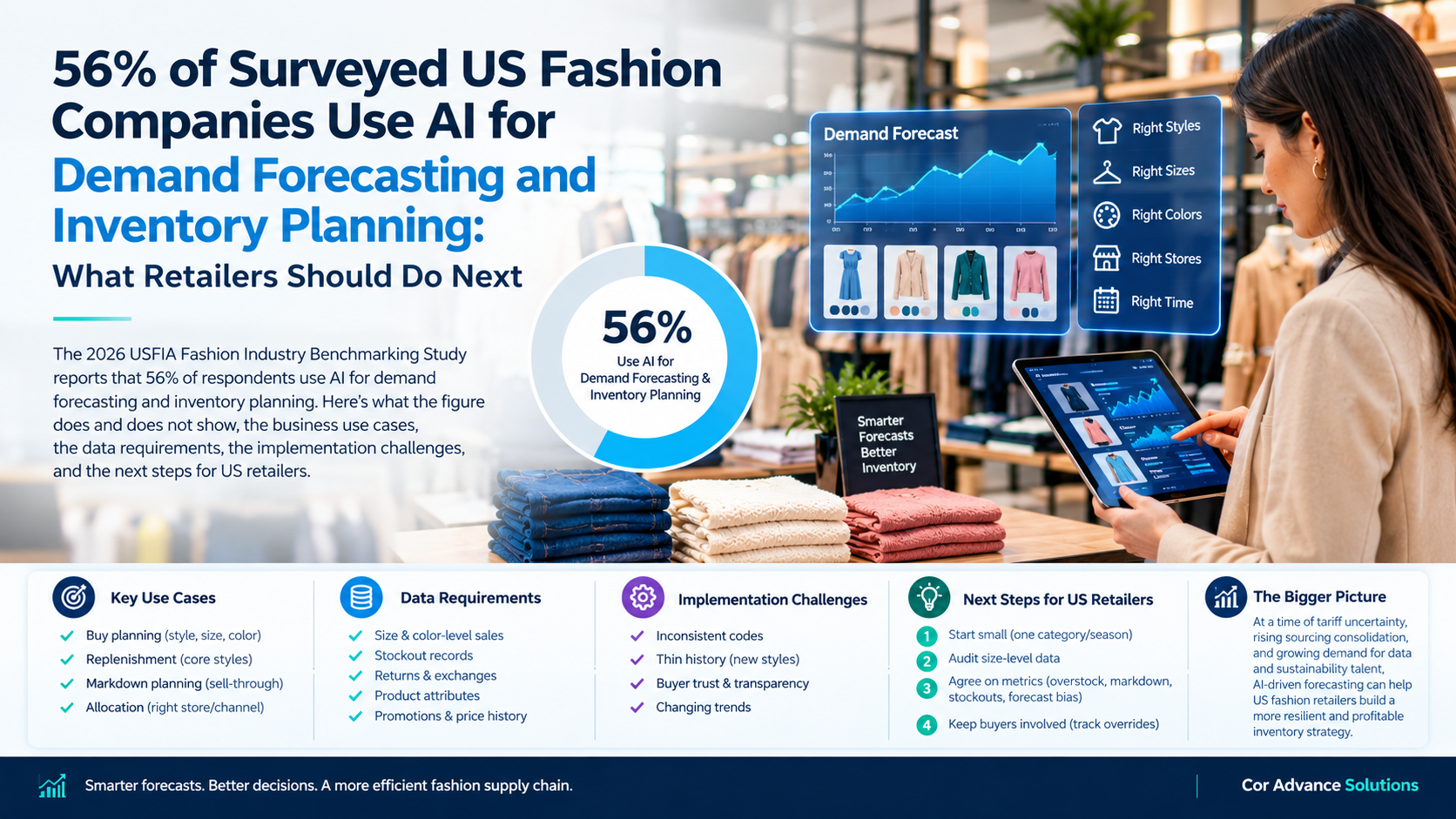
Quick take: In the 2026 USFIA Fashion Industry Benchmarking Study, 56% of respondents said they use AI for demand forecasting and inventory planning. It was the most common AI use reported. The study is a small survey of about 30 leading companies, so the figure describes surveyed firms, not every fashion company in the United States. If you are assessing this for your own range, our AI and machine learning services cover demand forecasting from setup to monitoring.
What the study reports
- Demand forecasting and inventory planning: 56% of respondents, the most common AI use in the survey.
- Who responded: executives at fashion brands, retailers, importers, and wholesalers, according to the United States Fashion Industry Association (USFIA).
- Scope: the survey also covers sourcing practices, trade policy, and business outlook.
The survey is useful for direction. It is not a measure of market-wide adoption, so avoid quoting it as "56% of US fashion companies."
Where AI is being used in forecasting
- Buy planning: forecasts by style, size, and color help set the depth of each order.
- Replenishment: reorder timing for core styles, based on sell-through.
- Markdown planning: sell-through forecasts show when price changes are needed.
- Allocation: units can move to the stores or channels where demand is strongest.
The same release reports that 50% of respondents use AI for sustainability tracking, risk management, and sourcing strategy and cost optimization, which shows how forecasting is being connected to wider planning work.
The wider business context
The USFIA's 2026 benchmarking release includes several figures that matter for planning:
- Tariffs are the top challenge. 92% of respondents rated protectionist US trade policy and tariff uncertainty as one of their top two business challenges in 2026.
- Hiring is planned. About 87% of companies plan to increase hiring over the next five years. Demand is expected to be strongest for data scientists, trade compliance specialists, and sustainability specialists.
- Forced-labor risk moved up. Managing forced-labor risk rose from tenth place in 2025 to sixth place in 2026.
- Sourcing is consolidating. FashionUnited's coverage of the study describes companies moving from supplier diversification toward consolidation and resilience. That makes demand planning across fewer, larger supplier relationships more important.
What the data has to look like
Fashion forecasts depend on detail that many retail systems do not capture well:
- Sales history by size and color, not only by style
- Stockout records, so lost sales are not read as low demand
- Returns and exchanges, which change net demand
- Product attributes, so new styles can borrow patterns from similar ones
- Promotion and price history, so price effects are separated from demand
Implementation challenges
- Inconsistent codes. The same style can carry different SKU or size codes across systems.
- Thin history. New and short-lifecycle styles have little data of their own.
- Buyer trust. Forecasts are used only when buyers can see the range and the reasons behind it.
- Changing trends. Models need regular updates as customer preferences shift.
What US fashion retailers should do next
- Start small. Test one category for one season, running the forecast alongside the current process.
- Audit size-level data. Check stockouts, returns, and style codes before training a model.
- Agree on metrics. Track overstock, markdown rate, core-size stockouts, and forecast bias together.
- Keep buyers involved. Record overrides with reasons, so the team can learn when judgment adds value.
Market context
US clothing and clothing accessory stores reported about $26.5 billion in seasonally adjusted sales for August 2026, the latest month in the U.S. Census Bureau series available through FRED. At that scale, small gains in forecast accuracy can affect significant inventory.
Sources: USFIA Fashion Industry Benchmarking Study · FashionUnited on the 2026 study · U.S. Census Bureau clothing store sales via FRED
More Industry Updates
See How This Applies to Your Business
Talk to our team about what this shift means for your roadmap.
Schedule Free Consultation