Best AI Solutions for eCommerce Stockouts and Overstock: Complete Guide 2026
Running an online store is hard. You have to keep the right amount of products in stock. Too many products and you lose money. Too few products and you lose customers. This problem is called inventory management, and it costs eCommerce businesses billions of dollars every year.
The good news? Artificial intelligence (AI) can fix this problem. AI solutions for eCommerce help you predict what customers will buy, manage your stock better, and make more money. In this guide, we will show you the best AI tools and strategies to stop stockouts and overstock problems.
What Are Stockouts and Overstock? Why Do They Matter?
Stockouts happen when you run out of a product. A customer wants to buy something, but it is not available. They go to another store instead. You lose the sale and the customer may never come back.
Overstock is the opposite problem. You buy too much of a product. It sits in your warehouse and costs money to store. The product may get old, damaged, or go out of style. You have to sell it at a discount, which hurts your profits.
Both problems cost money. Studies show that stockouts cost retailers about 4% of sales. Overstock can cost even more. Together, these issues waste billions of dollars every year in the eCommerce industry.
AI fixes these problems by using data and smart math to predict exactly what you need to buy and when to buy it.
How AI Solves Inventory Problems in eCommerce
AI is not magic. It is smart software that learns from your past data. Here is how it works:
Step 1: Data Collection AI systems look at your past sales. They see what sold well in winter, summer, and spring. They see which products sell together. They learn from holidays and special events.
Step 2: Pattern Recognition AI finds patterns that humans miss. It notices that blue shirts sell more on Mondays. It sees that winter coats are popular in November. It learns that price changes affect how many items sell.
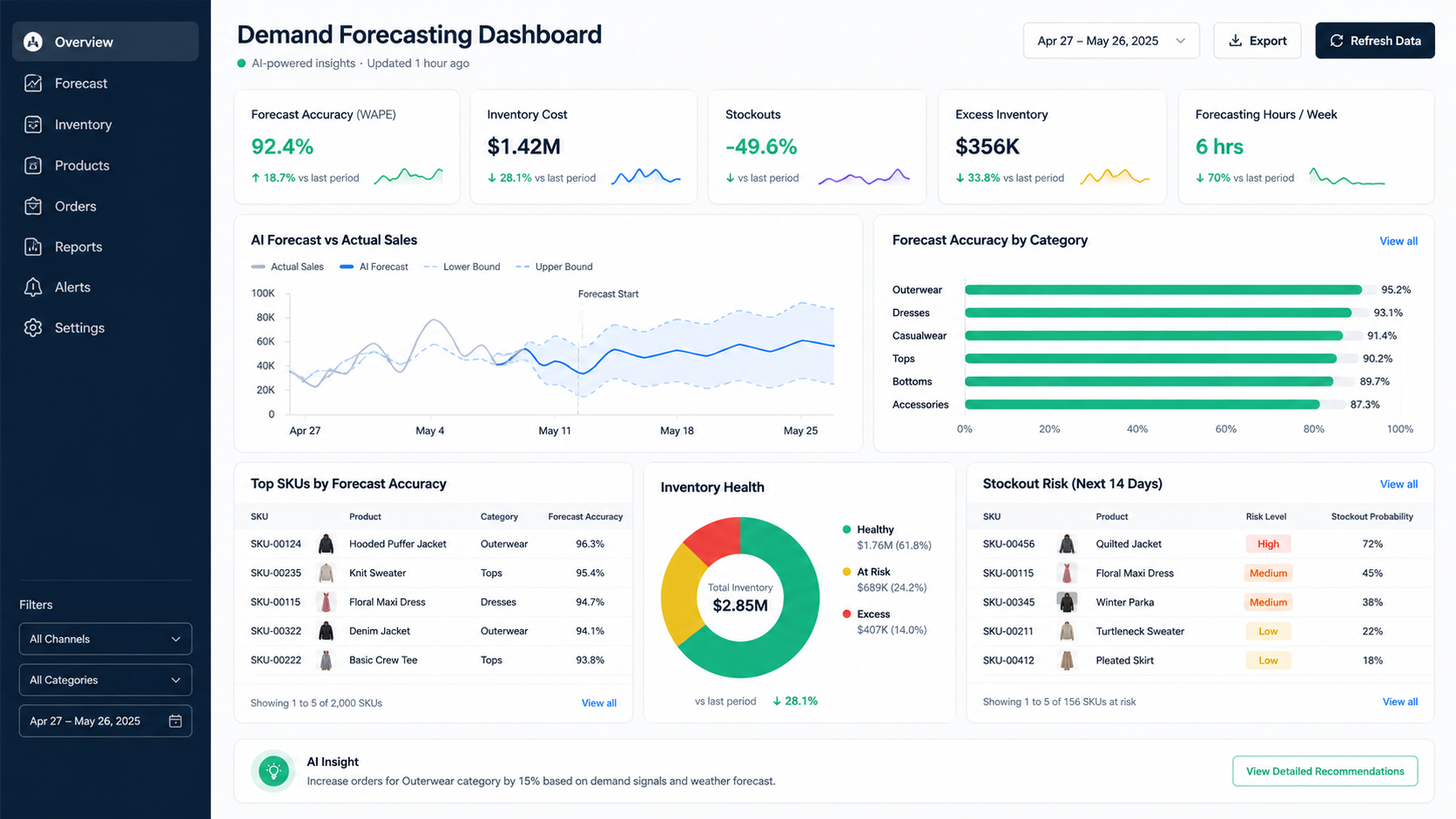
Step 3: Forecasting Using these patterns, AI predicts what you will sell tomorrow, next week, and next month. These predictions are very accurate - often 80% to 95% correct.
Step 4: Automatic Ordering AI tells you exactly how much to order. It considers your warehouse space, how fast items sell, and how long it takes to get new stock. This keeps your inventory perfect.
Primary Problem: Stockouts Cost You Money
A stockout is not just a missed sale. It costs you in many ways:
- Lost Revenue: When you are out of stock, you cannot sell. If you sell 100 shirts a day and run out for 2 days, you lose $4,000 in sales (if each shirt costs $20).
- Lost Customers: Customers remember when you let them down. Studies show 20% of customers who experience a stockout will buy from a competitor instead.
- Damaged Reputation: Online reviews matter. A customer who cannot buy leaves a bad review. This hurts your search ranking and other customers see negative feedback.
- Emergency Costs: When you run out, you have to pay extra for fast shipping to get stock quickly. These emergency orders cost 20% to 50% more than normal orders.
- Lost Cross-Selling: When someone cannot buy their main product, they also skip the add-ons they might have bought. This doubles the lost revenue.
How AI Prevents Stockouts
AI solutions use smart prediction to prevent these problems:
- Accurate Forecasting: AI knows you will need 500 shirts next week. It orders them before you run out.
- Seasonal Planning: AI remembers that you always sell more in summer. It automatically orders more before summer starts.
- Real-Time Updates: AI watches your sales every hour. If something is selling faster than expected, it alerts you to order more.
- Multi-Location Intelligence: If you have multiple warehouses or stores, AI balances stock between them. It moves fast-selling items to busy locations.
Shopify's inventory management report shows that AI-powered forecasting reduces stockouts by 35%.
Secondary Problem: Overstock Drains Your Profits
Overstock is equally expensive. Many small business owners do not realize how much money it costs:
- Storage Costs: A typical warehouse costs $5 to $15 per square foot per year. If you have $50,000 of extra inventory, it might cost you $2,500 to $7,500 just to store it.
- Spoilage and Damage: Some products go bad. Food, cosmetics, and electronics can become useless. You lose 100% of the money you spent.
- Markdowns: When you cannot sell something, you cut the price. If you buy shirts for $5 and sell them for $20, but have to mark down to $12, you lose $8 per shirt.
- Obsolescence: Fashion, technology, and trends change. Last year's phone or style becomes worthless.
- Cash Flow Problems: Money stuck in unsold inventory is money you cannot use to run your business or buy other products.
How AI Prevents Overstock
AI solves overstock by being smart about ordering:
- Precise Quantities: AI orders exactly what you need - not more, not less.
- Demand Sensing: AI notices when customer interest is dropping. If a product is selling slower than last month, AI reduces orders.
- Trend Analysis: AI sees that a fashion item is becoming less popular. It stops ordering before you get stuck with old stock.
- Supplier Coordination: AI talks to your suppliers. It coordinates timing so you get what you need when you need it.
McKinsey research shows that companies using AI cut overstock by 30% while reducing stockouts.
Best AI Tools for eCommerce Inventory Management
Several excellent AI solutions are available. Here are the top ones:
1. Demand Forecasting Platforms
These AI tools predict what you will sell:
Blue Yonder Blue Yonder uses AI and machine learning to predict customer demand. It looks at historical sales, seasonality, holidays, and market trends. It is used by big companies like Walmart and Target. For small businesses, it helps you order the right amount and reduce waste.
Lokad Lokad specializes in demand forecasting for eCommerce. It uses AI to predict demand for thousands of products. It works with your current system and gives you clear recommendations on what to order.
Demand Planning Software by Oracle Oracle's AI engine uses advanced algorithms to predict demand across your entire product range. It considers external factors like weather, social media trends, and competitor activity.
2. Inventory Optimization Tools
These tools help you keep the right amount of stock:
Inventory Labs Inventory Labs helps sellers on Amazon and other marketplaces. Its AI predicts demand and suggests exactly how many units to keep in stock. It also helps you reduce storage fees.
Skubana Skubana is an inventory management platform that uses AI to track stock across multiple channels. It automatically balances inventory between Amazon, eBay, Shopify, and your own store. This prevents overselling and reduces stockouts.
TraceLink TraceLink uses AI to manage supply chain visibility. It helps you see where your stock is and predicts problems before they happen.
3. Automated Ordering Systems
These tools automatically order stock for you:
Reorder Point AI This system uses AI to calculate the perfect time to order. It considers your sales speed, supplier lead time, and safety stock. When stock hits a certain level, it automatically triggers an order.
Shopify Flow Shopify Flow lets you create AI-powered automation. You can set rules like "When product X falls below 50 units, automatically order 200 more units from supplier Y."
NetSuite Inventory Management Oracle NetSuite uses AI to manage inventory across your business. It predicts demand, suggests optimal order quantities, and automates the ordering process.
How to Implement AI for Your eCommerce Business
Adding AI to your business takes planning. Here is how to do it:
Step 1: Evaluate Your Current Problem
Before buying AI tools, understand your problem:
- How often do you have stockouts? How much money does it cost?
- How much overstock do you have? How long does it sit?
- Which products cause the most problems?
- What is your budget for a solution?
Step 2: Choose the Right AI Solution
Based on your needs:
- Small stores with 50-500 products: Try Inventory Labs or Shopify Flow
- Medium stores with 500-5,000 products: Try Lokad or Skubana
- Large stores with 5,000+ products: Consider Blue Yonder or Oracle NetSuite
Step 3: Clean Your Data
AI works best with good data. Make sure your sales records are accurate. Remove old or wrong data. Add any missing information.
Step 4: Set It Up
Most AI tools integrate with your current store system. They connect to your sales data and start learning. This usually takes 1-4 weeks.
Step 5: Monitor and Adjust
Watch how the AI performs. Is it accurate? Is your inventory better? After 2-3 months, make adjustments based on results.
Step 6: Train Your Team
Your staff needs to understand the new system. Show them how to read AI recommendations and use the tools.
Real Results: How AI Improves eCommerce Inventory
Real businesses are seeing amazing results with AI:
Case Study 1: Fashion Retailer
A clothing store with 2,000 products was wasting $30,000 per month on overstock. They used AI forecasting and cut overstock by 40%. This saved them $12,000 per month - $144,000 per year.
Case Study 2: Electronics Marketplace
An online electronics seller had 15% stockouts on popular items. Using AI demand forecasting, they cut stockouts to 3%. This increased sales by 8% - worth $80,000 per year on $1 million in annual sales.
Case Study 3: Grocery eCommerce
A grocery delivery service used AI to manage thousands of perishable products. They reduced food waste by 25% and improved customer satisfaction scores by 18%. Happier customers means more repeat orders and more revenue.
According to Gartner research, companies using AI in inventory management see an average 20% improvement in forecast accuracy.
Key Benefits of AI Inventory Solutions
When you use AI for inventory, you get many benefits:
- Better Forecasting Accuracy (80-95%): AI is much better at predicting demand than humans. It sees patterns you miss. This accuracy keeps inventory perfect.
- Lower Costs: By reducing stockouts and overstock, you save money. These savings often pay for the AI tool in just a few months.
- Faster Decision-Making: AI gives you recommendations instantly. You do not have to spend hours looking at data. You can make decisions faster.
- Scalability: AI works whether you sell 100 items per day or 10,000. It manages thousands of products without slowing down.
- 24/7 Monitoring: AI watches your inventory all the time. It alerts you to problems before they become big issues.
- Improved Customer Satisfaction: When you have stock available, customers are happy. Fewer stockouts means better reviews and repeat buyers.
- Reduced Manual Work: AI automates ordering and stock tracking. Your team has time for more important work like marketing and customer service.
Common Mistakes When Using AI for Inventory
Many businesses make mistakes when adding AI. Here are common ones to avoid:
Mistake 1: Expecting Instant Results AI needs time to learn. It gets better after 2-3 months of data. Be patient.
Mistake 2: Poor Data Quality If your historical data is wrong, AI predictions will be wrong. Clean your data first.
Mistake 3: Ignoring External Factors AI learns from your data, but it also needs to know about holidays, sales events, and marketing campaigns. Tell your AI about these things.
Mistake 4: No Team Training Your staff needs to understand how to use the AI tools. Without training, they will not use them correctly.
Mistake 5: Not Adjusting Settings Different products need different settings. A fast-selling item needs more aggressive ordering than a slow-selling item. Adjust settings for each product category.
Mistake 6: Ignoring Recommendations Sometimes AI recommendations look wrong. But AI usually has good reasons. Before ignoring a recommendation, investigate why the AI made it.
The Future of AI in eCommerce Inventory
AI is improving fast. Here is what is coming:
Predictive Intelligence Future AI will predict not just demand, but also customer behavior. It will know which marketing campaigns work and how they affect inventory needs.
Autonomous Supply Chains AI will automatically negotiate with suppliers, arrange shipping, and manage logistics. Your business will run with minimal human involvement.
Real-Time Adaptation AI will respond instantly to changes - weather, competitor prices, trending products. Inventory will adapt in real-time.
Sustainability Focus AI will help reduce waste and carbon footprint. It will optimize for environmental impact, not just profit.
Collaborative AI AI systems will share information across the supply chain. Your AI will coordinate with supplier AI to ensure perfect timing.
Choosing the Right AI Partner
If you need help implementing AI for your inventory, partner with experts. Look for companies that:
- Understand eCommerce challenges
- Have proven results with businesses like yours
- Offer training and support
- Provide transparent pricing
- Integrate with your current systems
- Have references from other clients
Cor Advance Solutions specializes in AI solutions for eCommerce including inventory management, demand forecasting, and supply chain optimization.
Conclusion
Stockouts and overstock are expensive problems. They cost most eCommerce businesses thousands of dollars every month. But AI solutions fix these problems.
AI predicts demand with 80-95% accuracy. It tells you exactly what to order and when to order it. This keeps your inventory perfect - no stockouts, no overstock.
The best AI solutions include:
- Demand forecasting platforms (Blue Yonder, Lokad)
- Inventory optimization tools (Skubana, Inventory Labs)
- Automated ordering systems (Shopify Flow, NetSuite)
Implementation takes 2-4 weeks, and results usually appear in 2-3 months. Many businesses see payback in under 6 months.
Start today. Evaluate your inventory problems. Choose an AI solution that fits your business. In a few months, you will have better inventory, happier customers, and more profit.