Healthcare Data Integration: How to Unify EHR, Billing, Lab, and Patient Records
Learn how healthcare organizations can break down data silos, improve patient care, reduce billing errors, and gain complete visibility across all systems with unified healthcare data integration.
A patient walks into a hospital. The front desk takes their information. The billing department enters it again. The laboratory gets another copy. The EHR system has yet another version. By the time the patient sees the doctor, this same information exists in five different places with small variations in each one. Some records are current. Others are outdated. Nobody knows which version is correct.
This is the reality of healthcare data integration today. Most healthcare organizations use separate systems for electronic health records, billing, laboratory operations, pharmacy management, and patient records. These systems don't talk to each other. Data sits in disconnected silos. Doctors make decisions based on incomplete information. Billing departments send incorrect invoices. Patients get frustrated when they must repeat information. Operational costs rise. Medical errors increase.
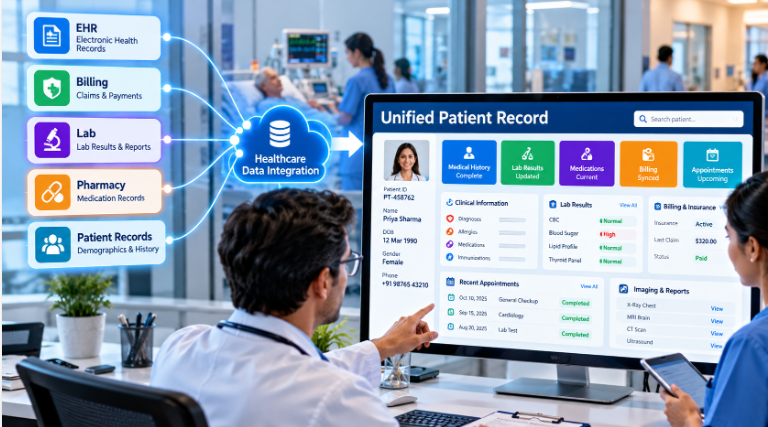
Healthcare data integration solves this problem by connecting all your operational systems into one unified source of truth. Instead of manual data entry, duplicate records, and constant reconciliation, your teams work with clean, real-time, and accurate patient information. Modern healthcare data integration services create a single patient view that includes medical history, billing information, lab results, and appointment records—all accessible instantly and safely. This transformation improves patient outcomes, reduces operational costs, and keeps your organization compliant with healthcare regulations.
In This Guide:
- •Why EHR and healthcare systems don't work together
- •Common healthcare data integration challenges
- •What a unified patient record includes
- •Benefits of healthcare data unification
- •Step-by-step integration implementation
- •Measuring ROI and integration success
Why Healthcare Organizations Struggle With Data Silos
The Legacy System Problem
Most healthcare organizations didn't plan for integration. They bought systems separately over many years. The EHR system came first. Then billing software. Then lab management. Then pharmacy. Each system worked independently. They never needed to talk to each other. But as healthcare operations grew, the cost of managing separate systems became expensive and dangerous.
Today, a large hospital might have 8 to 12 different systems running patient information. None of them share data automatically. A nurse must enter a patient's medication list into the EHR. The pharmacy sees a different version. The billing department has yet another copy. When a patient's information changes, someone must update it in every single system. This manual work creates errors, delays, and costs thousands of hours every year.
Manual Data Entry Creates Patient Safety Risks
Every time someone manually enters patient data, the risk of error grows. A nurse might misread a number. A billing clerk might type a wrong digit. A lab technician might select the wrong patient from a dropdown list. These small mistakes compound. A patient with a penicillin allergy might receive penicillin because the allergy information didn't transfer to the pharmacy system. A doctor might prescribe a medication that conflicts with another medication that exists only in a different system. These errors can cause serious patient harm.
Studies show that healthcare organizations with disconnected systems experience 30% more medical errors than those with integrated systems. The cost of a single preventable error can exceed $100,000 when you factor in hospital stays, lawsuits, and reputation damage.
Billing Errors Cost Money and Patient Satisfaction
When billing data sits in a separate system from clinical data, reconciliation becomes extremely difficult. A patient receives lab work ordered in the EHR. But the lab system doesn't know which insurance plan covers the patient. The billing department doesn't know what tests were actually run. The result is incorrect invoices, surprise bills, denied insurance claims, and frustrated patients. Healthcare billing integration is critical because billing errors are the number one reason patients complain about healthcare organizations.
What Happens When You Don't Have Healthcare Data Integration
Delayed Patient Care and Poor Clinical Outcomes
A patient comes to the emergency room with chest pain. The doctor asks about medications. The patient says "I don't remember all of them." The EHR shows one medication list. The pharmacy system shows a different one. The doctor waits for someone to manually pull records from another system. This delay costs precious time. In an emergency, minutes matter.
Without healthcare systems integration, doctors and nurses spend time searching for information instead of providing care. Lab results take longer to reach the clinical team. Test results might get lost. A patient might undergo unnecessary tests because the doctor doesn't know the test was already done in another system. All of these problems slow down diagnosis and treatment.
Increased Administrative Costs
Healthcare organizations with disconnected systems need more staff to manage data. Someone must manually transfer information between systems. Someone must verify that data matches across platforms. Someone must investigate discrepancies. Someone must handle customer complaints about billing errors. These administrative tasks don't improve patient care. They just cost money.
Research shows that healthcare organizations without patient records integration spend 20-30% more on administrative work than those with integrated systems. For a mid-size hospital, this could mean $500,000 to $1 million in unnecessary annual costs.
Compliance and Privacy Risks
Healthcare is heavily regulated. HIPAA requires healthcare organizations to protect patient privacy. When data sits in separate systems, it's harder to track who accessed patient information and when. Audit trails become complicated. If a data breach happens, it's difficult to determine what information was compromised. Regulatory penalties for HIPAA violations can exceed $1.5 million per violation.
Understanding Healthcare Data Integration: EHR, Billing, Lab, and Patient Records
What is Electronic Health Records (EHR) Integration?
An EHR is a digital record of a patient's medical history. It includes doctor visit notes, diagnoses, medications, allergies, and treatment plans. EHR integration means connecting this system to other healthcare systems so information flows automatically. When a doctor prescribes a medication in the EHR, that prescription automatically appears in the pharmacy system. When a doctor orders a lab test, it automatically appears in the laboratory system. No manual entry. No delays. No errors from copying information.
Most hospitals use one of three major EHR platforms: Epic, Cerner, or Allscripts. These systems are powerful but are designed to work mostly by themselves. Integrating them with other systems requires special connectors and middleware.
Healthcare Billing Integration Challenges
Healthcare billing is complicated. A single patient visit can include charges for the doctor visit, lab work, medications, imaging, anesthesia, and facility fees. All of these charges come from different departments and different billing systems. Without integration, the billing department must manually collect charges from multiple sources and combine them into one invoice.
Billing integration connects the EHR (where services are ordered and documented) to the billing system (where charges are calculated and sent to insurance). When integration works correctly, charges flow automatically. The billing department doesn't have to hunt for information. Insurance claims are more accurate. Patients receive correct bills.
Laboratory Data Integration Requirements
Laboratory systems manage test orders, samples, and results. When a doctor orders a blood test, the lab system needs to know what test was ordered, which patient it's for, and where the sample should go. When the test is complete, the results must go back to the doctor in the EHR. Laboratory data integration automates this flow.
Integration also means the lab doesn't have to answer the phone every time someone asks "where are my results?" Results appear automatically in the patient's EHR. Doctors see results in the system they use daily. No delays. No lost results.
What Unified Patient Records Include
A unified patient record brings together information from every healthcare system. It includes:
- Clinical Information: Medical history, diagnoses, medications, allergies, and treatment plans from the EHR
- Lab Results: All test results, reference ranges, and previous results from the laboratory system
- Imaging Reports: X-rays, CT scans, MRI results, and radiologist notes from imaging systems
- Billing Information: Insurance plans, coverage details, and payment history from billing systems
- Pharmacy Records: Current medications, prescriptions filled, and medication interactions from pharmacy systems
- Appointment History: Past, present, and scheduled appointments from scheduling systems
- Patient Demographics: Contact information, insurance information, and emergency contacts
- Consent and Preferences: Patient preferences for communication and treatment decisions
The Real Benefits of Healthcare Data Integration
Improved Patient Safety
When all patient information is in one place and always current, doctors make better decisions. They see the complete medication list from the pharmacy. They know about allergies. They know about previous reactions. They can check for dangerous drug interactions before prescribing. They can see all recent test results. They don't order the same test twice. They catch potential problems before they become serious.
Studies show that healthcare organizations with integrated systems reduce medical errors by 25-40% within the first year. This means fewer patient injuries, fewer lawsuits, and better patient outcomes.
Better Patient Experience
Patients are frustrated when they must repeat information. "We already gave you that information when we checked in. Why do you need it again?" When systems are integrated, patients enter information once. That information flows everywhere it needs to go. No more asking patients the same questions multiple times. No more waiting for records to be retrieved. Patients feel heard and respected.
Faster Billing and Accurate Claims
With billing integration, charges flow automatically from where services happen to where they're billed. A doctor orders a test. The test is done. The result is recorded. The charge appears in billing. No manual data entry. No lost charges. Healthcare insurance claims are submitted faster and more accurately. Insurance companies pay claims faster. The healthcare organization gets paid faster. Patients receive correct bills and fewer surprise bills.
Operational Efficiency and Cost Savings
When data doesn't require manual entry, staff can focus on patient care instead of data management. Administrative staff spend less time searching for information or fixing errors. The billing department processes claims faster with fewer rejections. Lab staff don't have to answer questions about lost results. Doctors and nurses spend less time on paperwork and more time with patients.
A 500-bed hospital can typically save $2-4 million per year by integrating systems and reducing administrative work.
Better Data for Decisions
When all your healthcare data is unified, you can analyze it to find patterns and improve operations. You can identify which treatments work best. You can find trends in patient outcomes. You can see which departments are most efficient. You can make data-driven decisions about staffing, equipment, and processes. This kind of healthcare process automation with integrated data leads to continuous improvement and better organizational performance.
How Healthcare Data Integration Works: Step-by-Step
Step 1: Understand Your Current Systems
Before you can integrate, you must understand what you have. Map all your healthcare systems. Write down which system does what. Understand how data currently flows (or doesn't flow). Identify the systems that absolutely must talk to each other. Understand what data lives in each system. Document how each system currently handles errors and exceptions.
Step 2: Define Your Integration Goals
Be clear about what you want to achieve. Do you want to eliminate duplicate patient records? Do you want to stop manual data entry between specific systems? Do you want to improve billing accuracy? Do you want faster lab results? Different goals require different integration approaches. Be specific. Write down measurable outcomes. This helps you evaluate success.
Step 3: Select Integration Technology
Healthcare data integration typically uses one of three approaches:
- API Integration: Systems connect directly through APIs (Application Programming Interfaces). This is fastest and most reliable but requires all systems to support APIs.
- Middleware Platforms: A separate software platform (like HL7 or FHIR) sits between systems and helps them communicate. This works even if systems don't have modern APIs.
- Master Data Management: A central database holds the "true" version of each patient record. Other systems sync with this central database.
Step 4: Plan Data Mapping and Transformation
Different systems use different words for the same thing. One system calls it "Patient ID" and another calls it "MRN" (Medical Record Number). One system stores dates as MM/DD/YYYY and another as YYYY-MM-DD. Before systems can share data, you must map these differences. You must decide which system holds the "truth" for each piece of information. You must create rules for handling conflicts.
Step 5: Build and Test Integration
Once you have chosen technology and mapped your data, you build the connections. Start with non-critical systems and work toward more important ones. Test thoroughly with fake data before going live. Test what happens when data is wrong or incomplete. Test what happens when systems go down. Make sure all error handling works correctly.
Step 6: Implement in Phases
Don't try to integrate everything at once. Start with two systems that work together closely. Get that working perfectly. Then add another system. This approach reduces risk and makes training easier. Phase implementation also allows staff to adapt gradually instead of facing massive changes all at once.
Step 7: Train Staff and Monitor
New systems require training. Doctors need to understand how to access integrated patient records. Nurses need to understand where information comes from. Billing staff need to understand new workflows. Lab staff need to understand new result reporting. Create training materials. Hold training sessions. Monitor adoption. Answer questions. Watch for problems.
Common Challenges in Healthcare Data Integration and How to Overcome Them
Legacy Systems That Resist Integration
Some healthcare organizations use systems that are 10, 15, or even 20 years old. These systems weren't designed with integration in mind. They don't have APIs. They store data in ways that are hard to extract. Updating them is risky because they support critical operations. Solution: Use middleware platforms or data extraction tools that can work with older systems. Consider gradual modernization. Sometimes it's better to replace one old system at a time than to integrate all legacy systems at once.
Data Quality Issues
If your source data is bad, integration makes it worse. Bad data gets copied to other systems. If patient addresses are sometimes missing or incorrectly formatted, that bad data spreads. Solution: Before integrating, clean your data. Identify and fix common problems. Create data quality rules. Monitor data quality continuously. Healthcare data integration requires clean data to work well.
Duplicate Patient Records
Healthcare organizations often have multiple records for the same patient. A patient with a common name might appear 5 different times in the system because their name is spelled slightly differently or their date of birth was entered wrong once. Identifying and merging these duplicate records is challenging. Solution: Use "master patient index" software that matches records using multiple data points, not just name. Manual review of potential duplicates. Careful planning before merging records.
Privacy and Security Concerns
More connected systems mean more places where patient information could leak. Healthcare organizations must be extremely careful about security. Solution: Use encrypted connections between systems. Control who can access what information using role-based access control. Log all access to sensitive data. Regular security audits. Compliance monitoring.
Best Practices for Successful Healthcare Data Integration
Get Executive Support and Funding
Healthcare data integration requires investment. You need software. You need staff. You need training. Projects fail when leadership doesn't understand the value or when funding runs out midway. Solution: Build a business case. Show how integration improves patient safety, reduces costs, and improves patient experience. Get buy-in from hospital leadership before starting.
Involve End Users in Planning
Doctors, nurses, and administrative staff understand the real problems with current systems. They know what integration would help most. Solution: Include them in planning. Ask them what frustrates them most. Ask them what would help them work better. Their insights lead to better integration plans.
Plan for Change Management
Integration changes how people work. Some people resist change. Some worry about learning new systems. Solution: Communicate clearly. Explain why change is happening. Train people thoroughly. Support them during transition. Recognize and celebrate successes.
Monitor and Continuously Improve
Integration isn't a one-time project. It's an ongoing process. Systems change. New systems get added. Regulations evolve. Solution: Create a team responsible for integration health. Monitor integration failures. Fix problems quickly. Plan for regular updates. Keep integration current as your organization evolves.
Measuring Success: Healthcare Data Integration ROI and Metrics
Key Performance Indicators to Track
How do you know if your integration is working? Track these metrics:
- Time to Access Patient Information: How long does it take to pull a complete patient record? Should drop from hours to seconds.
- Manual Data Entry Time: How many hours per month are spent manually copying data between systems? Should drop significantly.
- Billing Error Rate: What percentage of insurance claims are rejected? Should drop by 20-40%.
- Medical Error Rate: How many adverse events occur due to incorrect patient information? Should drop.
- Patient Satisfaction: Do patients report better experiences? Should improve.
- Staff Satisfaction: Do staff feel less frustrated with data management? Should improve.
- Revenue Cycle Time: How long does it take from providing a service to getting paid? Should improve.
Return on Investment (ROI) Timeline
Healthcare data integration requires upfront investment but delivers returns quickly. Most healthcare organizations see payback within 18-24 months. Initial costs include software, hardware, professional services, and staff time. Expected benefits include:
- $500,000 - $1 million in annual cost savings from reduced administrative work
- 5-10% improvement in billing accuracy leading to $100,000 - $500,000 in additional revenue
- Reduced malpractice insurance costs from fewer medical errors
- Improved patient satisfaction and retention
- Faster diagnosis and treatment leading to better outcomes
Healthcare Data Integration Standards and Compliance
Understanding FHIR and HL7 Standards
Healthcare systems use specific standards for exchanging data. HL7 is an older standard that has worked for decades. FHIR (Fast Healthcare Interoperability Resources) is a newer, modern standard that is replacing HL7. Most new healthcare systems use FHIR because it's simpler and works better with modern APIs.
HIPAA Compliance in Integration
The Health Insurance Portability and Accountability Act (HIPAA) governs how healthcare organizations handle patient information. When you integrate systems, you must maintain HIPAA compliance. This means:
- Data must be encrypted in transit and at rest
- Access must be logged and audited
- Only authorized users can access patient information
- Patient privacy must be protected
- You must have a plan for handling security breaches
21st Century Cures Act Requirements
The 21st Century Cures Act requires healthcare organizations to share patient records with other organizations using standard APIs. This law is accelerating healthcare data integration. Organizations that want to be forward-thinking must plan integration with external organizations in mind, not just internal systems.
Getting Started With Healthcare Data Integration
Assessment and Planning Phase
Start by assessing your current situation. Map all systems. List pain points. Define goals. Estimate costs. Get stakeholder buy-in. A good assessment takes 4-8 weeks and costs $20,000-$50,000 but saves money later by preventing costly mistakes.
Quick Wins to Build Momentum
Start with integration projects that deliver value quickly. Maybe integrate the lab system with the EHR first. Or integrate billing with the EHR. Choose projects that solve real problems people face daily. Quick wins build support for larger projects.
Build vs. Buy vs. Hybrid Approach
You can build custom integration using developers and APIs. You can buy integration software that handles healthcare systems. Or you can use a hybrid approach. Most healthcare organizations use a hybrid: buy middleware platforms for integration but build custom connections for unique requirements.
Frequently Asked Questions About Healthcare Data Integration
How long does healthcare data integration take?
Simple integration of two systems can take 3-6 months. Complex integration of many systems can take 12-24 months. Timeline depends on system complexity, data quality, and organizational readiness.
What does healthcare data integration cost?
Small integration projects cost $50,000-$200,000. Medium projects cost $200,000-$1 million. Large enterprise integration costs $1 million-$5 million. Most projects pay for themselves within 18-24 months.
Can we integrate with systems from different vendors?
Yes. This is called "vendor-agnostic" integration. Middleware platforms and integration services can connect systems from different vendors. This is actually common in healthcare where organizations use best-of-breed systems.
What happens if integration fails or data doesn't sync?
Good integration design includes error handling and fallback procedures. If one system goes down, others can continue working. Data that fails to sync gets flagged for manual review. Monitoring alerts staff to problems immediately.
How do we handle duplicate patient records after integration?
Master Patient Index (MPI) software identifies likely duplicates. A team of people manually verifies matches. Then the system merges duplicate records carefully, combining information from both records and archiving one. This process is careful because merging records wrong can cause serious problems.
Is cloud-based integration more secure than on-premises?
Both can be secure if implemented correctly. Cloud-based integration has advantages: automatic updates, automatic backups, managed security. On-premises integration gives you more control. Many healthcare organizations use hybrid approaches with some systems in the cloud and others on-premises.
The Future is Integrated: Healthcare Data Integration is No Longer Optional
Healthcare is changing. Regulations increasingly require interoperability. Patients expect their information to flow seamlessly between providers. Insurance companies expect integrated billing. The 21st Century Cures Act is pushing healthcare toward open standards and data sharing. Healthcare organizations that don't integrate their systems will find themselves at a competitive disadvantage.
Healthcare data integration is not just a technology project. It's a business transformation. It changes how doctors work. It improves patient care. It reduces costs. It improves patient satisfaction. It reduces legal and compliance risks. Organizations that successfully integrate their systems report significant improvements in efficiency, quality, and financial performance.
The journey to integrated healthcare systems is not easy. It requires careful planning, the right technology partners, and commitment from organizational leadership. But the benefits are substantial. A hospital that successfully integrates its systems becomes a better organization. Patients receive better care. Staff are happier. The organization runs more efficiently. Costs go down. Revenue goes up. Patient satisfaction improves.
If your healthcare organization is struggling with disconnected systems, data silos, and manual processes, healthcare data integration is the solution. Start by assessing your current situation. Define clear goals. Choose the right technology partner. Plan carefully. Implement step by step. Monitor and adjust. The result will be a more integrated, efficient, and effective healthcare organization that provides better patient care and achieves better financial performance.
Ready to Integrate Your Healthcare Systems?
Our healthcare data integration experts can help you unify EHR, billing, laboratory, and patient records. Let's discuss how integration can improve patient care and operational efficiency at your organization.
Schedule Free Consultation