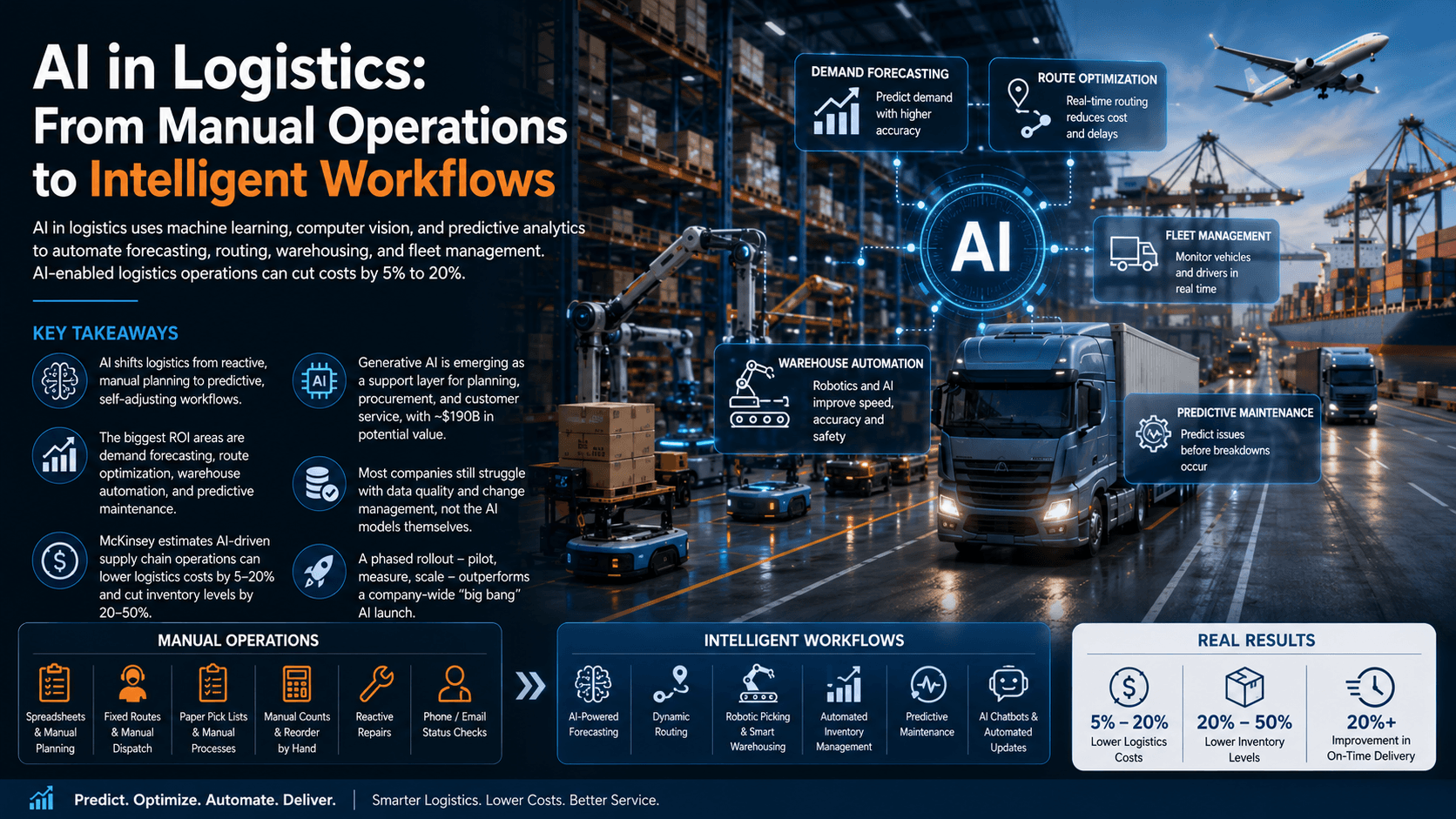
AI-Powered Delivery Systems That Reduce Operational Costs
Last-mile delivery is the most expensive part of logistics. A typical delivery costs $5–$15 per package, and fuel, labor, and routing inefficiencies eat most of that margin. dpdp penalties explained
Every day, thousands of delivery vehicles take inefficient routes, sit idle waiting for packages, and break down unexpectedly. The cumulative cost is staggering.
AI-powered delivery systems are changing this fundamental equation, cutting operational costs by 20–30% while simultaneously improving delivery speed and customer satisfaction.
The Delivery Problem
Most logistics companies still rely on manual routing and scheduling:
Manual routing problems:
- Dispatcher makes decisions based on intuition, not optimization
- Doesn't account for real-time traffic, weather, or vehicle capacity simultaneously
- Drivers take inefficient routes daily
- Result: 15–20% more miles driven than necessary
Manual scheduling issues:
- Forecasting demand with spreadsheets is inaccurate
- Over-hire for peak days, under-staff for normal days
- Last-minute rush hires are expensive and inconsistent
- Vehicle utilization is poor (many trucks half-empty)
Maintenance blindspots:
- Vehicles break down unexpectedly during shifts
- Preventive maintenance scheduled on calendar, not data
- One breakdown can delay 50+ deliveries
- Emergency repairs are 3–4x more expensive than preventive ai logistics reduce costs
Cost impact:
A mid-sized logistics company with 500 vehicles typically spends:
- $8–12M annually on fuel
- $6–8M on labor
- $2–4M on vehicle maintenance
- $1–2M on penalties for late deliveries
AI can reduce this by $4–6M annually.
How AI Transforms Delivery Operations
1. Real-Time Route Optimization
What AI does:
- Analyzes real-time traffic data, weather patterns, road conditions
- Considers vehicle capacity, weight, special handling requirements
- Factors in delivery time windows and customer preferences
- Accounts for driver capabilities and vehicle performance
- Continuously adapts routes as conditions change
The optimization:
Instead of "deliver to 30 addresses in order," AI calculates the mathematically optimal path considering:
- Distance traveled (minimize miles)
- Fuel consumption (minimize gas)
- Time windows (deliver within promised windows)
- Vehicle capacity (maximize utilization)
- Driver fatigue (comply with regulations)
Real results:
- 15–20% reduction in miles driven (from optimized routing)
- 18–22% reduction in fuel costs (fewer miles + optimized acceleration)
- 12–15% faster delivery times (better sequencing)
- 25% reduction in driver overtime (optimized schedules)
2. Demand Forecasting & Scheduling
What AI does:
- Analyzes historical delivery patterns by zone, day, hour, season
- Factors in external data (holidays, events, weather, economic indicators)
- Predicts demand 2–4 weeks in advance
- Recommends staffing levels and vehicle allocation
Example:
A logistics company operating 100 routes daily can forecast:
- Monday 8am pickup surge (weekend orders)
- Thursday afternoon peak (next-day delivery requests)
- December 15–20 surge (holiday shipping)
- Weather-related delays (snow, ice) logistics ai case study
Implementation:
- Hire exactly the staff needed each day (no over-hiring)
- Pre-position vehicles in high-demand zones
- Schedule maintenance during low-demand periods
- Distribute overflow to partner carriers only when needed
Real results:
- 20–25% reduction in labor costs (optimal staffing)
- 30% improvement in on-time delivery (pre-positioned vehicles)
- 15% improvement in vehicle utilization (better demand matching)
3. Predictive Maintenance
What AI does:
- Monitors vehicle sensors (temperature, vibration, fuel consumption, error codes)
- Tracks maintenance history and component lifespan
- Predicts component failures 1–4 weeks in advance
- Schedules maintenance during low-utilization windows
Example prediction pipeline:
- Engine temperature rising → potential head gasket issue in 2 weeks
- Brake wear pattern → brake replacement needed in 3 weeks
- Fuel consumption increasing → potential fuel leak or engine issue in 1 week
- Tire wear rate → replacement needed in 4 weeks
Benefits:
- Prevent breakdowns during active routes
- Schedule maintenance during overnight or low-demand shifts
- Order parts in advance instead of emergency sourcing
- Reduce emergency repair costs
Real results:
- 30–40% reduction in breakdowns (prevent failures)
- 25–35% cost reduction on repairs (planned vs. emergency)
- 15% improvement in vehicle availability (less downtime) AI & Machine Learning
4. Dynamic Load Optimization
What AI does:
- Analyzes shipment characteristics (size, weight, fragility, destination)
- Groups compatible shipments to maximize vehicle utilization
- Considers load balance, weight distribution, handling requirements
- Optimizes across multiple vehicles and routes
Implementation:
Instead of first-come-first-served loading, AI:
- Batches orders going to same neighborhoods
- Groups complementary shipments (light items in same vehicle)
- Balances load across fleet
- Reduces half-empty vehicle runs
Real results:
- 20–25% improvement in vehicle utilization (fuller trucks)
- 15% reduction in total vehicles needed (higher utilization)
- 10–15% cost reduction per delivery (spreading fixed costs)
Implementation Roadmap
Phase 1 (Weeks 1–4): Assessment
- Audit current routing and scheduling
- Assess data availability (GPS, delivery times, vehicle data)
- Identify highest-impact routes
- Select AI platform
Phase 2 (Weeks 5–8): Pilot
- Deploy on 50–100 routes
- Compare AI recommendations vs. manual routing
- Measure cost and speed improvements
- Train dispatchers on AI system
Phase 3 (Weeks 9–16): Rollout
- Deploy to all delivery routes
- Integrate with existing dispatch systems
- Monitor and optimize continuously
- Expand to fleet management (maintenance) Manufacturing
Phase 4 (Months 5+): Optimization
- Layer in demand forecasting
- Implement predictive maintenance
- Add autonomous vehicles / drones for specific routes
- Continuous refinement
Financial Impact
Typical mid-sized logistics company (500 vehicles, 1,000 deliveries/day):
Year 1 Savings:
- Route optimization: $2.0M–$2.5M (fuel + fewer vehicles)
- Scheduling optimization: $1.2M–$1.6M (labor)
- Predictive maintenance: $600K–$900K
- Improved delivery speed: $400K–$600K (customer retention)
- Total Year 1 Savings: $4.2M–$5.6M
Year 1 Costs:
- AI platform license: $150K–$300K
- Implementation: $200K–$400K
- Training: $50K–$100K
- Total Year 1 Cost: $400K–$800K
Year 1 ROI: 525–1,400%
Real-World Results
Case Study 1: National Parcel Carrier
- Deployed AI route optimization across 2,000 vehicles
- Result: 18% reduction in miles, $6.2M annual savings, 19% faster average delivery
Case Study 2: Regional Food Distributor
- Implemented demand forecasting + route optimization
- Result: 25% labor cost reduction, 22% fuel savings, 15% improvement in on-time delivery logistics cost reduction ai
Case Study 3: Urban Delivery Service
- Added predictive maintenance to existing routes
- Result: 35% reduction in breakdowns, 28% maintenance cost reduction
Key Success Factors
✅ Data quality — Accurate GPS, delivery, and vehicle data is essential
✅ Dispatcher adoption — Train team on AI system; it's a tool, not a replacement
✅ Continuous monitoring — Track savings, driver behavior, customer satisfaction
✅ Integration — Connect to existing dispatch, TMS, and fleet systems
✅ Driver incentives — Reward drivers who follow AI recommendations
✅ Customer communication — Improved delivery accuracy = better NPS
The Competitive Advantage
Companies deploying AI delivery systems gain:
- 20–30% cost advantage vs. manual operations
- Faster delivery = better customer satisfaction
- Scalability — Handle 3–5x volume without proportional cost increase
- Data insights — Understand exactly where inefficiencies are
Within 3 years, manual logistics will be uncompetitive vs. AI-optimized operations.
Getting Started
Evaluate your current state:
- What % of deliveries are late? (benchmark: 3–5%)
- Average fuel cost per delivery? (benchmark: $2–$4)
- Vehicle utilization rate? (benchmark: 65–75%)
- How often do vehicles break down? (benchmark: 1 per 100,000 miles)
Next steps:
- Identify routes with biggest cost/timing issues
- Pilot AI optimization on those routes
- Measure results (cost, speed, utilization)
- Scale across entire fleet
Ready to optimize your delivery network? Cor Advance Solutions helps logistics companies implement AI-powered delivery systems that reduce costs and improve customer satisfaction. Let's discuss which optimization would have the biggest impact on your operation.