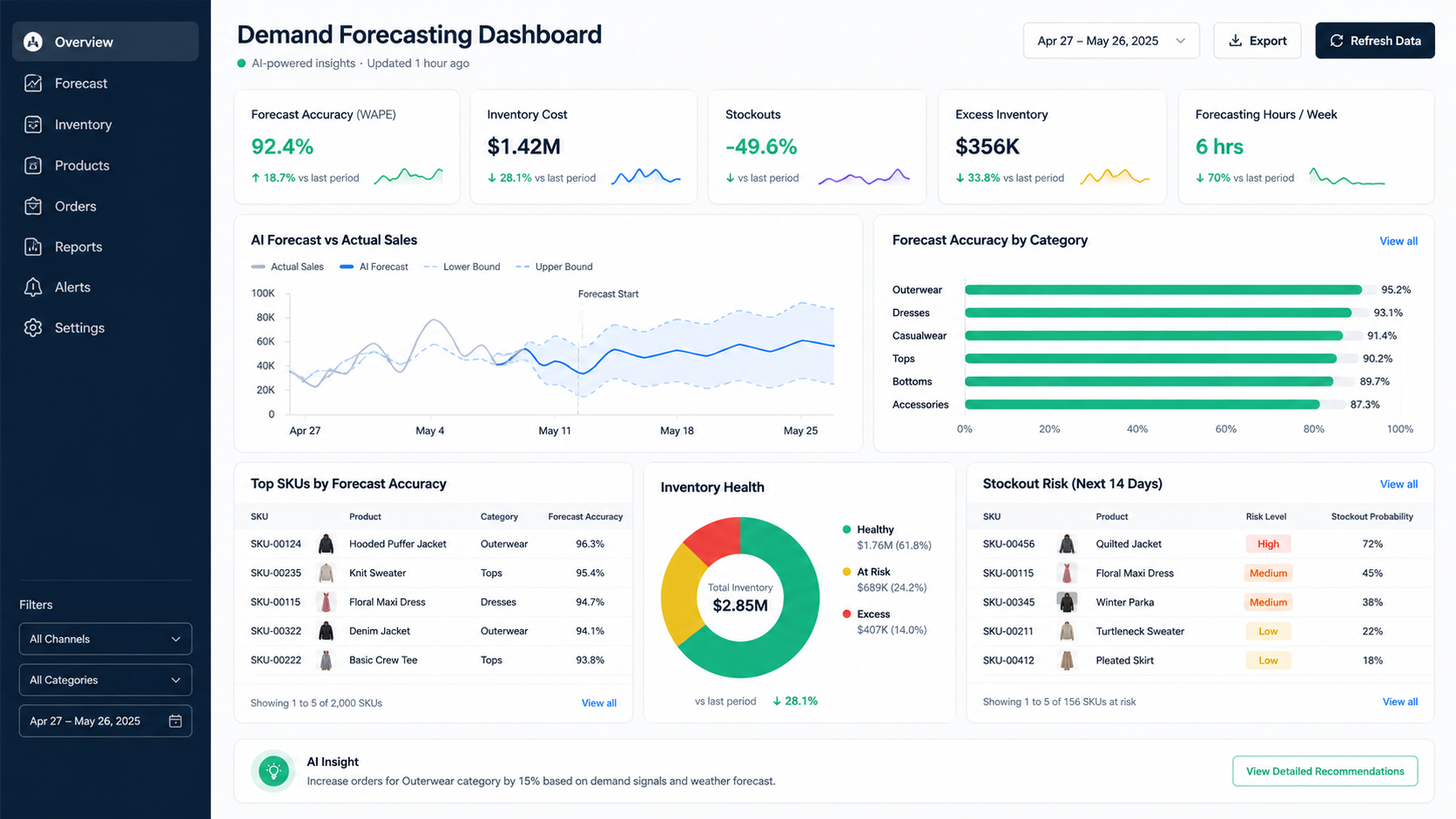
Quick Answer: AI demand forecasting reduces overstock and stockouts by analyzing historical sales, seasonality, promotions, weather, and local demand signals to predict what each store or SKU actually needs — instead of relying on static reorder points. US retailers using it typically cut excess inventory 20–30% and improve forecast accuracy well beyond spreadsheet-based planning, directly protecting profit margins.
Key Takeaways
- Inventory distortion — the combined cost of overstocks and stockouts — costs the global retail industry roughly $1.7 trillion a year (6.2% of retail sales), with North America absorbing an estimated $415 billion of that, according to IHL Group's 2026 Inventory Distortion Study.
- US retailers are on pace to process nearly $850 billion in returns in 2025 (15.8% of total sales), with online returns running even higher at 19.3%, per the National Retail Federation's 2025 Retail Returns Landscape report.
- Top-performing retailers maintain roughly 95% inventory accuracy, while struggling retailers operate closer to 65% — a gap that translates directly into locked-up capital and lost sales.
- Demand forecasting is now the single largest AI investment category in retail, accounting for an estimated 22.81% of total retail AI spend, reflecting how central it's become to retail operations.
- Carrying excess inventory isn't free: unsold stock typically costs 20–30% of its value per year in storage, insurance, markdowns, and obsolescence.
What Is AI Demand Forecasting?
Direct answer: AI demand forecasting is the use of machine learning models to predict future product demand at the SKU, store, or channel level, using far more variables than traditional forecasting methods can process.
Supporting explanation: Traditional retail forecasting typically relies on last year's sales plus a manual adjustment for growth — a method that breaks down the moment a promotion, weather event, regional trend, or supply disruption changes the picture. AI models instead ingest dozens of signals simultaneously: point-of-sale history, seasonality patterns, local events, weather forecasts, pricing changes, marketing calendars, and even social sentiment, then continuously update predictions as new data arrives.
Real example: A regional apparel retailer relying on a flat 10% year-over-year growth assumption will over-order on styles trending down and under-order on styles trending up. An AI model trained on SKU-level sell-through, regional weather patterns, and promotional history catches both shifts weeks before a human planner would.
- AI forecasting updates continuously; spreadsheet forecasting updates periodically (often monthly).
- It works at SKU-and-store granularity, not just category-level averages.
- It accounts for causal factors (weather, promotions, local events), not just historical trend lines.
Why Inventory Distortion Is a Bigger Problem Than Most Retailers Realize
Inventory distortion is the combined cost of two opposite failures happening at the same time, in different parts of the same store:
- Stockouts — popular items sell out, and the retailer loses the sale entirely, often to a competitor.
- Overstock — slow-moving items pile up, tying up cash and eventually requiring markdowns to clear.
According to IHL Group's 2026 research, roughly two-thirds of the $1.7 trillion global distortion cost comes from lost sales due to stockouts, and one-third from overstock carrying costs. The frustrating part: these two problems usually coexist in the same store, at the same time, because they stem from the same root cause — a forecasting method that can't react fast enough to real demand signals.
Important note: IHL's research also shows that after five straight years of improvement (distortion fell from 10.4% of retail sales in 2021 to 6.2% in 2026), the trend is now under new pressure from tariff-driven panic buying and shifting consumer confidence — meaning the forecasting methods that worked over the past few years may not hold up without AI-level adaptability.
How AI Demand Forecasting Actually Works
1. Data Ingestion
The model pulls in historical POS data, inventory levels, supplier lead times, and external signals like weather, local events, and competitor pricing where available.
2. Pattern Recognition
Machine learning models — typically gradient boosting or neural network architectures — identify demand patterns at a granularity human planners can't practically replicate: per SKU, per store, per day of week, per season.
3. Continuous Recalibration
Unlike a quarterly forecast, AI models retrain regularly (often weekly or even daily) as new sales data comes in, so a forecast from a sudden trend shift gets corrected within days, not months.
4. Actionable Output
The output isn't just a number — it feeds directly into replenishment systems, automatically adjusting reorder points, safety stock levels, and purchase order recommendations.
Real-World Impact: What This Looks Like in Practice
Cor Advance Solutions worked with a US apparel brand facing exactly this dual problem — popular sizes stocking out mid-season while slower styles piled up in the warehouse. Implementing AI-powered demand forecasting reduced inventory carrying costs by 28% while improving in-stock rates on top-selling items. Read the full breakdown in our AI demand forecasting case study.
This pattern is consistent with retail AI investment research, which found that demand forecasting represents the largest single category of retail AI investment at approximately 22.81% of total spend — retailers are concentrating budget here because the ROI is direct and measurable, unlike some other AI use cases with more diffuse returns.
AI Demand Forecasting vs. Traditional Forecasting Methods
| Factor | Traditional Forecasting | AI Demand Forecasting |
|---|---|---|
| Update frequency | Weekly, monthly, or quarterly | Continuous / daily |
| Granularity | Category or regional average | SKU + store level |
| External signals | Rarely incorporated | Weather, events, pricing, promotions |
| Reaction to trend shifts | Weeks to months | Days |
| Planner workload | High manual adjustment | Exception-based review |
| Typical inventory accuracy | 65–80% | 90%+ achievable |
Common Mistakes US Retailers Make With Demand Forecasting
- Treating all SKUs the same. A model tuned for high-velocity staples won't perform well on long-tail or seasonal items without separate handling.
- Ignoring external signals. Weather, local events, and competitor promotions materially move demand, especially for apparel, outdoor goods, and seasonal categories.
- Skipping a change-management plan. The best model in the world fails if planners override its recommendations by habit without understanding why it made a call.
- Not validating against a holdout period. Retailers should test a new forecasting model against real historical outcomes before fully trusting it with live purchase orders.
- Underestimating data quality issues. Missing, duplicate, or inconsistent POS and inventory data will quietly degrade model accuracy — this needs to be fixed before, not after, model deployment.
Best Practices for Implementing AI Demand Forecasting
- Start with your highest-impact category, not your entire catalog. Pick the category where stockouts or overstock hurt margin the most.
- Audit your data pipeline first. POS, inventory, and supplier data need to be clean and connected before a model can produce reliable forecasts.
- Keep planners in the loop. The best implementations pair AI forecasts with human review for exceptions, not full automation from day one.
- Set a clear accuracy baseline before implementation so you can measure real improvement, not just trust vendor claims.
- Plan for seasonal retraining. Retail patterns shift year to year — a model needs periodic recalibration, especially around major seasonal transitions.
Step-by-Step Guide to Getting Started
- Audit current forecast accuracy by comparing past predictions to actual sell-through, by category.
- Identify your worst-performing categories for both stockouts and overstock.
- Consolidate your data sources — POS, inventory, supplier lead times — into a single accessible pipeline.
- Pilot the model on one category or region before a full rollout.
- Set success metrics upfront: forecast accuracy, inventory turns, stockout rate, and carrying cost reduction.
- Run the pilot for at least one full seasonal cycle to capture real variability.
- Expand gradually to additional categories once the pilot proves out.
Pros and Cons of AI Demand Forecasting
| Pros | Cons |
|---|---|
| Meaningfully higher forecast accuracy than manual methods | Requires clean, connected data to work well |
| Reduces both overstock and stockouts simultaneously | Upfront implementation and integration effort |
| Frees planners to focus on exceptions, not routine forecasting | Needs periodic retraining as demand patterns shift |
| Scales across thousands of SKUs without added headcount | Initial trust-building period as planners learn to rely on it |
Expert Tips
- Don't judge a new forecasting model on its first month. Give it at least one full seasonal cycle before evaluating accuracy improvements.
- Track forecast accuracy by category, not just in aggregate — a model can look accurate overall while badly missing specific product lines.
- Pair AI forecasting with automated replenishment triggers. A great forecast that still requires manual purchase order entry loses much of its speed advantage.
Frequently Asked Questions
What is inventory distortion?
Inventory distortion is the combined cost of overstock (excess inventory) and stockouts (missed sales from insufficient inventory), which together cost the global retail industry an estimated $1.7 trillion annually.
How much does poor inventory forecasting actually cost retailers?
North American retailers absorb an estimated $415 billion a year in inventory distortion costs, and carrying excess inventory alone typically costs 20–30% of its value annually in storage, insurance, and markdowns.
How is AI demand forecasting different from traditional forecasting?
Traditional forecasting typically applies a flat growth assumption to last year's sales at a category level. AI forecasting works at the SKU-and-store level, updates continuously, and incorporates external signals like weather and local events.
How long does it take to implement AI demand forecasting?
A focused pilot on one category typically takes 8–12 weeks, including data integration. Full-catalog rollout usually spans several months, expanding gradually after the pilot proves accuracy gains.
Do I need a data science team to use AI demand forecasting?
No. Most retailers implement this through a specialized vendor or development partner rather than building an in-house team, though someone internally should own data quality and validate results.
Will AI demand forecasting replace my inventory planners?
No — it changes their role from manual forecasting to exception management and strategic oversight, which is generally a higher-value use of their time.
What data do I need to get started?
At minimum: historical POS data, current inventory levels by location, and supplier lead times. Weather, promotional calendars, and local event data improve accuracy further but aren't required to start.
How accurate can AI demand forecasting actually get?
Results vary by category and data quality, but retailers commonly move from 65–80% baseline accuracy to 90%+ on core SKUs after a properly implemented model matures.
Does this work for small and mid-size retailers, not just large chains?
Yes. Cloud-based forecasting tools have made this accessible below enterprise scale — the key requirement is clean data, not company size.
What's the biggest risk in implementing AI demand forecasting?
Poor data quality feeding the model. A sophisticated model trained on incomplete or inconsistent inventory data will produce unreliable forecasts, regardless of the underlying algorithm.
How does AI demand forecasting affect profit margins specifically?
It improves margins two ways: reducing markdown losses from overstock, and capturing sales that would otherwise be lost to stockouts — both flow directly to the bottom line without added marketing spend.
Conclusion
Inventory distortion isn't a rounding error — it's a $415 billion annual drag on North American retailers, split almost evenly between missed sales and wasted carrying costs. AI demand forecasting addresses both problems at once by replacing static, category-level assumptions with continuously updated, SKU-level predictions grounded in real demand signals. The retailers seeing the strongest results aren't necessarily the largest — they're the ones who started with clean data, a focused pilot category, and clear accuracy benchmarks before scaling.
Cor Advance Solutions builds AI demand forecasting systems for US retailers, including the apparel brand system that cut inventory carrying costs by 28%. Explore our AI & Machine Learning services or get in touch to discuss your inventory challenges.
Actionable Checklist
- Audit current forecast accuracy by category against actual sell-through
- Identify the category with the worst combined stockout/overstock cost
- Consolidate POS, inventory, and supplier data into one accessible pipeline
- Pilot AI forecasting on that one category for a full seasonal cycle
- Set measurable success metrics before the pilot starts
- Pair AI forecasts with human review for exceptions, not full automation
- Plan for periodic model retraining as seasons and trends shift
- Expand to additional categories once the pilot proves accuracy gains
Disclaimer: Statistics in this article are drawn from the cited industry research as of 2026 and represent industry-wide estimates, which will vary by retailer and category. This article is for general informational purposes and does not constitute financial or business advice.