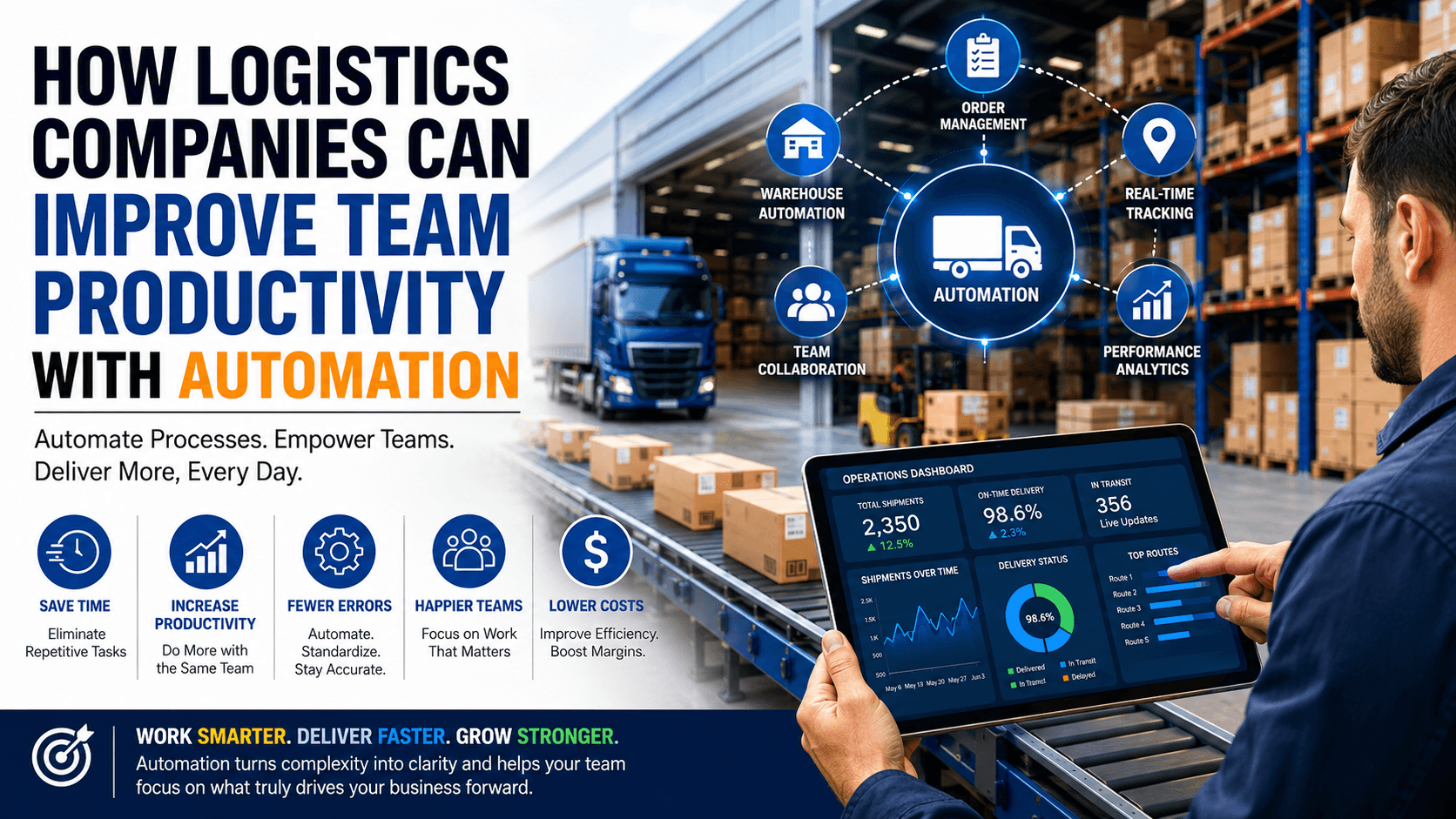
How Logistics Companies Can Improve Team Productivity With Automation
It is 9 AM on a Monday morning at a mid-sized logistics operation.
Your operations manager opens their email inbox and finds 47 unread messages—mostly shipment status inquiries from customers, requests for delivery updates from sales, and questions from warehouse staff about order priorities. While answering these emails, a driver calls asking for clarification on a pickup location. Then your WMS system goes down for 30 minutes, halting order processing. By noon, your team has responded to messages, updated spreadsheets, made phone calls, and manually entered shipment information into three different systems. None of these activities actually moved a shipment forward.
This is not inefficiency. This is what happens when logistics operations rely on manual processes to manage growing complexity.
Your team is not lazy or poorly managed. They are simply spending their productive hours on administrative work instead of actual operations. And as shipment volumes grow, this problem does not get better—it accelerates.
The solution is not hiring more people. It is systematically removing the repetitive work consuming your team's time. With proper AI and machine learning solutions, you can accelerate this transformation.
Why Logistics Teams Lose So Much Time to Manual Work
Here is what consumes most of a logistics team's day:
Data entry and re-entry. A single shipment touches multiple systems. Order information is entered into the TMS. Then it is re-entered into the WMS. Then billing information goes into the ERP. If something changes, the update has to happen in all three places—manually.
Status chasing. Customers call asking "Where is my shipment?" Warehouse staff email asking "What is the priority for this order?" Drivers text asking "What is my next pickup?" Your team spends hours answering the same question across different communication channels instead of having a central system where everyone can see the answer.
Manual reporting. Every Monday morning, someone spends 3 hours pulling data from multiple systems into a spreadsheet, calculating KPIs, and preparing a management report. The data is already there. It just is not connected.
Document handling. Delivery confirmations, proof-of-delivery documents, invoices, and customs paperwork are still being managed manually. PDFs are emailed, attachments are organized, and records are scattered across folders and email.
Shipment tracking updates. Your team manually checks the status of each shipment and sends notifications to customers via email or phone. If a shipment is delayed, the customer calls to ask why, and your team scrambles to find out.
Warehouse coordination. "Which orders should we pick first?" "Is this item in stock?" "Where do I store this received shipment?" These questions are answered by walking to the warehouse manager's desk or calling around. Time that could be spent on actual picking and packing.
Driver coordination. Dispatch still relies on phone calls, text messages, or a disconnected system that drivers do not always check. If there is a change—a new pickup, a delayed delivery, a reroute—it takes multiple calls to reach drivers and confirm they have the update.
The result: your team is busy all day. But much of that time is spent moving information around rather than actually improving logistics operations.
Productivity is not the same as being busy. Productivity is accomplishing meaningful work efficiently.
Where Logistics Automation Makes the Biggest Impact
Automating Order and Shipment Processing
When an order comes in, it triggers a cascade of manual steps: data validation, system entry, rate shopping, carrier assignment, label generation, customer notification.
With process automation, the order flows through these steps automatically. The system captures the order information, validates the data against your business rules, looks up the appropriate carrier based on destination and service level, generates the shipping label, and notifies the warehouse that the order is ready for picking. The entire workflow happens in seconds without human intervention.
The productivity gain is not just the time saved on manual data entry. It is the elimination of delays. Orders move to fulfillment immediately rather than waiting in a queue for someone to process them.
Automating Shipment Tracking and Status Updates
Your team no longer manually checks tracking information and sends updates. Instead, the system automatically pulls tracking data from your carriers and updates your internal systems. When a shipment is out for delivery, the system automatically sends a notification to the customer. If there is a delay, an alert routes to your operations team so they can proactively contact the customer rather than waiting for a complaint call.
This removes the repetitive work of status chasing while simultaneously improving customer experience.
Automating Warehouse Tasks
Warehouse work involves constant lookups: "Is this item in stock?" "Which order should I pick next?" "Where do I put this received shipment?" "Are there any alerts on this SKU?"
With warehouse automation, barcode scanning triggers automated workflows. Scanning an order triggers the picking sequence. Scanning received inventory automatically updates stock levels and alerts the team if there are discrepancies. Scanning at packing automatically generates labels, manifests, and shipping documents. Warehouse staff spend their time on picking, packing, and shipping rather than searching for information or waiting for instructions.
Automating Driver and Fleet Communication
Instead of dispatchers making phone calls and drivers relying on text messages, automated workflows notify drivers of assignments, route changes, and customer information. Drivers receive real-time updates without a phone call. When a driver picks up a shipment, it automatically updates your system and customer visibility. When a driver completes a delivery, proof-of-delivery is automatically captured and filed.
This reduces the constant back-and-forth communication that consumes dispatcher time while keeping drivers focused on driving.
Automating Customer Communication
Customers do not need to call to know where their shipment is. The system automatically sends order confirmation, shipment notification, delivery updates, and proof-of-delivery. If there is a delay, the customer gets a proactive notification explaining the issue rather than waiting to discover it on their own.
This eliminates repetitive customer service inquiries while improving customer satisfaction.
Automating Reports and Operational Dashboards
Instead of managers preparing manual reports, automated dashboards update in real-time. Managers see current shipment volumes, on-time delivery rates, cost per shipment, and exception rates without waiting for someone to compile the data. This shifts the manager's role from data collection to data interpretation and decision-making.
The Hidden Cost of Manual Logistics Processes
The cost of manual processes extends far beyond employee hours.
Data-entry errors. When the same information is entered multiple times, errors compound. A typo in an address creates a failed delivery. A missed shipment code creates billing errors. Your team spends time investigating and correcting these errors instead of processing new orders.
Delayed decisions. Managers cannot make informed decisions until the data is compiled—which might be hours or days after it actually happened. By then, the operational window has closed. A shipment was misrouted hours ago, but no one knew until the daily report was prepared.
Duplicate work. Multiple team members work on the same issue because they are not aware others are already handling it. A customer inquiry is answered by sales, operations, and customer service independently.
Overtime and burnout. As shipment volumes increase, your team works longer hours to keep up with manual processes. Productivity declines, errors increase, and employees become frustrated with work that feels unnecessarily complicated.
Slower order processing. A shipment that could be processed in minutes instead takes hours because it is waiting in a manual queue. Orders back up. Customers experience delays. Your competitive advantage erodes.
Poor operational visibility. Without automated data collection, no one knows the real status of your operations until someone manually checks. You are always operating on incomplete information.
Consider this example: A shipment takes 5 minutes to process manually. You process 5,000 shipments per month. That is 41,666 minutes of employee time—roughly 667 hours per month, or $20,000 in monthly cost. If automation reduces this to 2 minutes per shipment, you reclaim 500 hours per month. That is $15,000 in recovered productivity—every single month.
Before You Automate: Fix Your Process First
Here is the critical mistake most logistics companies make: they attempt to automate broken processes.
A bad process that runs automatically is still a bad process—just faster. Before you automate, you need to understand the workflow, identify where the actual bottleneck is, and determine whether automation or process redesign is the right solution.
The right approach has seven steps:
Step 1: Identify the bottleneck. Where do shipments spend the most time waiting? Where do employees spend the most time on repetitive work? Where do errors occur most frequently?
Step 2: Measure the current process. How long does each step take? How often does the task occur? What is the error rate? What is the cost per transaction?
Step 3: Find the repetitive steps. Not every step should be automated. Focus on steps that are identical every time—data validation, system entry, notification generation, document routing.
Step 4: Determine what can be automated. Some processes require human judgment. A shipment that arrives damaged needs a human decision about how to handle it. A customer special request needs to be understood and addressed by a person. Automate the rule-based steps and escalate exceptions to humans.
Step 5: Integrate your systems. Automation only works if your systems can talk to each other. You need integrations between your TMS, WMS, ERP, billing system, and customer communication platform.
Step 6: Test thoroughly. Before full deployment, test the automated workflow on a subset of shipments. Identify edge cases and exceptions. Make sure the process handles them correctly.
Step 7: Monitor and adjust. Measure whether the automation achieved the intended outcome. Did processing time decrease? Did errors decrease? Did employee hours decrease? If not, adjust the workflow.
Key principle: bad processes should be simplified before they are automated.
Your Practical Automation Implementation Framework
Step 1: Map Your Current Workflow
Start by documenting exactly how work flows through your organization. Follow a shipment from order to delivery. Note every step. Note every system involved. Note every time information is re-entered. Note every delay. Talk to your operations team—they know where the real bottlenecks are.
Step 2: Measure Everything
For your most critical processes, measure:
- Task frequency (how many times per day/week/month?)
- Processing time (how long does each task take?)
- Error rate (how often does something go wrong?)
- Employee involvement (how many people touch this process?)
This data becomes your baseline for measuring ROI after automation.
Step 3: Prioritize High-Impact Tasks
Not all processes are equal. Focus first on tasks that are:
- Repetitive (happen the same way every time)
- High-volume (occur frequently)
- Time-consuming (consume significant employee hours)
- Error-prone (mistakes are costly)
- Well-understood (everyone agrees on how the process should work)
Step 4: Connect Your Existing Systems
Most logistics companies already have the systems they need. They are just not connected. Your TMS knows the shipment details. Your WMS knows the inventory. Your CRM knows the customer. Your ERP knows the costs. An integration platform can connect these systems so data flows automatically from one to the next without manual re-entry.
You do not need new software. You need integration between the software you already have. Data warehousing and analytics capabilities make this integration seamless.
Step 5: Automate Workflows and Notifications
Once systems are connected, set up automated rules: "When an order is received in the order management system, automatically create a shipment in the TMS and alert the warehouse." "When a shipment is picked and packed, automatically generate a label and alert the carrier." "When a delivery is confirmed, automatically send a notification to the customer and update the customer portal."
These rules move work forward automatically without human intervention.
Step 6: Give Employees Visibility
Automation only works if your team has access to the information. Create dashboards where warehouse staff can see order priorities, current inventory, and incoming shipments. Give dispatchers real-time visibility into shipment status, driver availability, and customer requirements. Give managers dashboards showing current KPIs, exceptions, and performance metrics.
This shifts employee time from information gathering to problem-solving.
Step 7: Measure ROI Continuously
Track whether automation is delivering results. The metrics that matter:
- Order processing time (how quickly does an order move to fulfillment?)
- Employee hours per shipment (how many minutes of human time per transaction?)
- Error rate (did accuracy improve?)
- Cost per shipment (did operational cost decrease?)
- On-time delivery rate (did reliability improve?)
- Time to reporting (how quickly can management see operational metrics?)
Real-World Example: A 5,000-Shipment Operation
Let us walk through a realistic scenario.
A logistics company processes 5,000 shipments per month. Currently:
Before Automation:
- A customer places an order online
- The order appears in an email inbox for manual processing
- An operations person logs into the TMS and enters the order information
- Another person logs into the WMS and creates the pick list
- Warehouse staff manually search for inventory locations
- After picking and packing, a staff member prints the label
- The label is manually applied to the box
- The shipment is added to a delivery manifest
- A manager manually compiles delivery manifests for each carrier
- The customer receives an email confirming shipment (sent manually or hours later)
Time per shipment: 8-12 minutes Monthly employee hours: 667-1,000 hours Monthly cost: $20,000-$30,000
After Automation:
- The customer places an order online
- The order automatically flows into the TMS
- The system automatically creates a pick list and sends it to the WMS
- The system automatically pulls inventory locations based on picking algorithm
- Warehouse staff scan items, and the system automatically confirms picks
- The system automatically triggers label generation
- The system automatically routes the shipment to the correct carrier
- The system automatically sends a shipment confirmation to the customer
- The system automatically generates manifests for each carrier
Time per shipment: 2-3 minutes (mostly warehouse picking and packing, which cannot be automated) Monthly employee hours: 167-250 hours Monthly cost: $5,000-$7,500 Monthly savings: $12,500-$25,000
The automation did not replace the warehouse workers. It removed the administrative work so they could focus on actual picking and packing. The operations manager now spends time optimizing workflows instead of manually entering data.
These numbers are illustrative. Your actual results will depend on your current processes, order complexity, and system integration depth. But the principle is clear: automation removes administrative bottlenecks, freeing your team to focus on higher-value activities.
What to Automate First: A Priority Framework
Not every process is equally worth automating. Start with quick wins:
Tier 1 (Start Here):
- Order-to-shipment workflow (highest frequency, highest impact)
- Automated customer notifications (reduces repetitive emails and calls)
- Shipment status tracking (eliminates manual status chasing)
- Routine reporting and dashboards (managers spend excessive time on this)
Tier 2 (Next):
- Warehouse inventory updates (frequent, error-prone)
- Driver assignments and route optimization (high volume)
- Exception alerts (reduces time to problem-solving)
- Proof-of-delivery management (currently manual, creates delays)
Tier 3 (Later):
- Predictive analytics (valuable but requires mature data with proper data warehousing infrastructure)
- Dynamic pricing (complex, requires business rule refinement)
- Advanced route optimization (requires good foundational automation)
- Customer portal self-service (builds on existing automation)
Why this order? Because Tier 1 processes are repetitive, high-volume, well-understood, and directly impact employee productivity. You get fast results, build internal credibility, and create the foundation for more advanced automation.
Attempting to do everything at once is the most common reason automation projects fail. Start with one high-impact process. Get it working. Measure the results. Then move to the next.
Common Automation Mistakes to Avoid
Learning from other companies' mistakes can save you time and budget.
Automating broken processes. You identify a process that consumes time, so you automate it. But the process is inefficient by design. Now you have a faster broken process. Simplify first, then automate.
Choosing tools without understanding the workflow. You attend a vendor demo, like their software, and buy it. Then you try to fit your workflow into their software. This approach always results in customization costs and user frustration.
Ignoring employee adoption. Your team has been doing things a certain way for years. Automation changes that workflow. If you do not involve employees in designing the automation, they will find reasons why it does not work and revert to old processes.
Creating disconnected systems. You automate order processing, but the warehouse system is not connected. You automate shipment tracking, but the customer portal is separate. Disconnected automation creates new manual handoffs.
Automating without measuring ROI. You implement automation and assume it is working. Six months later, you do not actually know whether processing time decreased, errors decreased, or costs decreased. Measure before and after.
Failing to integrate existing software. You assume you need new software. You do not. You need integration between the software you already have. Integration costs less than buying and implementing new systems.
Trying to automate everything at once. Large-scale automation projects are high-risk. Start small. Prove the value. Expand from there.
Ignoring data quality. Automation is only as good as the data it processes. Before automating, ensure your data is clean and accurate.
Your 30-Day Automation Starting Plan
You do not need a year-long project to get started. Here is a practical 30-day roadmap:
Week 1: Identify Productivity Bottlenecks
Meet with your operations, warehouse, and customer service teams. Ask: "Where do we spend the most time on repetitive work? Where do we lose orders to manual queues? Where do we make the most errors?" Document at least three high-impact processes.
Week 2: Select One High-Volume Repetitive Process
From your list, select the process that:
- Occurs most frequently
- Consumes the most employee time
- Has the clearest rules
- Would have the biggest impact if accelerated
Do not try to automate everything. Pick one.
Week 3: Design and Test the Automation Workflow
Map out exactly how the process should work if it were fully automated. Identify what systems need to be connected. Determine what rules need to be set up. Identify exceptions that still require human decision-making. Test the workflow on a small batch of transactions.
Week 4: Measure Results and Plan Next Steps
After two weeks of running the automation, compare your metrics:
- How much faster are transactions processing?
- How much employee time was reclaimed?
- Did error rates decrease?
- Did any new issues emerge?
Based on the results, decide whether to expand this automation or move to the next process.
The Path Forward
Your logistics team is losing significant productivity to manual processes. Every day spent entering data manually, chasing shipment status, preparing spreadsheets, and answering repetitive questions is a day not spent on actual operational improvement.
Automation removes these bottlenecks. It does not replace people. It frees people from administrative work so they can focus on decisions, problem-solving, customer service, and operational optimization.
The companies winning in logistics are not those with the most employees. They are the companies that eliminated repetitive work and leveraged their existing team more effectively.
Start by identifying where your team is losing the most time. Map that workflow. Measure it. Then automate it. The results will be immediate and measurable.
Your next shipment does not need another person to process it. It needs that same person freed from manual data entry so they can focus on getting it delivered faster, more accurately, and more profitably. Explore how AI and machine learning solutions can transform your operations.
That is what logistics automation is actually about.